
By Rabbi Josh Wander
Every year as Yom Yerushalayim approaches, the slogans return on cue. “Jerusalem, the eternal undivided capital of Israel.” Politicians from the right to the left stand shoulder to shoulder declaring the unity of the city. Since 1967, Jerusalem has been described as sovereign Israeli territory, liberated and reunified after nearly two thousand years of exile and foreign occupation. The emotional centerpiece of that victory was, of course, the Old City, the City of David, and the Temple Mount, the beating heart of Jewish history and identity. But perhaps it is time to stop repeating slogans and start asking uncomfortable questions.
Is Jerusalem actually united?
Anyone who lives here already knows the answer. Western and eastern Jerusalem function largely as separate worlds, with different populations, different school systems, different infrastructure, and entirely different realities of law enforcement. Entire neighborhoods operate with little sense of shared civic identity. The political rhetoric speaks endlessly of unity while the practical reality reflects fragmentation. The “undivided capital” often feels administratively stitched together while socially and culturally divided. Yet even that is not the true scandal. The real scandal lies at the very center of Jerusalem itself.
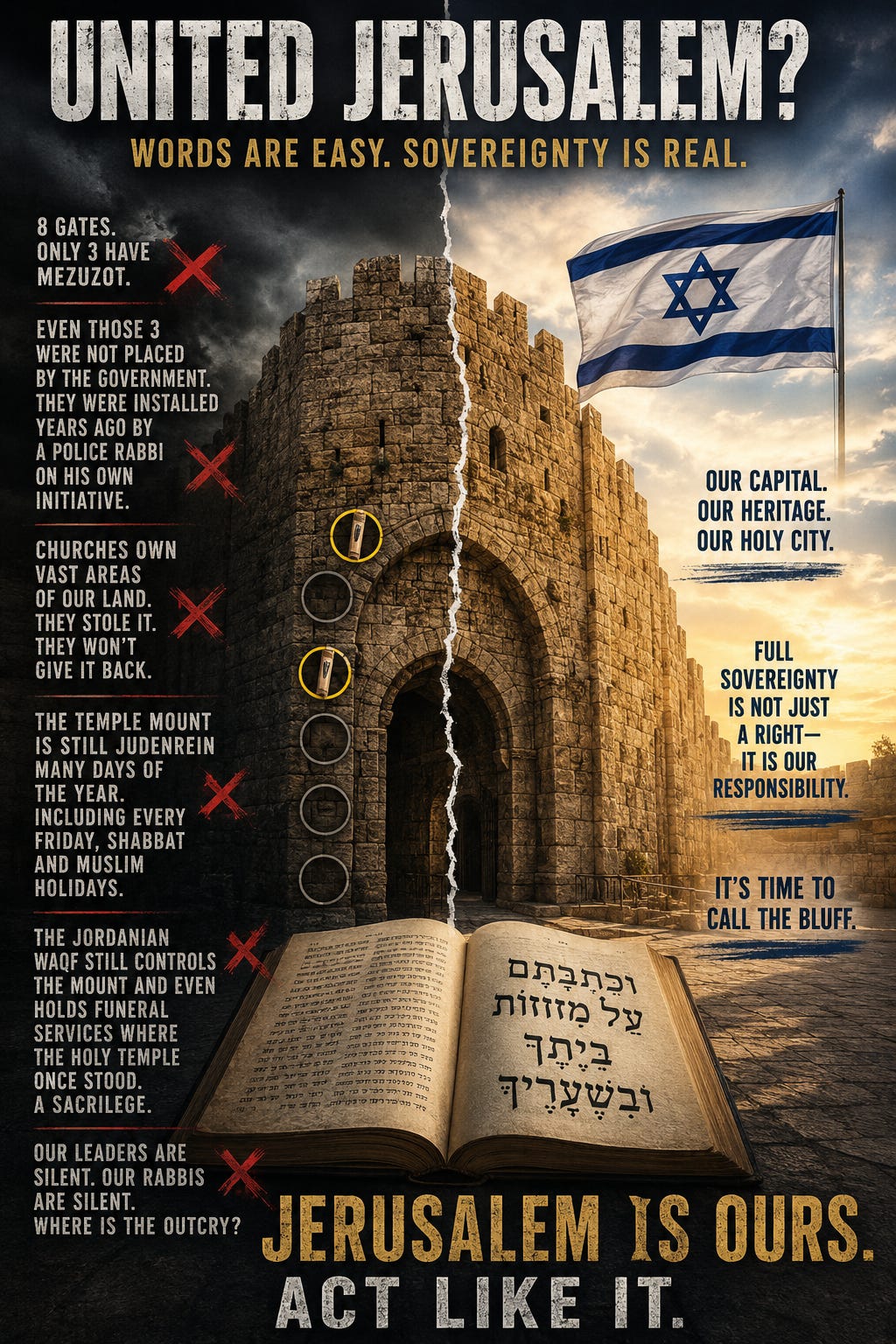
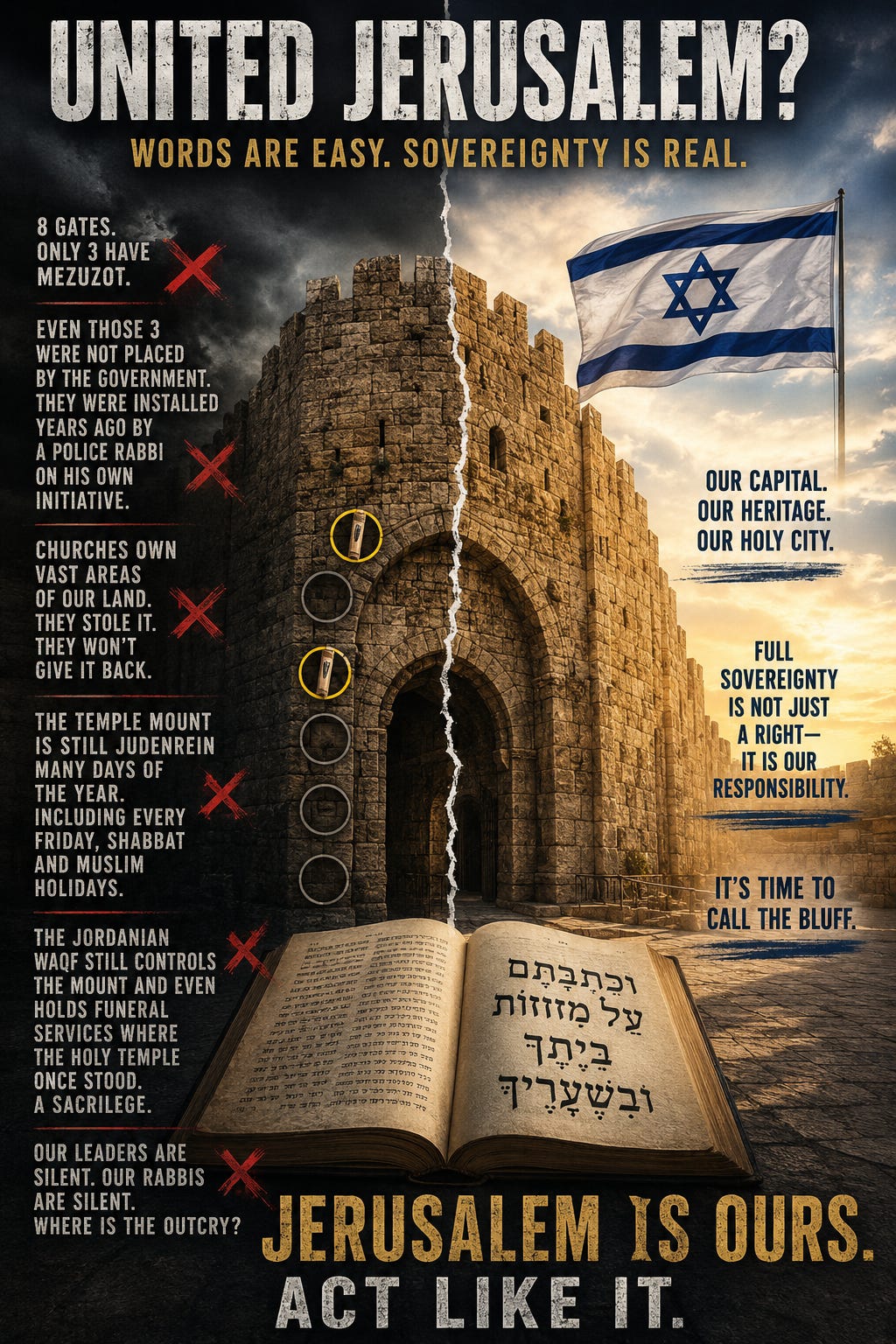
Twice a day Jews recite the words, “And you shall write them upon the doorposts of your homes and your gates.” Gates are not symbolic in Judaism. Gates represent sovereignty, ownership, presence, and responsibility. Yet unbelievably, out of the eight gates of the Old City of Jerusalem, only three contain mezuzot. And the irony becomes even more painful when one realizes that even those three mezuzot were not installed by the State of Israel, the Jerusalem municipality, or the Chief Rabbinate as part of any official recognition of Jewish sovereignty over the city. They were placed there years ago by a police rabbi acting on his own initiative. Think about how absurd that is. After two thousand years of exile, after wars fought and blood spilled for Jerusalem, after endless speeches declaring it our eternal capital, the Jewish state itself never saw fit to place mezuzot on the gates of the Old City. One individual in the police force understood the embarrassment of a Jewish Jerusalem without mezuzot on its gates more than the entire political and religious establishment.
The deeper one looks, the more disturbing the picture becomes. Vast tracts of land in and around the Old City remain under the control of churches and foreign religious institutions which accumulated ownership during centuries of exile and weakness. Some of these institutions openly refuse to return lands tied to Jewish history and heritage. Entire sections of our holiest city remain effectively beyond Jewish authority while our leadership smiles for cameras and repeats hollow talking points about sovereignty. What exactly are we afraid of? Why does a sovereign Jewish state continue to behave with such hesitation in the very place that defines Jewish history itself?
Then we arrive at the epicenter of the issue: the Temple Mount. The Temple Mount, the holiest site in Judaism, still remains effectively off-limits to Jews during large portions of the week, including Fridays, Shabbat, and Muslim holidays. The mountain where the Holy Temple stood is routinely rendered Judenrein under Jewish sovereignty. Let that sentence sink in. A Jew can walk and pray freely in Rome, Berlin, London, or Washington, but on the holiest place on earth for the Jewish people there are still days and times when Jewish presence is treated as an unwanted provocation.
Even more outrageous is the continued role of the Jordanian Waqf on the Mount. A foreign religious authority maintains ongoing operational control over Judaism’s holiest site while the State of Israel, the supposedly sovereign ruler of united Jerusalem, largely defers to it. And this surrender has consequences. Funeral ceremonies have been conducted on the Mount itself, with corpses displayed in the area of the Holy Temple. This is not merely a political insult, but a profound desecration of sacred space. A place once entered only by the High Priest under the strictest conditions of holiness is now treated as a platform for political theater and religious domination. Yet not only are the politicians unwilling to seriously confront this humiliation, but even the overwhelming majority of rabbis refuse to address it publicly. Hashem’s holy presence is desecrated daily, and the silence from leadership is deafening.
Of course, not everyone remains silent. A few individuals speak out. A few protest. A few ascend the Mount despite enormous political and religious pressure. But the overwhelming majority of religious and political leadership prefer avoidance because the issue is too explosive, too uncomfortable, and too politically dangerous. It is easier to sing songs about Jerusalem than confront the reality of what is happening in its heart. It is easier to wave flags than to acknowledge that the center of our capital still functions under hesitation, compromise, and fear.
But Yom Yerushalayim is supposed to be more than nostalgia. More than parades, flags, and emotional videos from 1967. If Jerusalem truly is the eternal undivided capital of Israel, then act like it. Sovereignty cannot merely exist in speeches. It must exist in practice, in law, in courage, and in national consciousness. Because a nation unwilling to fully assert itself in its own capital is a nation still psychologically trapped in exile.
The tragedy is not merely that foreign entities continue to claim ownership over parts of Jerusalem. The tragedy is that many Jews have become so accustomed to the abnormal that they no longer even recognize the disgrace. We celebrate sovereignty while tolerating surrender. We speak of redemption while avoiding the responsibilities that redemption demands. Yom Yerushalayim should force us to ask a painful question: have we truly returned to Jerusalem, or have we merely returned to the outskirts of our destiny?