
THE SYNAGOGUE OF SATAN
A Reading of Revelation 2:9 and 3:9 in a Native Jewish Framework
By Pesach Sander
I. The Humiliation Policy
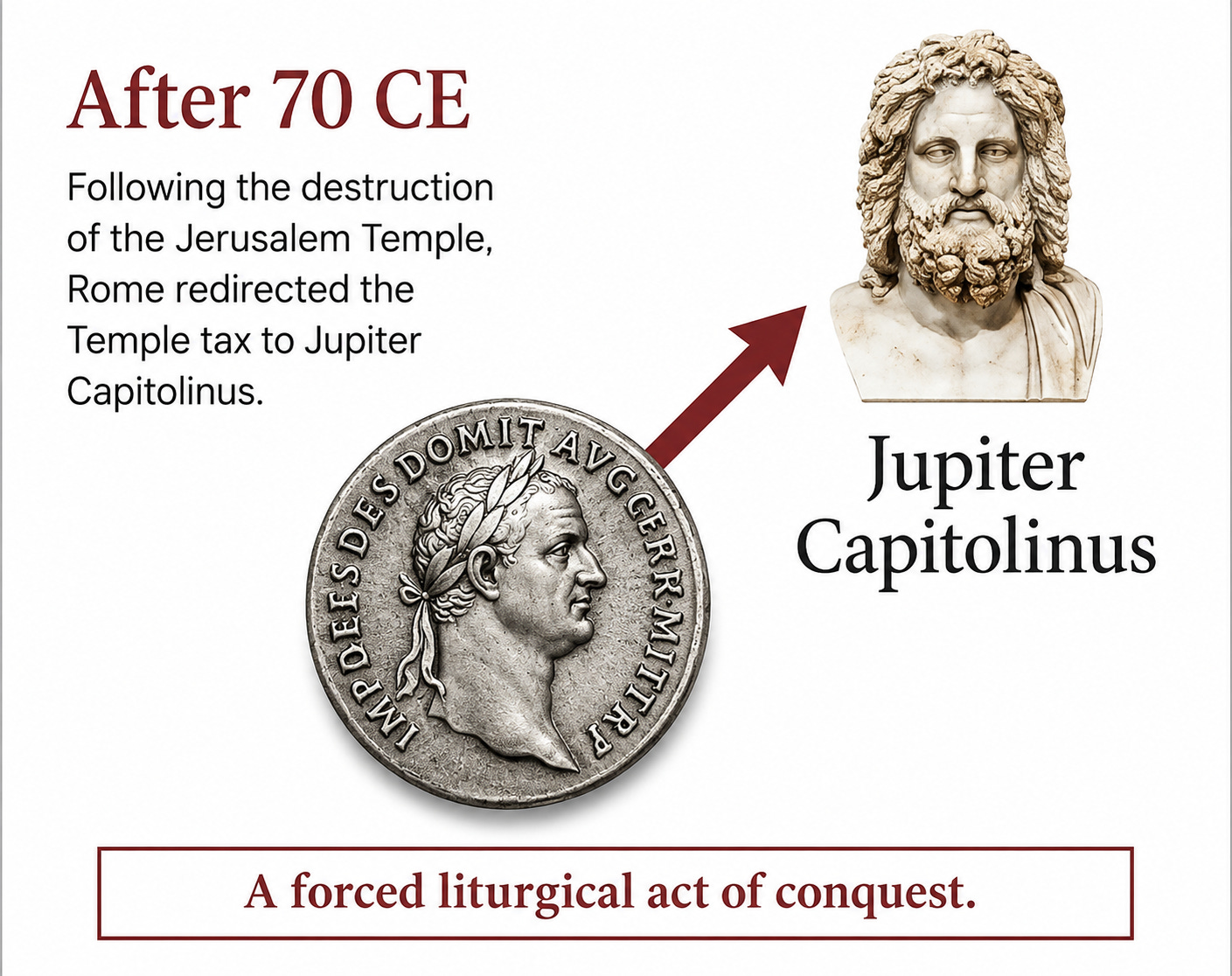
When Vespasian redirected the temple tax to Jupiter Capitolinus (c. 70 CE), he was not merely collecting revenue. He was making a theological claim: the God of Israel had been defeated, his house burned to the ground, and the tribute his people had consecrated to him would henceforth fill the treasury of his conqueror’s god. The fiscus Judaicus (Latin: “Jewish tax”) was policy meant to humiliate and to subjugate.
Before the destruction of the Temple, the fiscus Judaicus had served as an exemption from participation in the Caesar cult, allowing the Torah-faithful Jew to openly practice as a permitted ancestral custom. This changed after the Jewish War (66–73 CE), after which it was weaponized. The funds which had once been allocated to the house of YHWH were now directed to the Temple of Jupiter Capitolinus. Every denarius paid was a forced liturgical act — a confession extracted under duress: that Jupiter’s hand was stronger than YHWH’s. The half-shekel that had once expressed covenant now expressed conquest. The sacred had been inverted and pressed into the service of avodah zarah (literally “foreign service/liturgy,” often translated “idolatry”).
Rome had a habit of absorbing conquered gods. What it did to Israel after 70 CE was something sharper: it did not absorb YHWH. It humiliated him. The message was not “your god is ours now” but “your god lost.” The Roman victory was made into a liturgy — a theology of conquest embedded in stone, funded by the conquered subjects. This is where the tribute ultimately pointed.
✦ ✦ ✦
✦ ✦ ✦
✦ ✦ ✦
II. The Readers
It is into this landscape — catastrophic defeat, desecrated covenant, imperial surveillance — that the book of Revelation speaks. It is addressed to Torah-faithful, halakhah-affirming Jews (Jews committed to the full observance of biblical and national Jewish law) who also held that Yeshua was the messiah of Israel, and who held this in such a way that did not separate them from the rest of Israel but rather intensified their relationship of fidelity to Am Yisrael (Hebrew: “the people of Israel”). They are not a new religion. They were not a sect that has departed from the covenant. They were Israel, reading the destruction of the temple as a national defeat, yet who continued to observe Torah in a Roman world that now had even more reason to surveil and suppress visible Jewish practice.
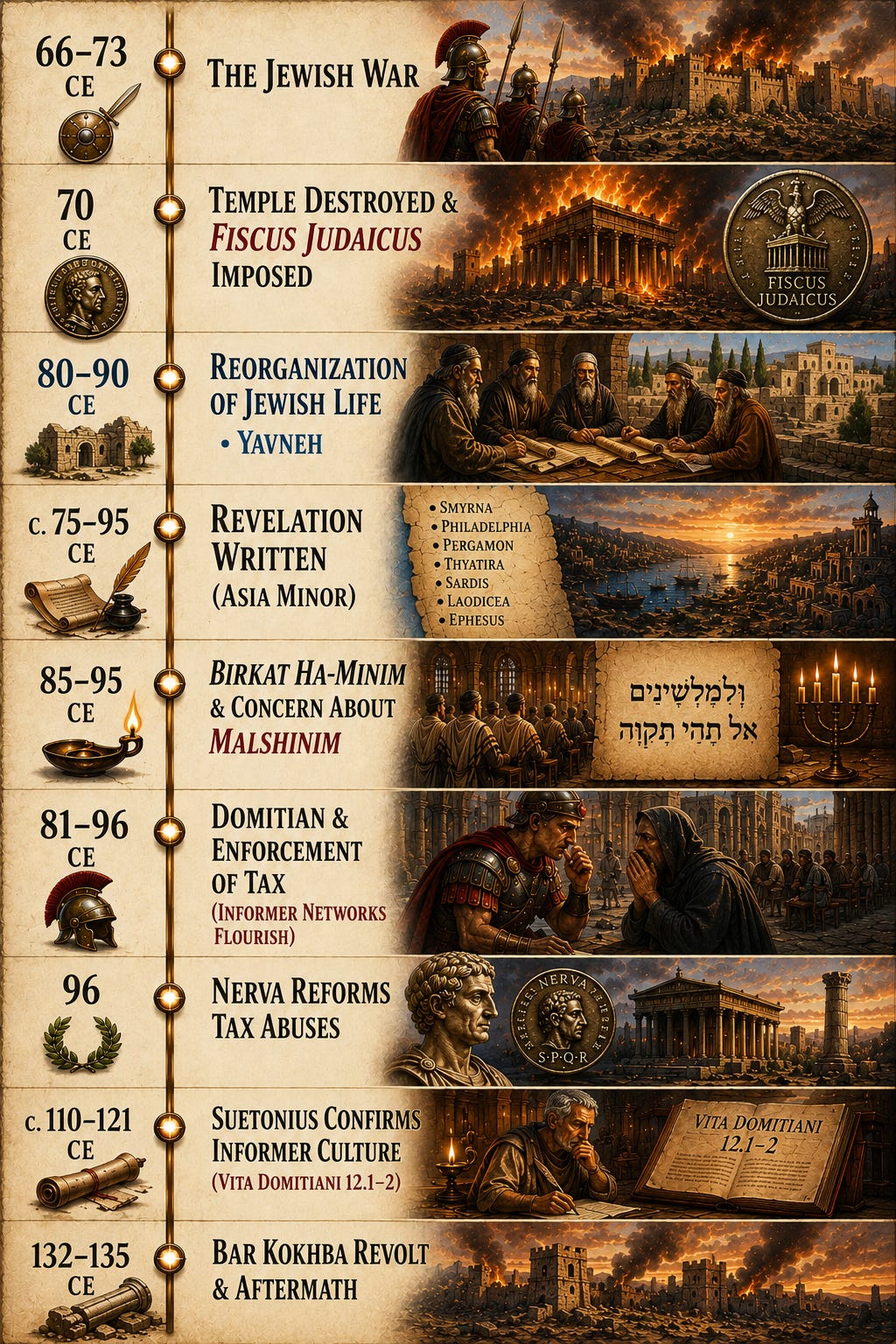
Revelation was almost certainly written before 90 CE — possibly during the Jewish War itself (66–73 CE), possibly in its immediate aftermath — when the wounds were fresh. Informer networks were active, and the question of who could be trusted was mortal.
✦ ✦ ✦
III. The Texts
Revelation 2:9 — to the community at Smyrna (a major port city on the Aegean coast):
οἶδά σου τὴν θλῖψιν καὶ τὴν πτωχείαν, ἀλλὰ πλούσιός εἶ, καὶ τὴν βλασφημίαν ἐκ τῶν λεγόντων Ἰουδαίους εἶναι ἑαυτούς, καὶ οὐκ εἰσίν, ἀλλὰ συναγωγὴ τοῦ Σατανᾶ.
“I have known thy tribulation and thy poverty — but thou art rich — and the slander from those saying themselves to be Jews, and they are not, but a congregation of the Accuser.”
Revelation 3:9 — to the community at Philadelphia (a city in the interior of Asia Minor):
ἰδοὺ δίδωμι ἐκ τῆς συναγωγῆς τοῦ Σατανᾶ, τῶν λεγόντων ἑαυτοὺς Ἰουδαίους εἶναι, καὶ οὐκ εἰσίν ἀλλὰ ψεύδονται, ἰδοὺ ποιήσω αὐτοὺς ἵνα ἥξουσιν καὶ προσκυνήσουσιν ἐνώπιον τῶν ποδῶν σου, καὶ γνῶσιν ὅτι ἐγὼ ἠγάπησά σε.
“Behold, I give from the congregation of the Accuser — those saying themselves to be Jews, and they are not but they lie — behold I will make them that they shall come and bow before thy feet, and they shall know that I have loved thee.”
The standard reading of these passages treats the construction καὶ οὐκ εἰσίν… ἀλλά (Greek: “and they are not… but”) as a flat denial of Jewish identity: these people claim to be Jews but are not. This reading, pressed through centuries of Gentile Christian interpretation, became the theological foundation for treating the synagogue as the institutional enemy of the church — a reading that has underwritten immeasurable violence against Jewish communities across two millennia.
The Greek will not bear that weight. The conjunction ἀλλά (’alla), the precise Hebrew equivalent of אֶלָּא (ellāʾ, the Mishnaic Hebrew word used to introduce a stronger or additional characterization) — functions in this construction not as simple negation-and-replacement but as adversative intensification: not merely this, but and what is more, this. Mishnaic Hebrew uses the formula לֹא… אֶלָּא (”not… but rather”) not always to substitute one thing for another but frequently to add a further and more limiting characterization to what has already been named. The construction in 2:9 rendered into Mishnaic Hebrew reads:
וְאֵינָם כֵן אֶלָּא כְנֵסֶת הַשָּׂטָן הֵם
“They are not merely that, unless they are [furthermore] a congregation of the Accuser.”
They are Jews. And they are also — the אֶלָּא pressing the charge harder — a congregation of the Accuser.
The ψεύδονται (Greek: “they lie”) of 3:9, which might seem to reinforce the denial reading, lands differently under this interpretation. The lie is not the claim to be Jewish. The lie is the performance of Jewish solidarity while actively betraying the community to imperial power. They present themselves as members of Am Yisrael while functioning as instruments of Rome against it. That is the lie. That is what ψεύδονται (”they lie”) names.
✦ ✦ ✦
IV. The Legal Framework: Maimonides on the Informer
To understand what the author of Revelation is describing, the best framework available is not patristic commentary (the writings of the early church fathers) but the halakhic taxonomy (legal classification system) of Maimonides (Rabbi Moshe ben Maimon, 1138–1204, the greatest codifier of Jewish law in history), who in Hilkhoth Teshuvah (Hebrew: “Laws of Repentance,” a section of his monumental legal code the Mishneh Torah) addresses the perennial social and moral phenomenon the text describes.
Hilkhoth Teshuvah 3:9 (end) — the paradigm mumar:
מוּמָר לְכָל הַתּוֹרָה כֻּלָּהּ — כְּגוֹן הַחוֹזְרִים לְדָתֵי הָעוֹבְדֵי כוֹכָבִים בְּשָׁעָה שֶׁגּוֹזְרִין גְּזֵרָה, וְיִדַּבֵּק בָּהֶם, וְיֹאמַר מַה בֶּצַע לִי לְהִדַּבֵּק בְּיִשְׂרָאֵל שֶׁהֵם שְׁפָלִים וְנִרְדָּפִים, טוֹב לִי שֶׁאֶדַּבֵּק בְּאֵלּוּ שֶׁיָּדָם תַּקִּיפָה — הֲרֵי זֶה מוּמָר לְכָל הַתּוֹרָה כֻּלָּהּ
“A mumar (one who has abandoned covenantal fidelity) regarding the entire Torah — such as those who revert to the religion of the star-worshippers (a rabbinic term for practitioners of Roman and Hellenistic paganism) at a time when a decree is issued, and cleave to them, and say: ‘What profit is there for me in cleaving to Israel who are low and persecuted? Better for me to cleave to those whose hand is strong’ — this one is a mumar regarding the entire Torah.”
The Rambam’s paradigm mumar is not a heretic or a theological doubter. He is a man who looks at the power differential between persecuted Israel and the imperial power, calculates his advantage, and chooses the stronger side — openly, verbally, without shame. The phrase מַה בֶּצַע לִי (”what profit is there for me”) exposes the transaction. It is deliberate calculation.
Hilkhoth Teshuvah 3:12 — the two categories of the mosēr (informer):
שְׁנַיִם הֵם הַמּוֹסְרִין: הַמּוֹסֵר חֲבֵרוֹ בְּיַד עוֹבֵד כּוֹכָבִים לְהָרְגוֹ אוֹ לְהַכּוֹתוֹ; וְהַמּוֹסֵר מָמוֹן חֲבֵרוֹ בְּיַד עוֹבְדֵי כוֹכָבִים אוֹ בְּיַד אַנָּס שֶׁהוּא כְּעוֹבֵד כּוֹכָבִים. וּשְׁנֵיהֶם אֵין לָהֶם חֵלֶק לָעוֹלָם הַבָּא
“There are two [types of] moserim: one who hands over his fellow to a gentile to kill him or to strike him; and one who hands over his fellow’s property to gentiles or to a violent oppressor who is like a gentile. Both of them have no share in the World to Come.”
Two categories. Clean. Final. The first is the one who exposes a fellow Jew to physical violence at gentile hands. The second is the one who facilitates economic destruction through gentile power. Both are the structural act the author of Revelation is naming when he writes כְּנֵסֶת הַשָּׂטָן (”congregation of the Accuser”).
✦ ✦ ✦
V. The Historical Record
The historical record confirms that this was not a theoretical threat. Suetonius, writing of Domitian’s administration of the fiscus Judaicus, records that the tax was levied with the utmost rigour, and that informers were plentiful — prosecuting both those who lived a Jewish life without publicly acknowledging it and those who concealed their Jewish origin to avoid the tax (Vita Domitiani 12.1–2, written approximately 121 CE). The informer system was financially incentivized: accusers received a portion of the proceeds of a successful prosecution. Denunciation of Torah-observant Jews was not merely ideologically motivated — it was profitable. The conspicuous Jew, the one whose practice was visible, whose Shabbat observance was known to neighbors, who refused the imperial cult, was the natural target.
Acts 17:5–8 provides a narrative instance of the mechanism in operation. At Thessalonica, in an intra-Judean conflict, certain Judeans drag Jason and others before the city authorities on an explicitly imperial-loyalty charge: “These men who have upset the world have come here too… and they act contrary to the decrees of Caesar.” The accusation is constructed for Roman ears. The apparatus of imperial authority is being weaponized by one group of Jews against another. The הַשָּׂטָן (haśśāṭān, “the Accuser”) function — standing before power and accusing the brethren — is being performed in real time.
The remnant of Israel’s judges who convened at Yavneh (where Jewish legal and religious life was reconstituted after the destruction of the temple in 70 CE) recognized this threat and responded liturgically. The birkat haMinim (Hebrew: “the blessing concerning the heretics/deviants,” one of the nineteen benedictions of the Amidah, the central Jewish daily prayer), formulated in the decades following the destruction, pairs malshinim (Hebrew: informers, denouncers) with minim (Hebrew: sectarians or deviants) in the same curse. The pairing is not incidental. In the Yavneh context, denunciation to Rome and covenantal betrayal are treated as aspects of the same phenomenon, serious enough for incorporation into the daily liturgy of every Torah-observant community.
The birkat haMinim and the condemnation in Revelation 2–3 are not merely historically contemporaneous. They are parallel in genre and function — two instantiations of the same communal act, performed in the same crisis, against the same threat. The Yavneh sages embedded their malediction against the מַלְשִׁינִים in the daily liturgy; the author of Revelation embedded his in his apocalyptic letter. Different forms, identical function: the formal
denunciation and communal quarantine of the informer. Both are acts of communal self-protection by Torah-faithful Jews in the aftermath of catastrophe.
This parallel carries a decisive implication for how Revelation is read. If the author of Revelation and the sages at Yavneh are performing the same genre act against the same figure, Revelation cannot be a sectarian document attacking mainstream Judaism from outside. It is operating in concert with it — from inside the same tradition, drawing on the same communal instinct, issuing the same verdict. כְּנֵסֶת הַשָּׂטָן (”congregation of the Accuser”) and the birkat haMinim’s curse against the מַלְשִׁינִים (malshinim, Hebrew: informers, denouncers) are the same sentence in two different literary registers.
One dating note is necessary here. The formalized Yavneh birkat is typically placed in the 80s–90s CE, which may postdate Revelation on the chronology argued above. But Yavneh was codifying a practice, not inventing one. The malediction against the informer as a communal form is attested well before 70 CE — the instinct to formally exclude and condemn the מוֹסֵר (mosēr, informer) from the covenant community was already embedded in Jewish practice. What Yavneh did was institutionalize and standardize what the author of Revelation was already doing: pronouncing the informer outside the boundaries of Am Yisrael.
✦ ✦ ✦
VI. כְּנֵסֶת הַשָּׂטָן — The Precise Term
The term כְּנֵסֶת הַשָּׂטָן must be read against its native Hebrew background, not its later Latin and Greek ecclesiastical reception. הַשָּׂטָן (haśśāṭān, “the Accuser”) in the Hebrew Bible is not primarily a cosmic evil figure. He can be any accuser, anyone bringing a charge of culpability. In Job 1–2 a שָּׂטָן (śāṭān, “an accuser”) roams the earth and reports to YHWH against Job. In Zechariah 3:1–2 an accuser stands at the right hand of the high priest Yeshua (a common Hebrew name, the same name as Jesus of Nazareth) to accuse him before the angel of YHWH. The function is juridical (legal): surveillance, identification, accusation, and exposure to power.
The מוֹסֵר (mosēr, informer) who reports Torah-faithful Jews to Roman authority is performing this function with structural precision. He identifies the observant and/or non-compliant and brings his accusation before imperial power. כְּנֵסֶת הַשָּׂטָן is not a theological slur. It is a functional description. These are the ones who do the Accuser’s work.
The eschatological promise attached to the Philadelphia letter sharpens this. The prostration language of 3:9 — they shall come and bow before thy feet — draws directly from Isaiah 49:23 and 60:14, where the nations and their kings bow before restored Israel. In their original context (the prophet Isaiah writing to exiled Israel in Babylon, sixth century BCE) those who bow are the goyim (Hebrew: the nations, the non-Jewish peoples) who had oppressed and scattered Israel. The author of Revelation applies this eschatological role to the מוֹסְרִין (mosərīn, the informers) — the Jews who chose Rome’s hand over covenantal solidarity are assigned, in the eschatological reversal, the structural position of the nations in Isaiah’s vision. The irony is devastating and operates entirely within Jewish scriptural categories.
✦ ✦ ✦
VII. De-Judaization and the Reversal
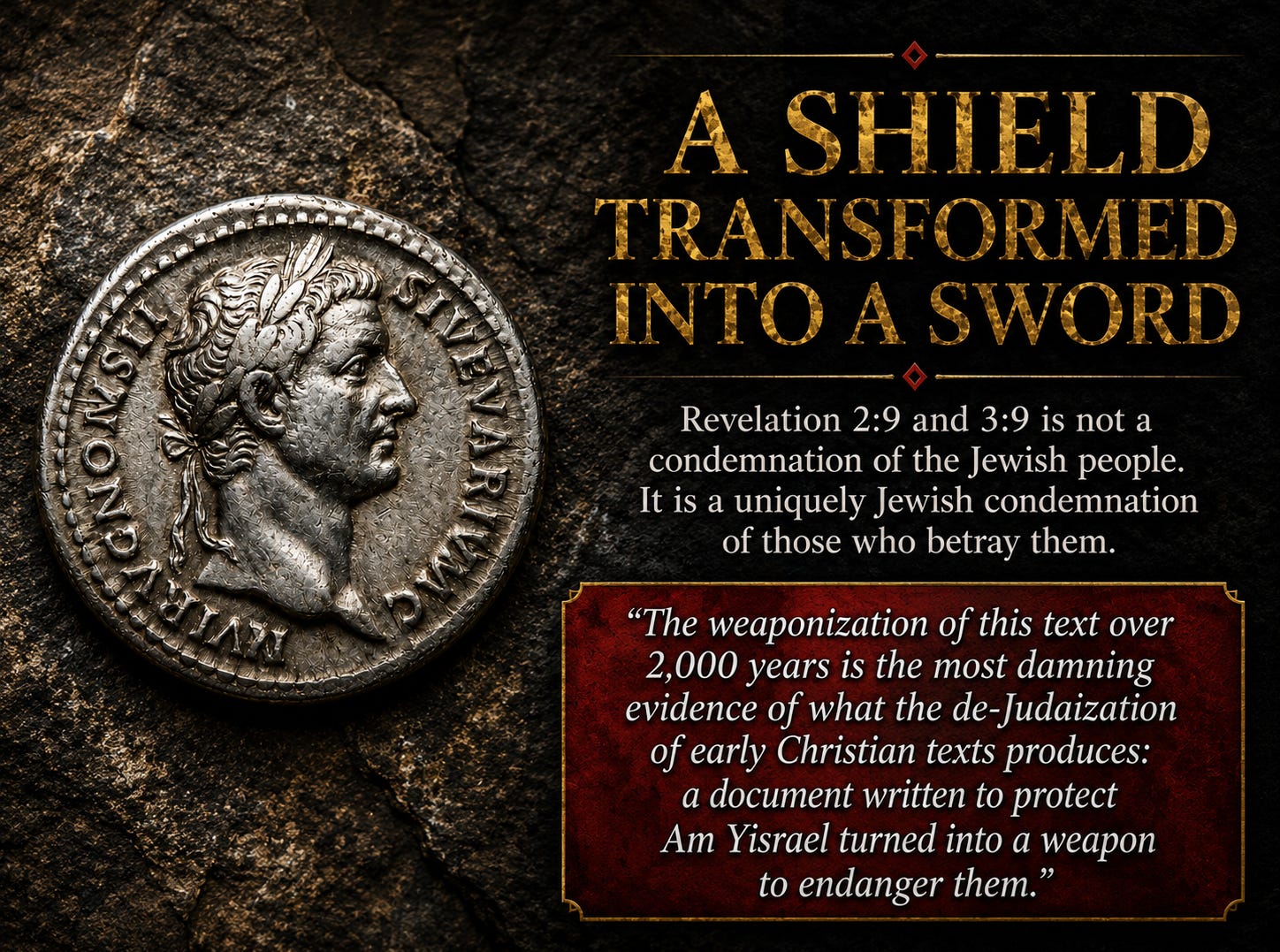
This reading neutralizes the historical anti-Jewish valence. It is a Jewish author, writing to Torah-faithful Jews, warning them about the most lethal internal threat their community faced in the most catastrophic moment in their lives. The text was written to protect observant Jews from informers. It has been weaponized for centuries to endanger them. That reversal is itself the most damning evidence of what the de-Judaization of early Christian texts produces: a document written in solidarity with Am Yisrael transformed into a weapon against it.
✦ ✦ ✦
VIII. The Contemporary Application
When an individual — whether Jewish or not, whether claiming religious identity or not — publicly posts content that identifies, spotlights, or marks conspicuous, observant Jews for social or political hostility, they are performing the precise function the Rambam defines in Hilkhoth Teshuvah 3:12 and that the author of Revelation names with כְּנֵסֶת הַשָּׂטָן. They are making the calculation of 3:9: יָדָם תַּקִּיפָה (”their hand is strong”) — and pointing that hand at the vulnerable. They are standing before the throne of imperial power — whether Rome’s or its modern equivalents — and accusing the Jews.
Those who spotlight the Jewish people, making them targets for social and political violence, are performing the function of כְּנֵסֶת הַשָּׂטָן — the congregation of the Accuser.
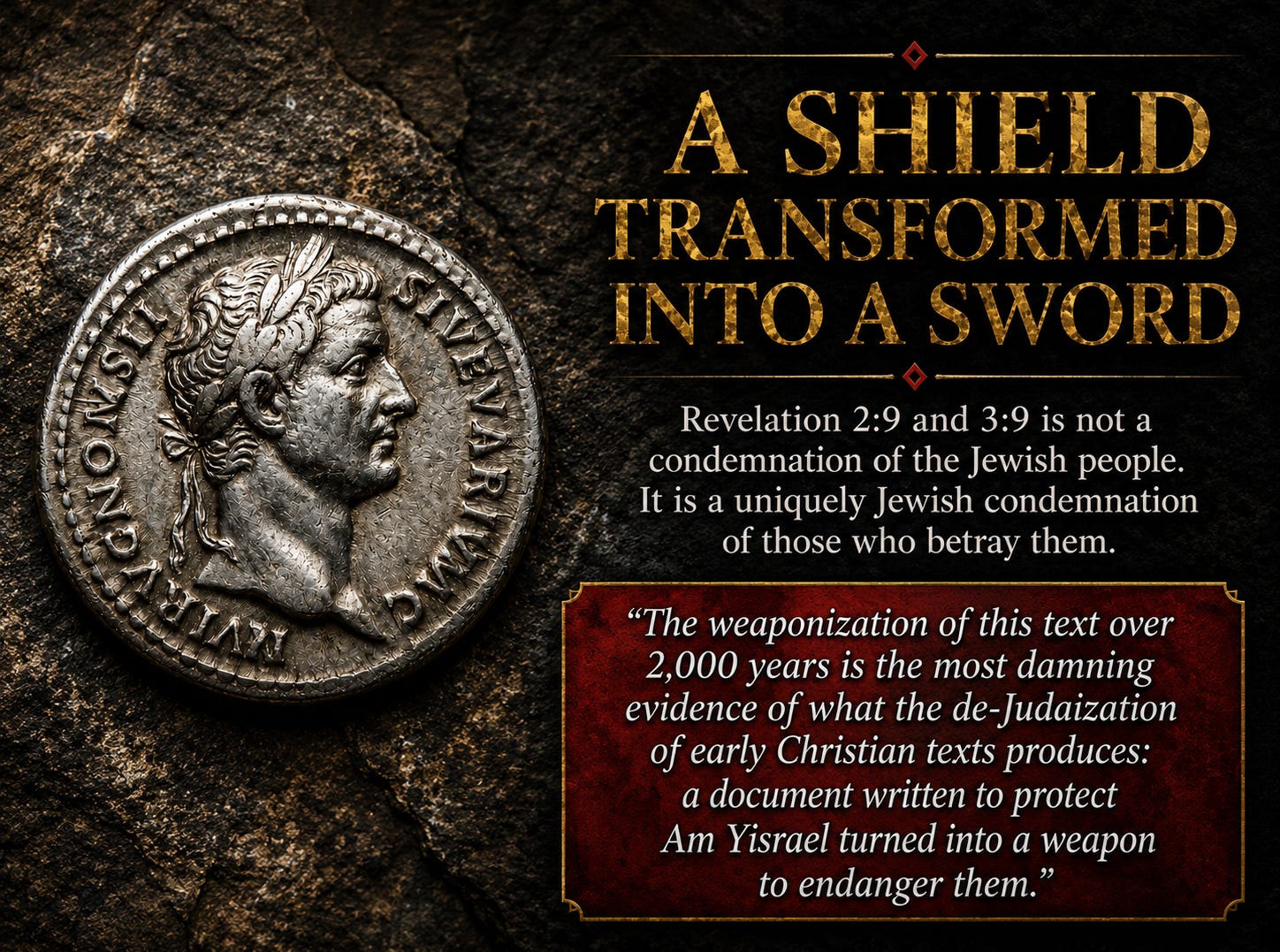
The text of Revelation has been misread for two thousand years as a condemnation of the Jewish people. Read in its native framework, it is something else entirely: a condemnation of those who betray them.
This essay is part of a larger body of work reading the New Testament as early Jewish texts within their native covenantal, halakhic, and liturgical frameworks — reading them not as departures from Israel but as voices within it. A translation and commentary of the Gospel of Matthew is in preparation. Further teaching, resources, and ongoing work are available at perfectingtheworld.com.