
By Rabbi Josh Wander
The controversy surrounding the punishment of a Nahal combat soldier for wearing a “Moshiach” patch did not emerge in a vacuum. To understand why this incident has shaken so many Israelis, one must understand the revolution that has quietly been unfolding inside the Jewish nation since Simchat Torah, October 7th. When the war began, hundreds of thousands of reservists flooded into the IDF almost overnight. Men left businesses, universities, families, vacations, and normal life without hesitation. Brothers reunited with brothers in arms. Across Israel, civilians mobilized on a scale almost unimaginable. At the very same time, millions of Jews around the world davened for the safety and success of these soldiers. Something ancient awakened within the Jewish people. The war was not experienced merely as another military operation or another painful round in an endless conflict. For many Jews, it felt existential, historical, and even biblical in scope.
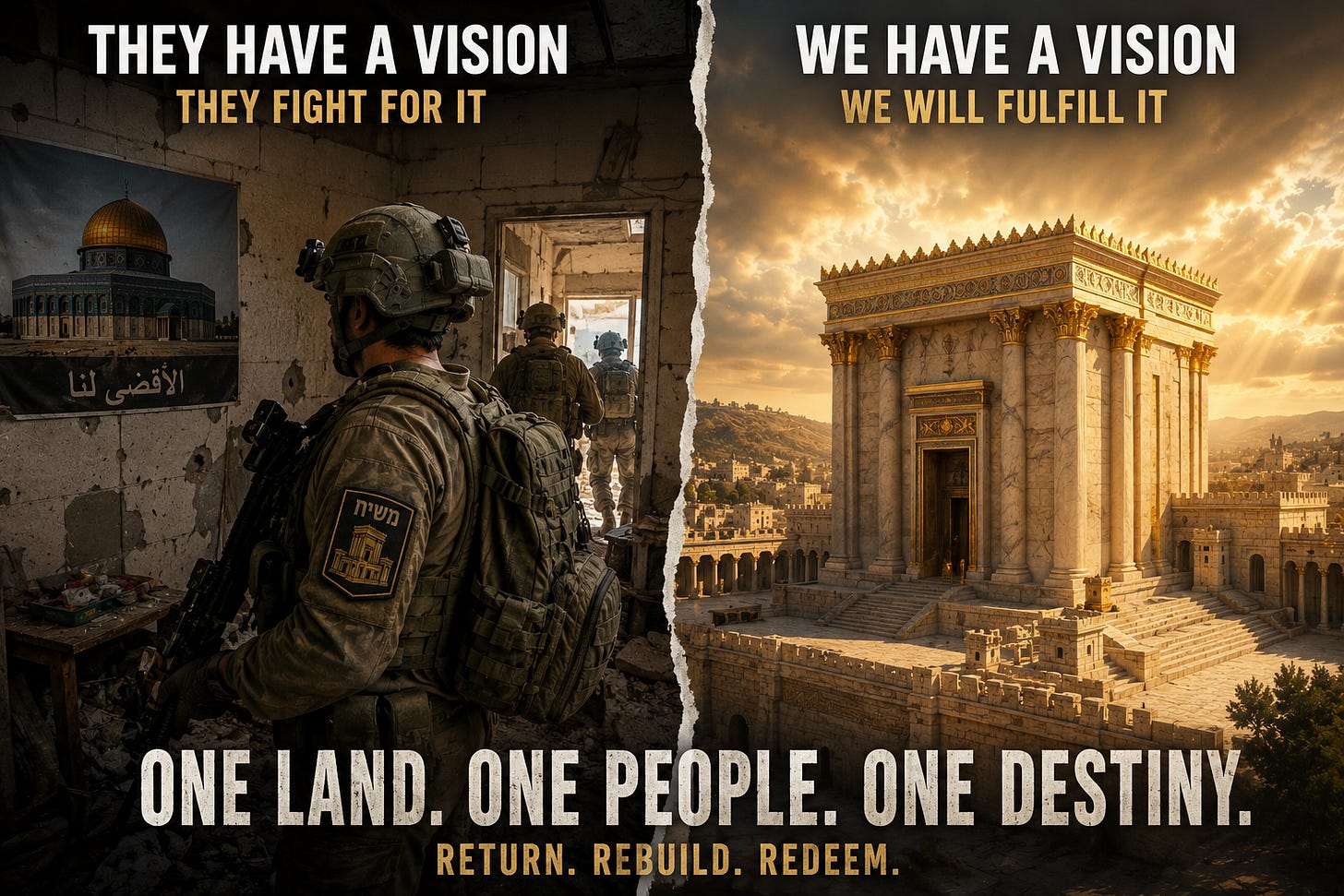
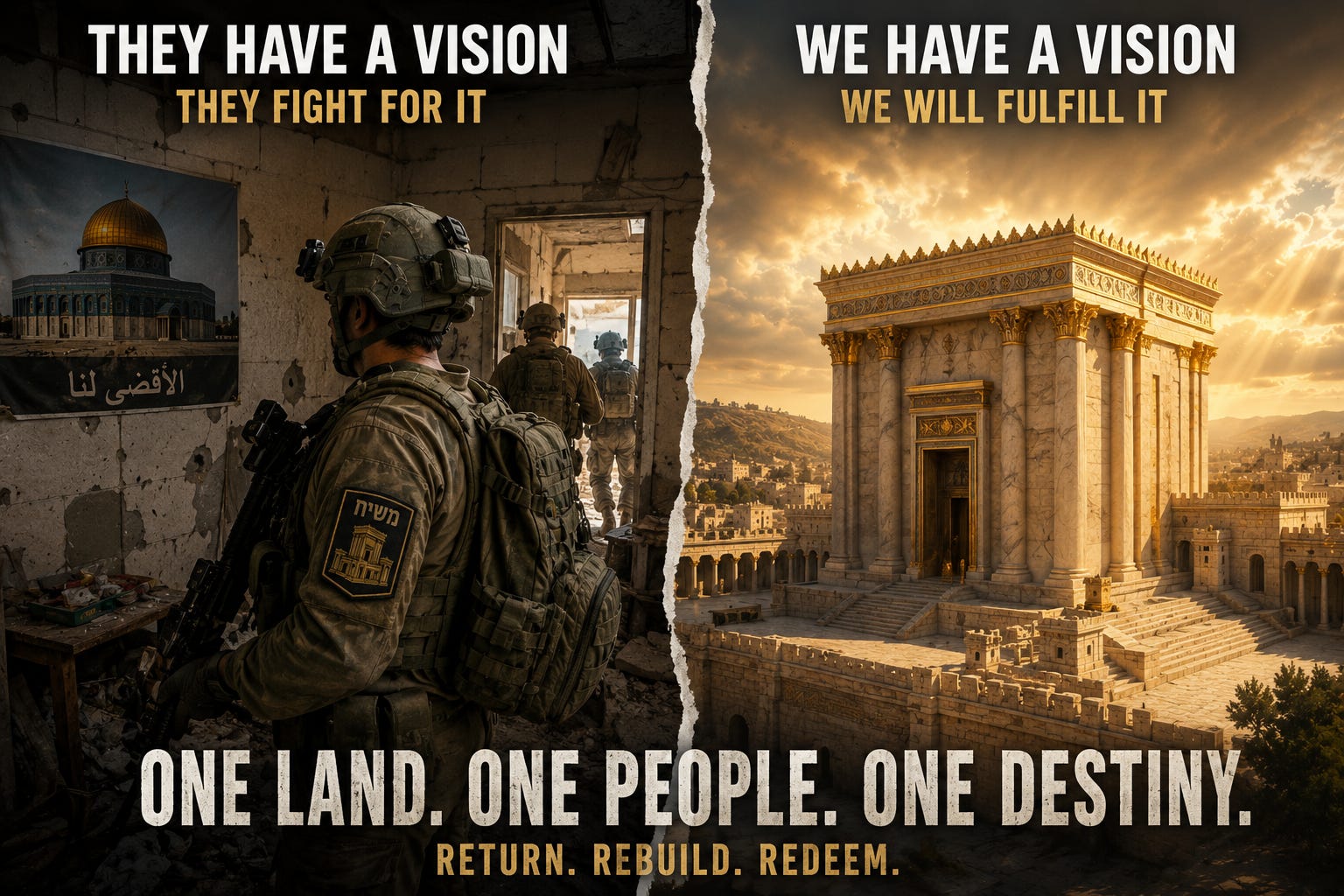
At first, the national objective seemed simple and obvious: destroy the enemy, erase the threat, and wipe out Amalek from our midst. Israelis were united around the understanding that the massacre of October 7th could not simply become another tragic chapter followed by temporary deterrence and diplomatic maneuvering. The nation demanded victory. But very quickly, many of the soldiers entering Gaza began encountering something that deeply disturbed them. Again and again, inside homes, schools, mosques, government offices, tunnels, and military compounds, they saw the same image staring back at them: the Temple Mount. Not Tel Aviv. Not Haifa. Not vague nationalist slogans. Har HaBayit. Al Aqsa. Jerusalem. The enemy understood something with absolute clarity. They called the war “Al Aqsa Flood” for a reason. Their entire narrative, motivation, and identity revolved around Jerusalem and the site of the Beit HaMikdash. They were willing to massacre, rape, kidnap, and die for a vision connected to that mountain. Their propaganda, education system, and ideology all centered around a long-term vision. Whether twisted or evil is irrelevant to the point. They knew exactly what they were fighting for.
Suddenly many Israeli soldiers began asking themselves a painful question: if our enemies have a vision, what is ours? What exactly are we fighting for? Security? Quiet? Another temporary ceasefire until the next massacre? “Managing the conflict” for another decade? Is Jewish history merely about surviving one more attack and returning to normal life until the next siren sounds? That question became impossible to ignore. It was precisely from that realization that a phenomenon emerged organically among the troops: patches bearing the image of the Beit HaMikdash and slogans connected to redemption, Jewish destiny, and Moshiach. This was not because soldiers suddenly became extremists or radicals, but because they understood something essential. A nation cannot fight indefinitely without purpose. Military campaigns require more than drones, intelligence briefings, and tactical objectives. Human beings need meaning. Soldiers risking their lives need to believe they are participating in something larger than another temporary security operation.
For two thousand years Jews dreamed of returning to Zion, returning to Jerusalem, and rebuilding what was destroyed. Every wedding ended with the memory of Jerusalem. Every day Jews prayed toward the Temple Mount. Every year on Tisha B’Av Jews mourned the destruction of the Beit HaMikdash and longed for redemption. And now, for the first time in Jewish history, that dream is no longer theoretical. Jews govern Jerusalem. Jews possess sovereignty. Jews have an army. Jews have the ability to shape history rather than merely survive it. The soldiers understood this instinctively. That is why these patches exploded in popularity across the IDF. They represented something far larger than a uniform accessory. They were a declaration that the Jewish people also possess a vision. We are not merely fighting because our enemies attacked us. We are fighting because Jewish history is moving somewhere. Because after two thousand years of exile, dispersion, humiliation, and powerlessness, the Jewish nation has returned home.
But this is precisely where the growing disconnect began to emerge. Many within Israel’s older leadership class were raised on a very different version of Zionism, one rooted primarily in secular nationalism, socialist ideals, and the creation of a “new Jew” disconnected from exile religion and messianic longing. For decades, that worldview dominated many of the institutions of the state, including large parts of the military establishment. Judaism was often tolerated as cultural symbolism or private spirituality, but national destiny rooted in Torah, redemption, and the Beit HaMikdash remained deeply uncomfortable territory for many within the elite. Then October 7th shattered the illusion that Jewish identity could remain spiritually empty. The nation changed. The soldiers changed. The war stripped away layers of post-Zionist detachment and forced Israelis to confront the raw reality of being Jews in history once again. Faced with barbarism, death, sacrifice, and existential danger, many soldiers did not move further away from Judaism. They moved closer to it. Fighters began asking for tzitzit and tefillin before battle. Tehillim became commonplace in staging areas. Torah classes spread through military bases. Secular Israelis who had never spoken publicly about faith suddenly began discussing miracles, destiny, and Jewish purpose. A spiritual awakening quietly spread through parts of the nation, especially among those carrying rifles on the frontlines.
Some within the leadership simply do not know how to process this transformation. Instead of recognizing this renewed Jewish spirit as a source of strength and morale, they often react with suspicion, discomfort, or hostility. The old secular Zionist model that once defined the state is visibly weakening, and many of those who built their identities around it are watching the ground shift beneath them in real time. The soldiers emerging from Gaza and Lebanon are not always the same soldiers who entered. Many have come face to face not only with the enemy, but with Jewish history itself. That is what this fight over patches is truly about. It is not fundamentally about discipline or uniform regulations. Armies can enforce standards without sentencing frontline combat soldiers to prison over symbols tied to Jewish hope and identity. The severity of the response reveals something much deeper: fear. Fear that the nation is moving in a direction many within the old establishment neither expected nor desired. Fear that Jewish nationalism is reconnecting with Jewish destiny.
The tragedy is that while our enemies remain singularly focused on their vision, parts of our own leadership appear more disturbed by Jewish symbolism among Israeli soldiers than by the ideological fanaticism of those trying to destroy us. Instead of harnessing the רוח awakening among the troops, they attempt to suppress it. But the soldiers are telling us something important. They are telling us that the Jewish people are no longer satisfied with surviving. They are telling us that after October 7th, slogans about “normalcy” ring hollow. They are telling us that the return to Zion must stand for something deeper than merely constructing another Western state that happens to speak Hebrew. And perhaps that is what frightens some people most of all.
Personally, I’m looking forward to the day soon, when we will see a Chief of Staff of the IDF proudly wearing a patch of the Mikdash on his shoulder! נצח ישראל לא ישקר.