Imagine a six-year-old child running through the streets of ancient Jerusalem during the First Temple period. This child has never read a theological commentary. He doesn’t know what a “Rabbinic fence” is. Yet, when his mother tells him that sundown is approaching and they must cease all Melachah, the child knows exactly what boundaries to draw. He doesn’t need a dictionary, because Biblical Hebrew is not a collection of static, arbitrary words. It is an organic, architectural matrix built on three-letter roots called Shorashim (שֳׁרָשִׁים).
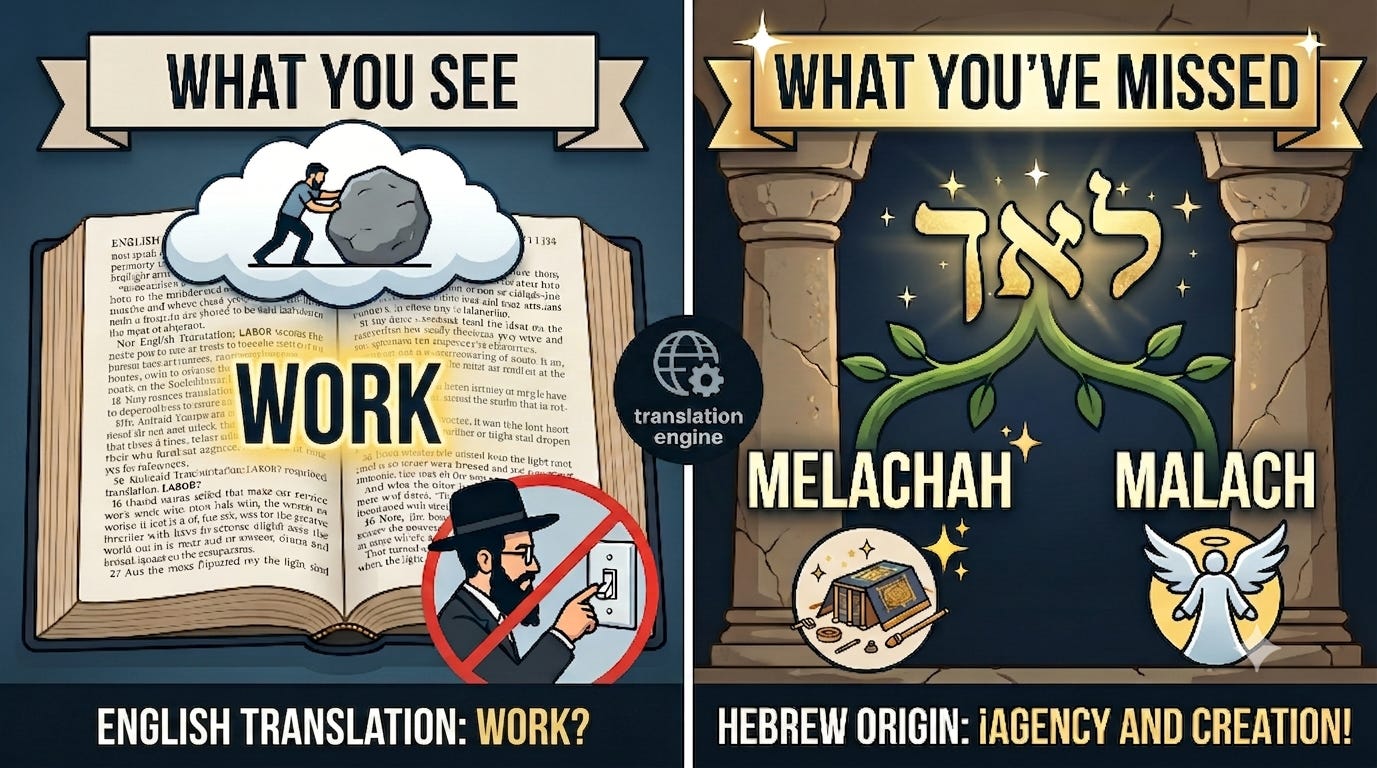
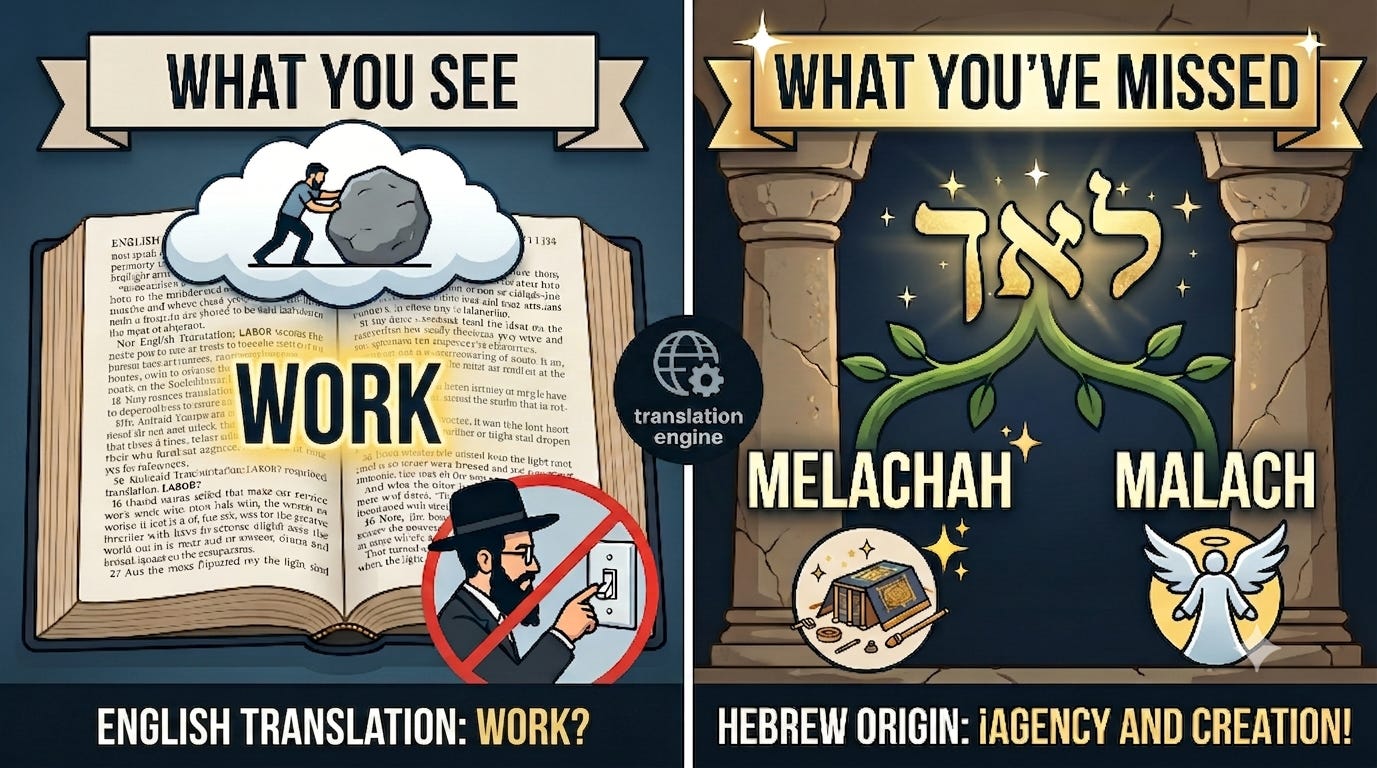
In Hebrew, if you know the three-letter root, you instantly know the spiritual DNA, the cosmic function, and the intrinsic meaning of any word derived from it. To that six-year-old child, the word Melachah (מְלָאכָה) is visually, phonetically, and structurally inseparable from its true parent root: L-A-K (ל-א-ך).
Look at how the architecture works when the prefix Mem (מ) is applied to activate the root:
מְלָאכָה ⟵ ך-א-ל+מ ⟶ מַלְאָךְ
From this single three-letter root sprout two primary branches:
Malach (מַלְאָךְ): Professionally translated by Westerners as “angel” or “messenger.”
Melachah (מְלָאכָה): Professionally translated by Westerners as “work” or “labor.”
To the modern Western mind, an “angel” and a “factory shift” have absolutely nothing in common. They exist in completely different universes of thought. But to the Hebrew language, they are twins.
What does a Malach (an angel) actually do? An angel does not punch a time card. An angel does not sweat, tire, or earn an hourly wage. An angel is an agent of will. A Malach takes an abstract thought, design, or decree from the spiritual realm and executes it, fundamentally altering or manipulating the physical reality of the universe below to match that intelligent design.
Therefore, the child automatically knows what the sister word Melachah means. Melachah is not physical exertion; it is the act of being an agent of will over the physical creation. It is the application of human intelligence, craftsmanship, and mastery to transform, alter, or manipulate the natural state of matter.
The Architecture of the Root System
To a Western reader, a language is a bucket of independent labels. The word “apple” has no structural relationship to the word “gravity,” even though an apple dropped on Newton’s head. But Hebrew does not function through isolated labels; it functions through dynamic, geometric expansion. The three letters of a root (shoresh) act like genetic code. Every single word that mutates out of that root carries the same DNA.
When a Western critic opens a translation, they are looking at a flat, two-dimensional snapshot of a word. But the six-year-old child sees the word in three dimensions, like a holographic tree. They understand that L-A-K (ל-א-ך) is an active, living force. Because Malach (the agent) and Melachah (the agency) share the exact same root letters, the Hebrew mind cannot separate the worker from the nature of the work.
This is why trying to define Shabbat using English or Spanish definitions is an exercise in futility. In Western languages, “work” is defined by the person doing it—if a machine does it, or if it’s easy, it ceases to feel like “work.” But in the architectural design of the Torah, Melachah is defined by the effect on the object. Did you change its state? Did you ignite it? Did you assemble it? Did you tear it apart to build something else? If you executed your intelligent will to transform matter, you engaged in Melachah, regardless of whether you broke a sweat or merely flicked your wrist.
The Blueprint of the Tabernacle (Mishkan)
This structural reality explains the profound connection that completely confuses the outside critic: the relationship between Shabbat and the Tabernacle (Mishkan).
In Exodus 35, the Torah abruptly halts the instructions for building God’s sanctuary to issue a stark, terrifying warning about keeping the Sabbath. To the casual English reader, this looks like a random, clunky interruption by the editor. The critic reads it and thinks, “Why is God talking about resting from manual labor right in the middle of a blueprint for a tent?” But to the Hebrew mind, it is the ultimate conceptual alignment.
The building of the Tabernacle was the absolute pinnacle of human Melachah. It required every single form of creative human mastery over the physical world: spinning thread, dying cloth, refining metals, carving wood, and kindling refining fires. The Tabernacle was a microcosm of the universe—it was humanity using its divine spark of intelligence to construct a dwelling place for the Divine.
By placing the Shabbat laws directly next to the Tabernacle blueprint, the Torah is providing the ultimate master key. It is telling us: The exact creative acts required to build a physical sanctuary for Me are the exact categories of creative authority you must abdicate on the Seventh Day. Judaism didn’t invent thirty-nine arbitrary, legalistic categories of “work” to make life miserable on Saturday. The Prophets and the Sages simply looked at the architectural layout of the text itself. They looked at the construction of the Tabernacle and said, “Here is the complete catalog of human creative mastery over nature.” When we cease from these thirty-nine actions, we aren’t hiding from a cosmic boss who wants us to sit in the dark; we are actively stepping down from the throne of our own mini-empires to let the true King rule.
When the Torah commands Israel to rest from Melachah on the Seventh Day, it isn’t an instruction to rest their tired muscles. It is a cosmic boundary line. For six days, humanity is given permission to act like mini-creators—to exercise intelligent sovereignty over the earth, bending nature to human will. But on the seventh day, we freeze. We drop our hands. We cease our intentional manipulation of matter to openly acknowledge that we are not the owners of this estate; God is the Ultimate Creator.
The text is completely transparent. But it was about to be fed into a global translation engine that would flatten this entire majestic architecture into a flat text.
The Domed Sandbox: How Every Culture “Correctly” Misunderstood the Text
When the machinery of global evangelism and Western colonialism began exporting the Bible to the ends of the earth, translators faced an immediate, structural crisis: the target languages did not possess a vocabulary word for “metamorphic creation driven by human agency or, it did but did not reflect the word being introduced from the English. In other words, the new bible was translated from the English translation instead of Hebrew.”
Languages are reflections of the cultures that build them. The dominant global languages were shaped by feudalism, agrarian peasant labor, Roman legal codes, and industrial commerce. They had words for survival, words for muscle strain, and words for economic output. They did not have words for the holy craftsmanship of the Tabernacle.
So, the translators did the only natural, innocent thing they could do: they reached into their own linguistic sandboxes and grabbed the closest economic or physical equivalent.
The Global Translation Gap: Melachah vs. Work
A linguistic cross-cultural analysis showing how standard Bible translations across the top 20 most spoken languages flatten the Hebrew concept of Melachah (creative mastery/agency) into secular, localized concepts of physical labor, employment, or economic tasks.
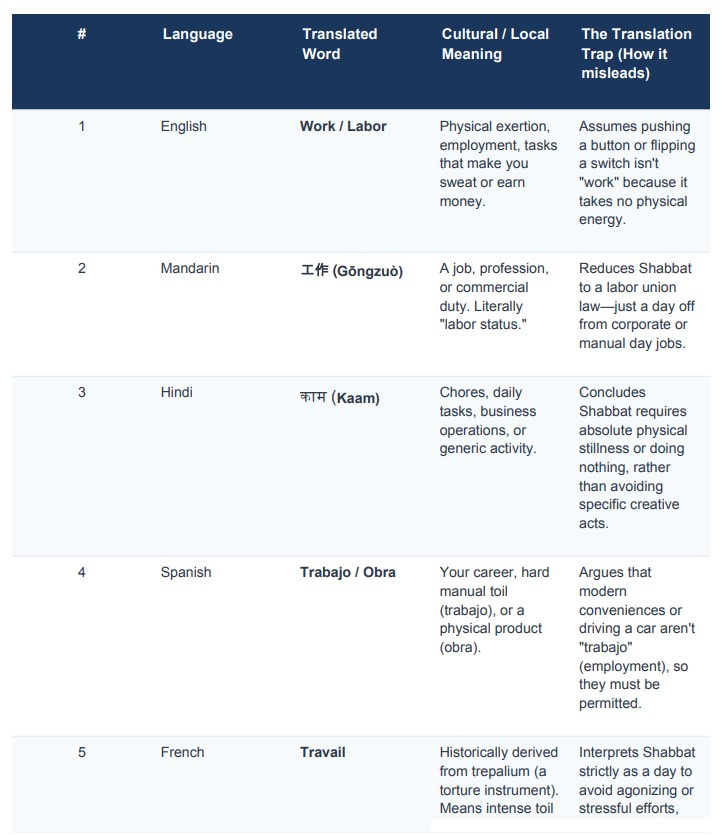
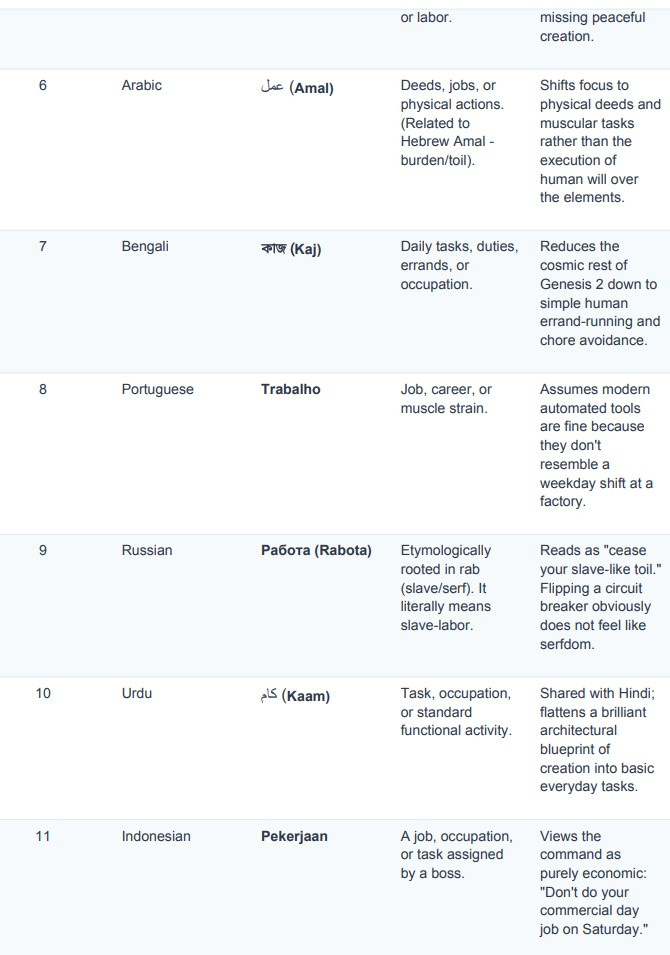
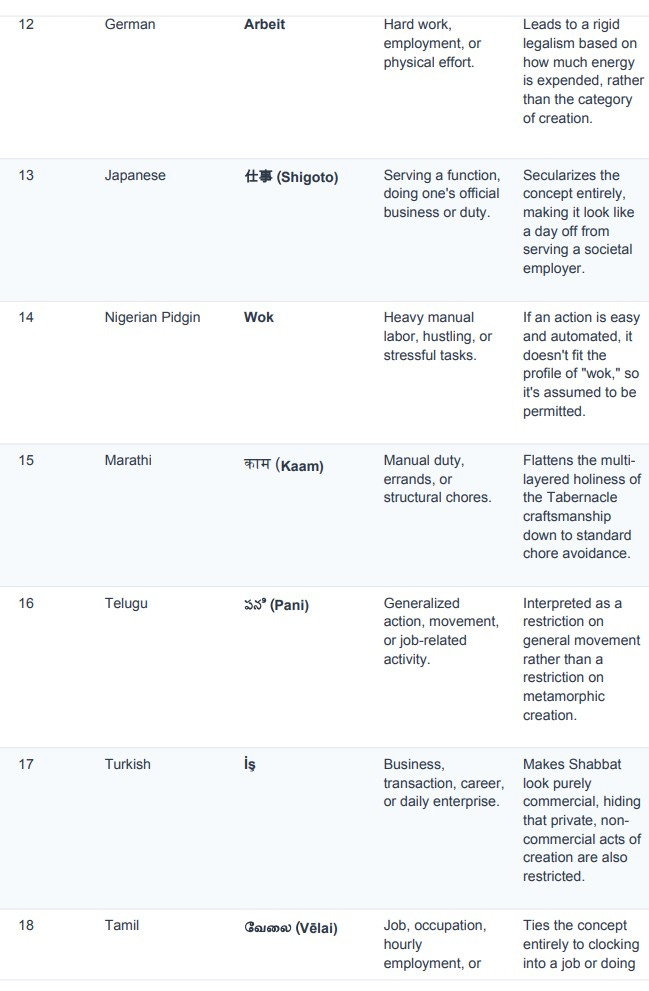
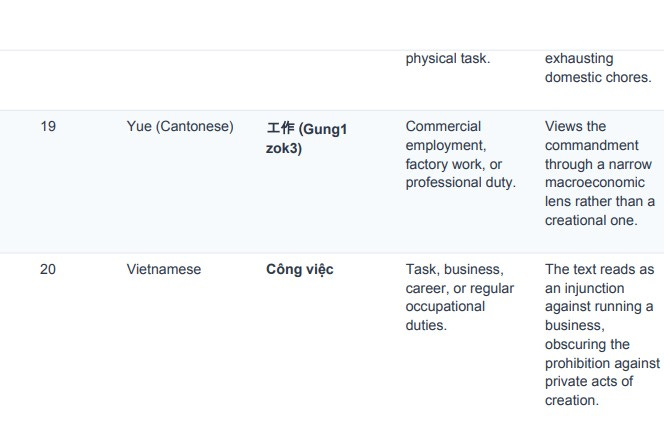
Look closely at what happened. When you look at this global landscape, you see a spectacular historical phenomenon: Every culture is completely logical, airtight, and correct in its understanding based on the native words they were given. If you are an English speaker, your sandbox defines “work” as physical labor or your job. Therefore, your logic is flawless: flipping a light switch or turning an ignition key doesn’t make you sweat, and it isn’t your job, so the Jews must be crazy legalists who are “adding rules” to the Torah.
If you are a Spanish speaker, trabajo means your employment or strenuous toil. Driving a car to go see family doesn’t feel like a factory shift, so your logic is airtight: the Rabbinic definition must be a human invention breaking Deuteronomy 4:2.
The Russian reader looks at Rabota (historically rooted in slave labor) and thinks, “Flipping a circuit breaker doesn’t feel like serfdom, so I am obeying the plain text.”
They are all using impeccable, watertight logic. They are setting up brilliant, robust, theological arguments. But they are playing inside a dome. Their logic is perfectly sound inside the translation, but their translation has actively assisted them in completely misunderstanding the Hebrew beneath it. They are fighting fiercely to defend the integrity of a corporate employee handbook, completely oblivious to the fact that the Torah is a cosmic architectural blueprint.
When the critic rails against the Talmudic applications of Shabbat law—accusing the Jewish people of adding “bullshit rules” because an elevator button or an air conditioner switch is barred—they aren’t exposing a flaw in Judaism. They are loudly exposing the boundaries of their own vocabulary. They have mistaken their native language’s cultural definitions for the voice of God at Sinai.
The Final Word: An Invitation to the Sandbox Bench
If you are one of those readers who has spent years passionately studying your translation, laying out what you believed were the most logical, unassailable arguments against Jewish tradition, I want to say something to you directly:
Your understanding of your translation is awesome. Truly, it is. Your arguments are coherent, your deductions are disciplined, and your dedication to what you see on the printed English page is highly commendable. You just don’t know what the Hebrew communicates.
You have built a watertight fortress, but you built it entirely inside an artificial, gentilized sandbox.
So, here is my invitation to you: Step out of the dome. Walk away from the corporate employee handbook that the translators handed you. Come over here, take a seat on the bench right next to that ancient six-year-old Judean child, and let’s start over from the very basics of the alphabet.
Let’s look at the actual roots. Let’s look at the deep, interconnected, geometric design of the language the Creator chose for His Torah.
But fair warning: what we have just exposed in this article regarding the word Melachah is barely scratching the surface of the text. If you choose to sit on this bench, you must be prepared to have your entire theological paradigm completely shattered and rebuilt from the bedrock up. You will quickly realize that the things you thought the Rabbis “added” are often just the deep, structural realities of the language that your translation was simply too poor to carry across the sea.
We have a very long way to go, and the sandbox is getting smaller by the day. It’s time to learn how to read. Join https://PerfectingTheWorld.com today.