
By Rabbi Josh Wander
Few issues divide Israeli society today more than the debate over drafting yeshiva students into military service. During a time of war, when reservists have served hundreds of days away from their families and livelihoods, and casualties continue to mount, it is understandable why many Israelis struggle to accept that large segments of the population remain exempt from service. The frustration is not merely about manpower. It is about shared responsibility.
At the same time, the concerns of the Torah world cannot simply be dismissed. Hundreds of thousands of yeshiva students sincerely believe that Torah study is one of the pillars protecting the Jewish people. Many also fear that military service could expose their communities to influences that threaten their religious way of life. While some of these fears may reflect historical realities from Israel’s early years, when parts of the secular establishment openly sought to reshape traditional Judaism, today’s Israel is very different. Torah learning flourishes on an unprecedented scale, religious soldiers serve throughout the military, and dedicated religious frameworks already exist.
What makes this debate particularly frustrating is that many of the political players involved have little incentive to solve it. The left energizes its voters by promising to draft the charedim. The charedi parties energize their voters by promising to prevent the draft. The controversy itself has become politically valuable. A genuine solution would deprive both sides of one of their most effective campaign issues.
Ironically, even the army does not necessarily want to absorb tens of thousands of charedim overnight. Such an effort would require enormous resources, specialized frameworks, and major cultural accommodations. More importantly, simply forcing large numbers of unwilling people into uniform does not automatically strengthen the military. Successful armies are built on motivation, discipline, and morale. The goal should not be to maximize the number of people wearing uniforms but to maximize the nation’s ability to defend itself.
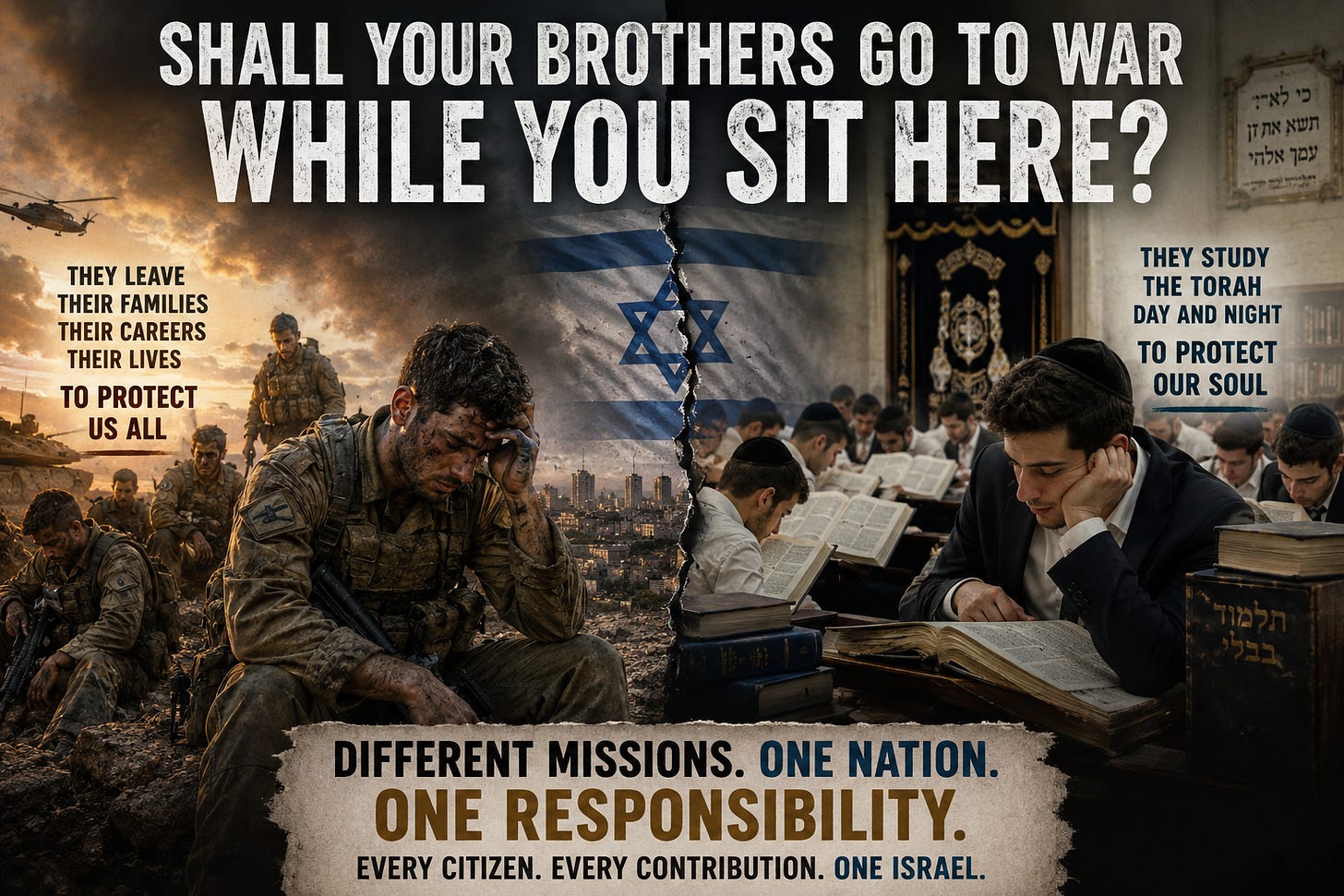
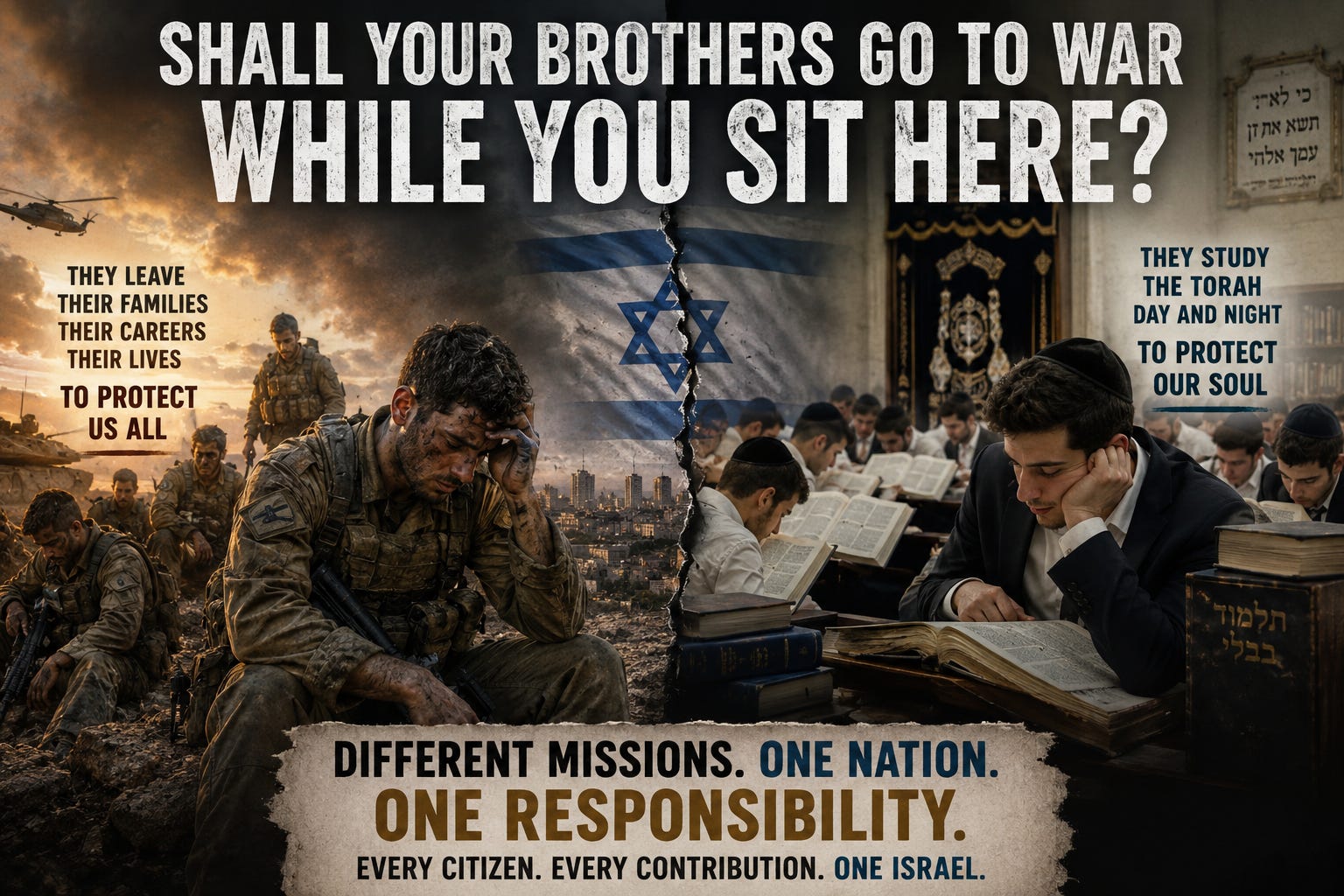
The Torah itself presents arguments for both sides. When the tribes of Reuven and Gad sought to remain east of the Jordan River, Moshe challenged them with the words, “Shall your brothers go to war while you sit here?” National responsibilities must be shared. Yet we also find that the tribe of Levi was largely exempt from military service and dedicated itself to the spiritual needs of the nation. The challenge is determining how those two principles can coexist in a modern Jewish state.
Perhaps the solution is not universal military service but universal national service. Every citizen should contribute to the nation, but not necessarily in the same way. Some will serve in the military. Others will serve in emergency response, healthcare, education, social services, community security, or other national frameworks. Tens of thousands of charedim already volunteer through organizations such as Hatzalah, ZAKA, Yedidim, Yad Sarah, and Yad Eliezer. These contributions should be recognized as valuable national service.
Likewise, a limited number of exceptional Torah scholars should be recognized as serving the nation through advanced Torah study, much as the tribe of Levi served the spiritual needs of Israel. However, that status should be reserved for a select group rather than applied broadly to an entire population.
Any serious discussion about equality of burden must also address Israeli Arabs, who largely do not participate in military or national service while often entering higher education and the workforce years before their Jewish counterparts. If the principle is that every citizen should contribute to society, then that principle must apply universally.
The question Moshe asked the tribes of Reuven and Gad was not, “Must everyone serve in exactly the same way?” The question was, “Shall your brothers go to war while you sit here?” The issue was never uniformity. It was responsibility.
The State of Israel already understands that different people contribute in different ways. Not every soldier is a fighter pilot, a tank commander, or an infantryman. The military identifies talents and places people where they can best serve. The same principle should guide national service as a whole.
Israel needs soldiers. Israel needs doctors. Israel needs emergency responders. Israel needs teachers. Israel needs Torah scholars. The challenge is not making everyone identical. The challenge is ensuring that every citizen shares in the responsibilities of nationhood.
The debate over the draft will continue, but perhaps the real question is not who should be exempt. The real question is how every citizen can contribute to the future of the Jewish state. Once we begin asking that question, we may finally discover that the solution has been in front of us all along.