
By Rabbi Josh Wander
There are moments in history that do not arrive with announcements or consensus. They come quietly, almost disruptively, breaking patterns we have grown comfortable with and forcing us to confront questions we would rather not ask. Something is taken away, access is limited, and what once felt natural suddenly feels uncertain. In those moments, the instinct is to resist, to restore what was, to return to the familiar. But sometimes the disruption is not a setback. Sometimes it is a correction.
This year, Lag BaOmer carries that feeling. For generations, the emotional and spiritual center of the day has been Meron. Hundreds of thousands gathering at the kever of Rabbi Shimon bar Yochai, celebrating the light of the Zohar, connecting to the hidden dimensions of Torah through song, fire, and unity. It has become more than a custom; it has become the experience of Lag BaOmer itself. And now, that center is closed. The immediate reaction is disappointment, even pain, as if something essential has been taken from us. But that reaction assumes that what we built around the day is exactly where our focus was meant to be.
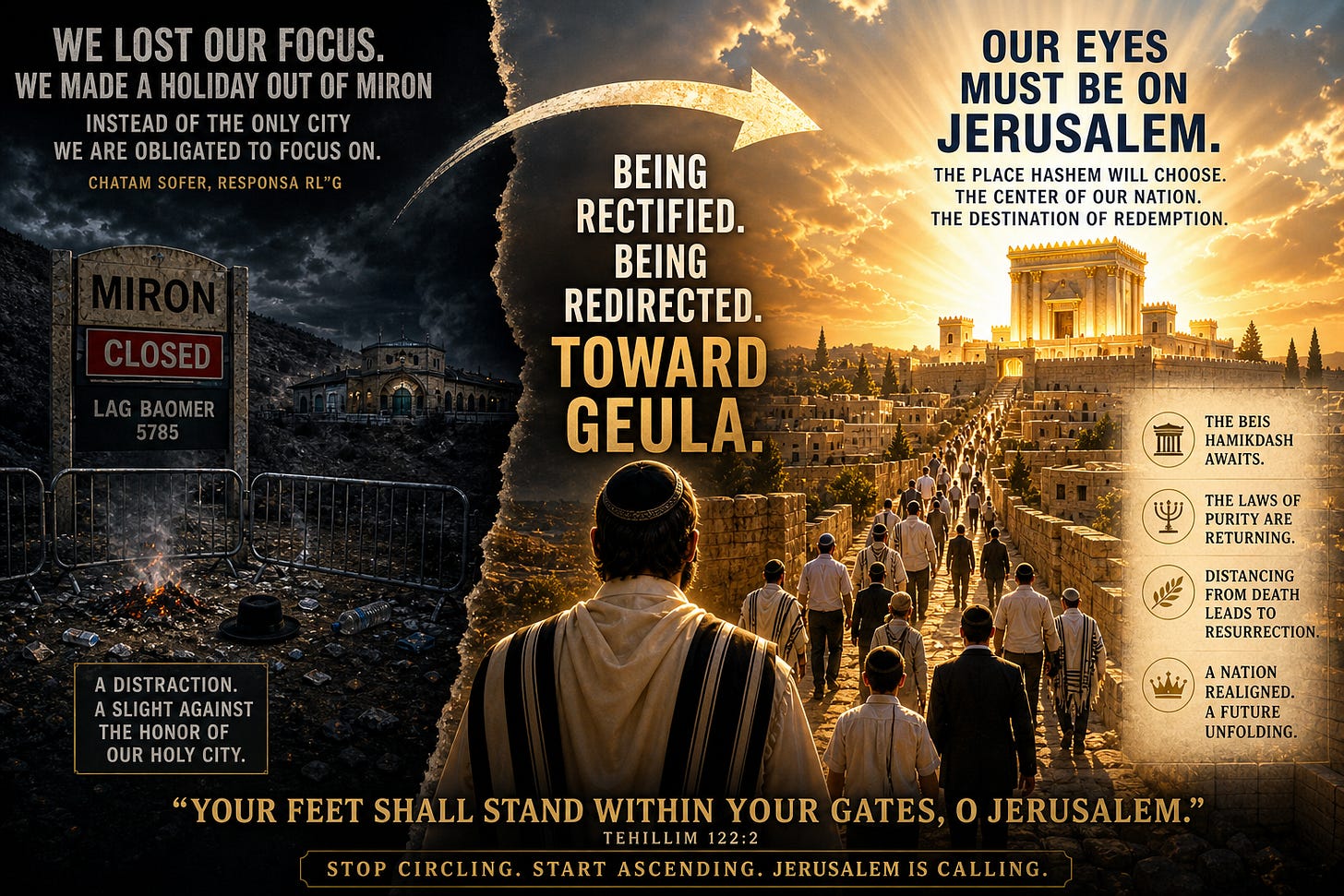
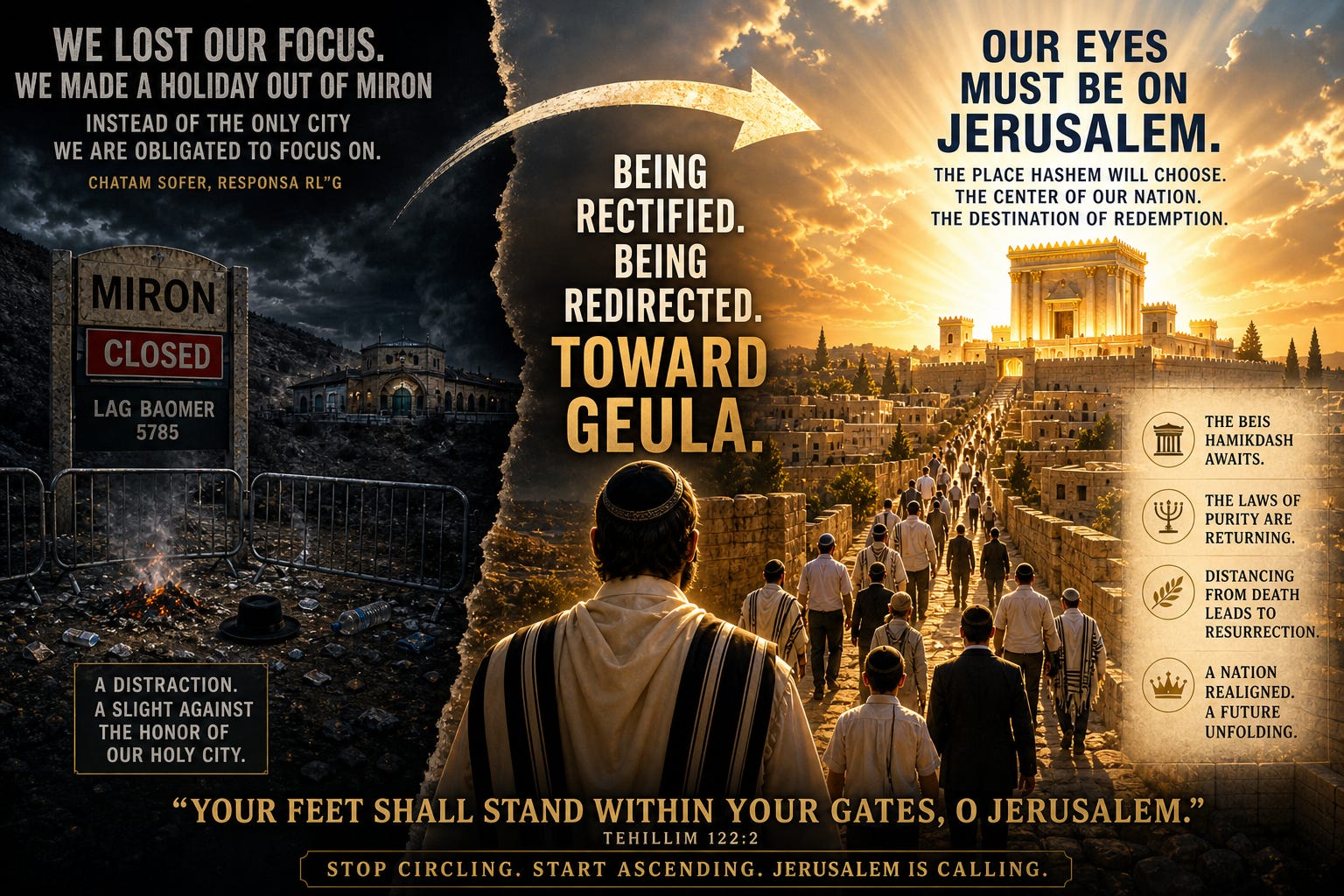
The Chasam Sofer, in responsa רל״ג, saw a danger in this long before it became entrenched. His concern was not with Rabbi Shimon bar Yochai or with the celebration of his legacy. It was with the shift in focus. He writes with a tone of discomfort at the idea that Jews would elevate Meron into a focal point of national celebration while neglecting Yerushalayim, the one city toward which our entire spiritual orientation is commanded. There is only one מקום אשר יבחר ה׳, only one place that stands at the center of our avodah, our tefillah, and our national identity. Yerushalayim is not one holy place among many. It is the axis around which everything else revolves.
Over time, however, a subtle but profound shift occurred. A day that could have served as another opportunity to deepen our connection to Yerushalayim and the מקום המקדש became associated with a different mountain entirely. This was not inherently wrong, but it created a misalignment. The emotional weight of the day began to drift away from the place that the Torah itself defines as central. What we are witnessing now, with Meron being closed, may not be arbitrary at all. It may be a quiet rectification of that imbalance, a redirection back toward where our focus was always meant to be.
When this is viewed alongside other developments, the picture becomes sharper. At a recent conference on the Para Aduma, a striking idea was presented regarding the return of the laws of Tumah and Tahara. These laws are often understood as technical, as details belonging to a past era of Mikdash life. But their reemergence signals something far deeper. They represent a transformation in how a person experiences the boundary between life and death. In our current reality, contact with death is almost casual. A person can attend a funeral, walk through a cemetery, and then move on without any structural consequence to their spiritual state. Death is present, but it does not define behavior.
In a world oriented toward the Beis HaMikdash, that changes completely. Entry into the Mikdash requires a state of purity, and that requirement reshapes how a person lives. Contact with death becomes a serious consideration, not only emotionally but existentially. A person begins to ask where they want to stand, what state they wish to be in, and whether their actions are aligning them with life or tethering them to death. This heightened sensitivity is not a restriction; it is a reorientation toward a higher reality.
The idea that emerges from this is deeply counterintuitive. Distancing oneself from constant engagement with death is what prepares the world for תחיית המתים. It is not by immersing ourselves in death that we connect to those who have passed, but by aligning ourselves with a reality of life so strong that death itself begins to lose its hold. A world ready for resurrection is a world that has already begun to transcend the dominance of death in daily life.
Seen in this light, the closure of Meron takes on a different meaning. It is a place associated with a kever, with connection to the dead, even at the highest spiritual level. At the same time, there is a renewed focus on the laws that distance us from death and prepare us for entry into the מקום המקדש. These are not isolated developments. They point in the same direction. They suggest that we are being gently but firmly moved away from a Judaism centered on memory and commemoration, and toward a Judaism centered on presence and readiness.
And then comes the timing, which is almost too precise to ignore. Not long after Lag BaOmer, we arrive at Yom Yerushalayim, the day marking the reunification of the city and the restoration of Jewish access to its holiest places. The calendar itself seems to be speaking. First, a closing in the north, at a site that had come to dominate the emotional expression of the day. Then, almost immediately, a national focus on Yerushalayim, on the city that stands at the heart of our destiny. It is as if one door is being gently shut so that another, far more essential one, can no longer be overlooked.
The Chasam Sofer’s words now feel less like criticism and more like prophecy. The slight to the honor of Yerushalayim was never meant to endure indefinitely. It was a product of a certain stage in our history, a stage in which exile conditioned us to find connection wherever we could. But that stage is shifting. As we move closer to a reality in which Yerushalayim is not only symbolic but functional as the center of our national life, the misalignments of the past begin to correct themselves.
Meron being closed is not simply a loss. It is a signal. It is an invitation to reassess where our focus lies and whether it reflects the reality we claim to be approaching. Yerushalayim remains open, not only physically but spiritually, waiting for a nation to reorient itself toward it. The question is not whether we can return to what was, but whether we are ready to move forward into what is being demanded of us.
Geula is not a distant concept waiting to arrive. It is a process unfolding in real time, reshaping priorities, redefining relationships, and demanding alignment. The disruptions we experience are not random inconveniences; they are directional cues. They force us to confront whether we are still living in the mindset of exile or whether we are prepared to step into a reality of redemption.
What we are witnessing is not the removal of something essential, but the stripping away of what no longer aligns. The focus is narrowing. The center is being clarified. Yerushalayim is not one option among many. It is the destination toward which everything has always been moving. The question is whether we are ready to stop circling around it and finally direct ourselves toward it, not as an idea, but as the defining reality of our time.