
By Josh Wander
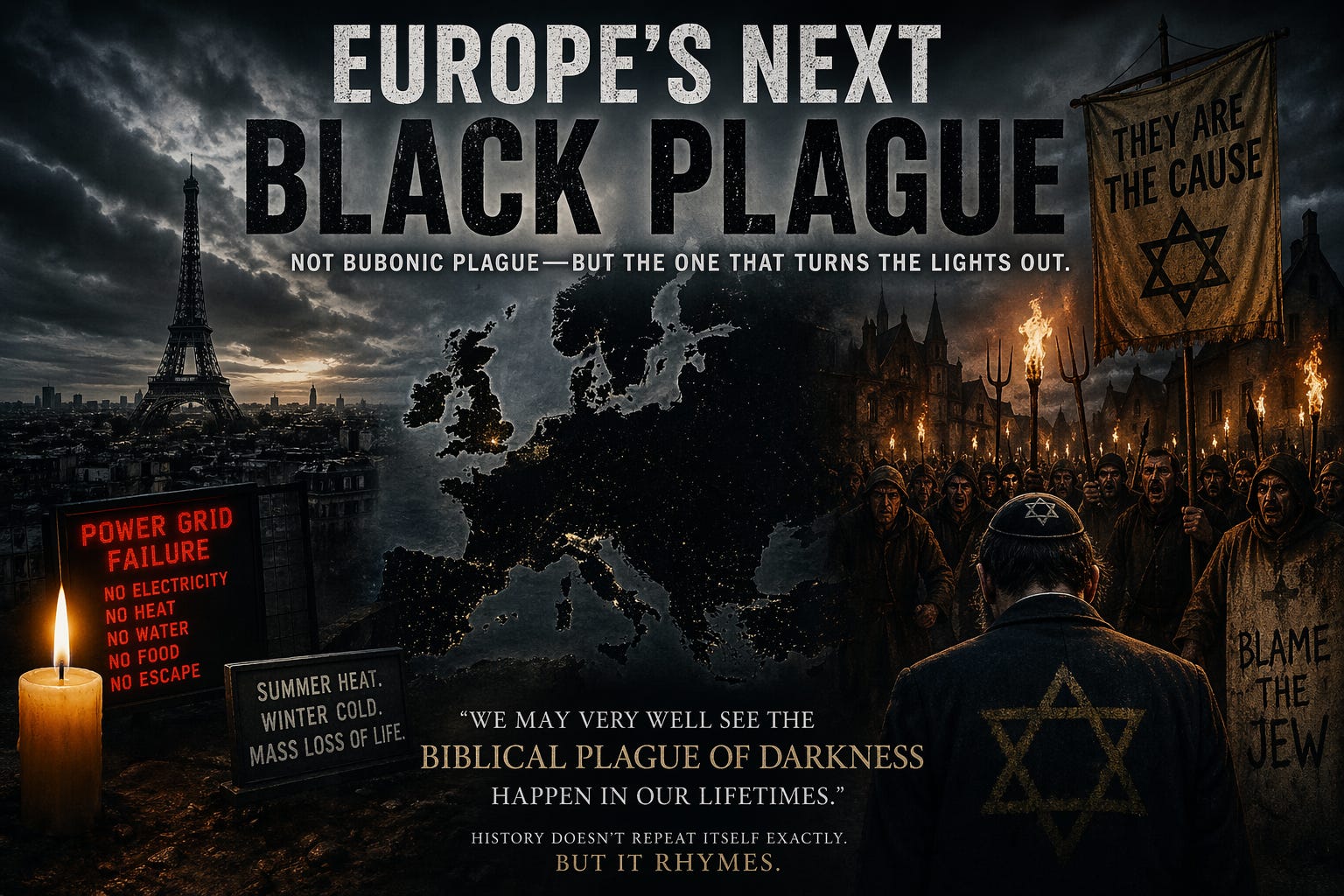
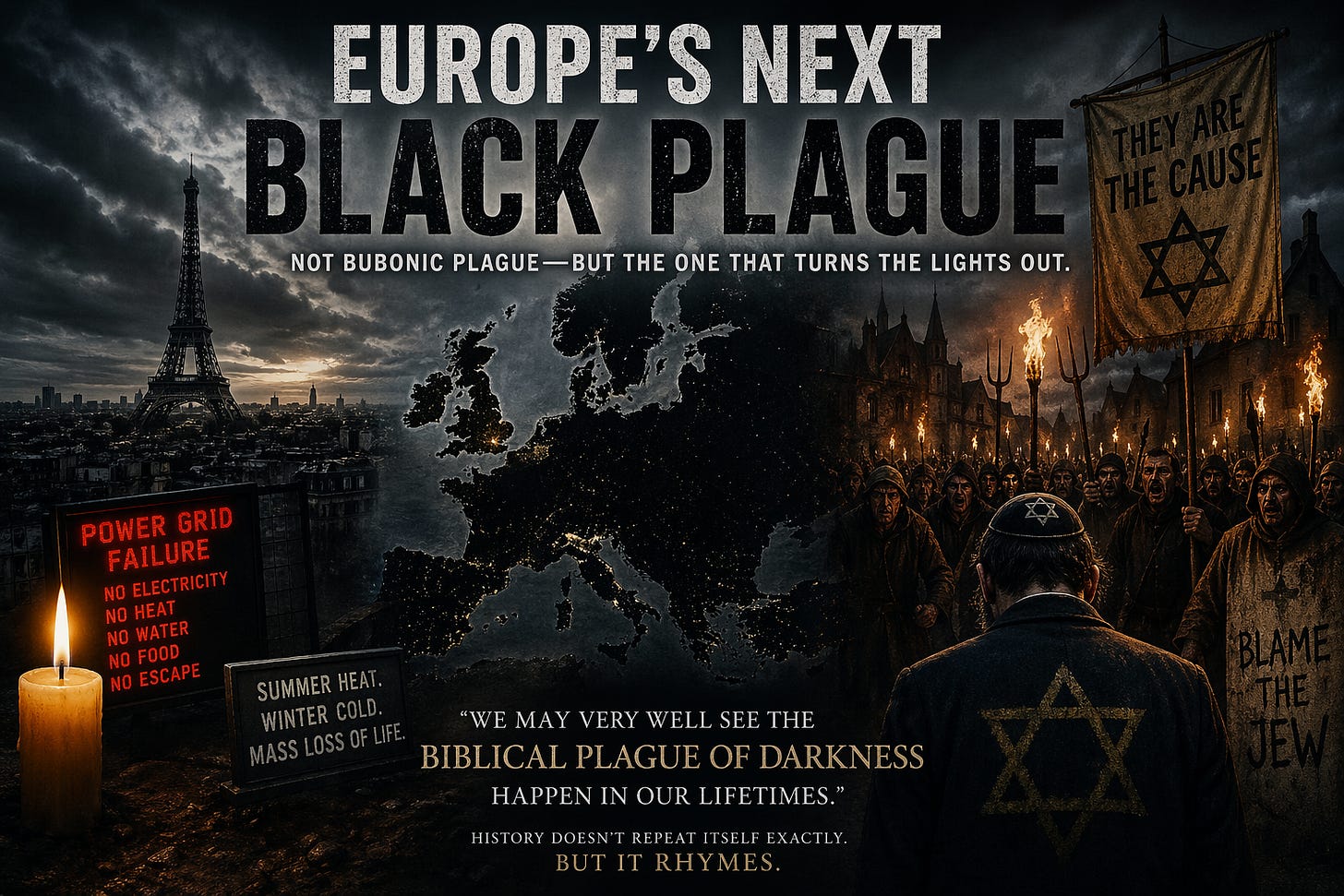
History rarely repeats itself cleanly, but it echoes with unsettling precision. The Black Death that swept through Europe in the 14th century didn’t just kill tens of millions; it exposed something darker beneath the surface of civilization. As bodies piled up and societies buckled under pressure, blame needed a target. The Jews—isolated, different, and already resented—became that target. Wells were poisoned, communities were burned, and entire populations were wiped out, not because of what they had done, but because of what frightened societies needed them to represent.
Fast forward to today, and the threat facing Europe may not come in the form of rats and fleas, but it may prove just as deadly. Strip away the modern infrastructure, the illusion of stability, the endless hum of electricity—and what remains? A continent utterly dependent on energy flows it does not fully control. The modern European system is not resilient; it is efficient. And efficiency collapses quickly under strain.
An energy crisis is not theoretical anymore. It is already unfolding in slow motion. Supply chains are fragile. Political tensions are rising. Energy is being weaponized. If oil and gas supplies are restricted further—whether through war, sanctions, or strategic chokeholds—the consequences will not be abstract economic downturns. They will be physical. Immediate. Lights go out. Heating systems fail. Air conditioning stops in the peak of summer heatwaves. Hospitals struggle to function. Food storage breaks down. Transportation halts. What begins as inconvenience rapidly turns into survival. And here is where the historical echo becomes deafening.
When societies face existential pressure, they don’t respond with calm rationality. They look for someone to blame. The more complex the crisis, the simpler the scapegoat. In medieval Europe, it was the Jew accused of poisoning wells. In modern Europe, the accusation may take on a different language—financial manipulation, political influence, foreign loyalties—but the mechanism is identical. Fear demands a face.
We are already watching the early stages of this shift. Anti-Israel sentiment morphing into broader hostility. Jewish communities requiring increased security. Political discourse becoming more aggressive, less restrained. It doesn’t take much imagination to see how quickly this escalates if entire populations are left in the dark—literally.
Picture a European winter where the grid fails for extended periods. Not hours. Days. Weeks. Homes unheated. Supply chains frozen. Governments scrambling, credibility collapsing. In those conditions, the public doesn’t analyze energy policy failures or geopolitical miscalculations. It turns outward. It turns against. And historically, that turning has a direction. This is not alarmism. It’s pattern recognition.
The Torah describes a plague of darkness so thick it could be felt—חושך אפלה—where people were immobilized, unable to move from their places. On the surface, that sounds supernatural. But strip it down, and it describes something eerily familiar: a society paralyzed, systems frozen, movement halted, people trapped in place. Darkness not just as absence of light, but as collapse of function.
Modern civilization is far more fragile than it appears. It runs on uninterrupted systems. Remove the current, and everything stops. The difference between order and chaos is thinner than people are comfortable admitting. And when that line is crossed, history doesn’t ask permission to repeat itself.
The uncomfortable truth is that Jews in Europe have lived this story before. Not in theory, not in prophecy alone, but in lived, documented, brutal reality. Periods of relative calm, even prosperity, followed by sudden, violent reversals when the surrounding society buckles under pressure. The illusion of permanence shattered in moments.
The question isn’t whether Europe will face increasing instability. It already is. The question is how deep it will go—and how quickly old instincts will resurface when modern systems fail.
There’s a tendency to dismiss these warnings as extreme, as if the lessons of history expired with the last century. But history doesn’t expire. It waits.
A continent that once descended into darkness—both physical and moral—does not need to reinvent the path. It already knows the way.
And if the lights begin to go out again, it won’t just be an energy crisis. It will be a test. Of societies. Of values. Of whether anything has truly changed beneath the surface.
Because the real plague was never just the disease. It was how people responded when the world around them stopped working.