
By Rabbi Josh Wander
There is something profoundly tragic about watching history unfold in real time while the people tasked with interpreting it seem determined not to notice.
In recent days the Chief Rabbinate has issued rulings on a variety of matters. They have debated whether El Al may conduct rescue flights on Shabbat. They have discussed whether weddings may be permitted during the early days of Sefirat HaOmer. These are legitimate halachic questions. No serious person would claim otherwise. Jewish law governs every aspect of life, and rabbis have always been called upon to answer practical questions.
But something feels deeply out of proportion.
The house is shaking, the walls are moving, the entire architecture of Jewish history is being rebuilt before our eyes—and the official conversation is still about rearranging the furniture.
For centuries this focus made perfect sense. Jewish life in exile revolved around survival. Communities scattered across Poland, Morocco, Yemen, Germany, and America relied on a shared legal framework rooted in the four sections of the Shulchan Aruch: Orach Chaim, Yoreh Deah, Even HaEzer, and Choshen Mishpat. Those volumes, together with the ocean of responsa literature stretching back through the Talmud and the rulings of generations of sages, provided a complete operating system for Jewish life in exile. And it worked.
The system guided communities through expulsions, inquisitions, pogroms, and migrations. It regulated kashrut, marriage, commerce, prayer, mourning, and daily conduct. For Jews living as minorities under foreign rule, these tools were sufficient. But exile has a certain structure to it. Halacha developed within that structure. What happens when the structure disappears?
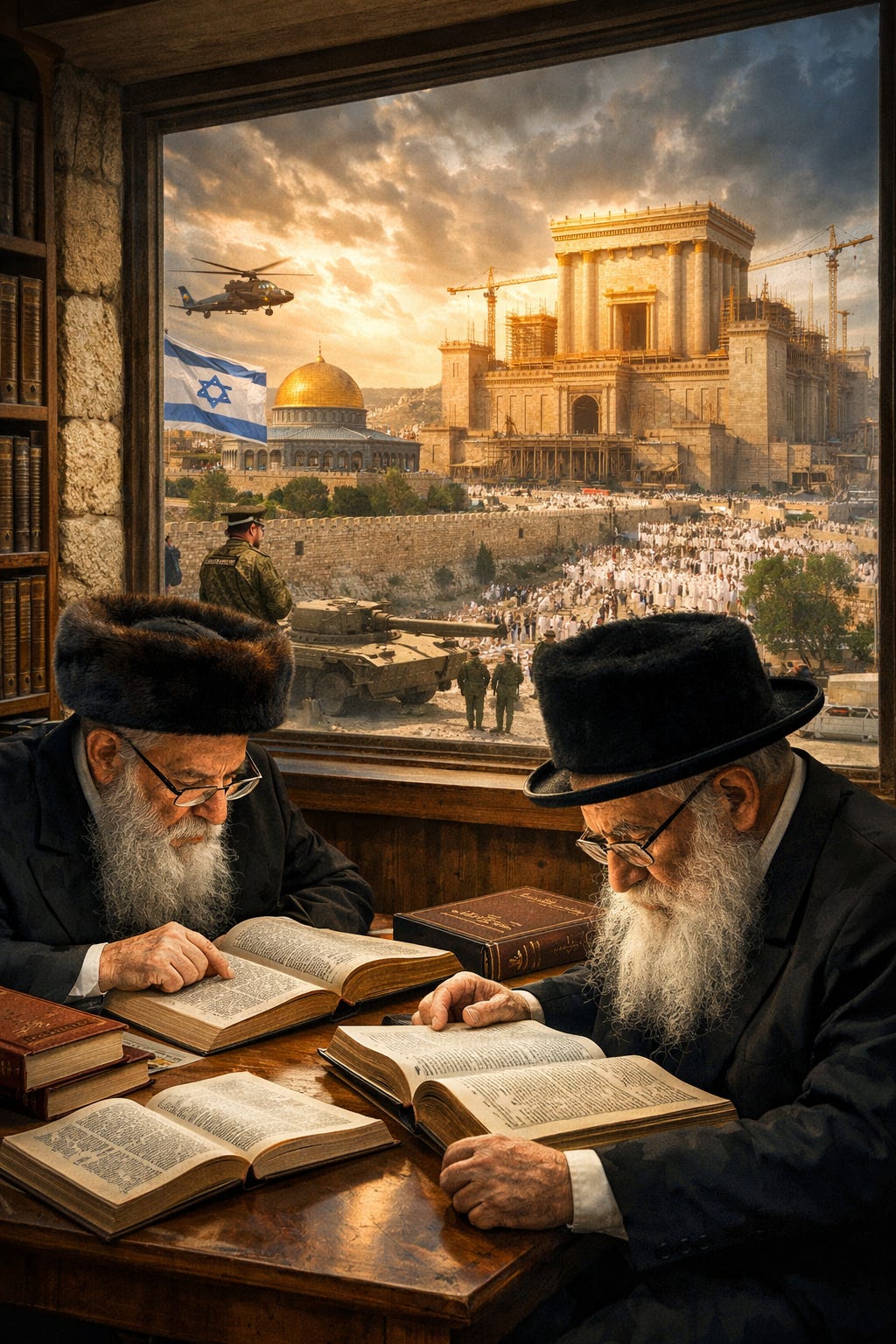
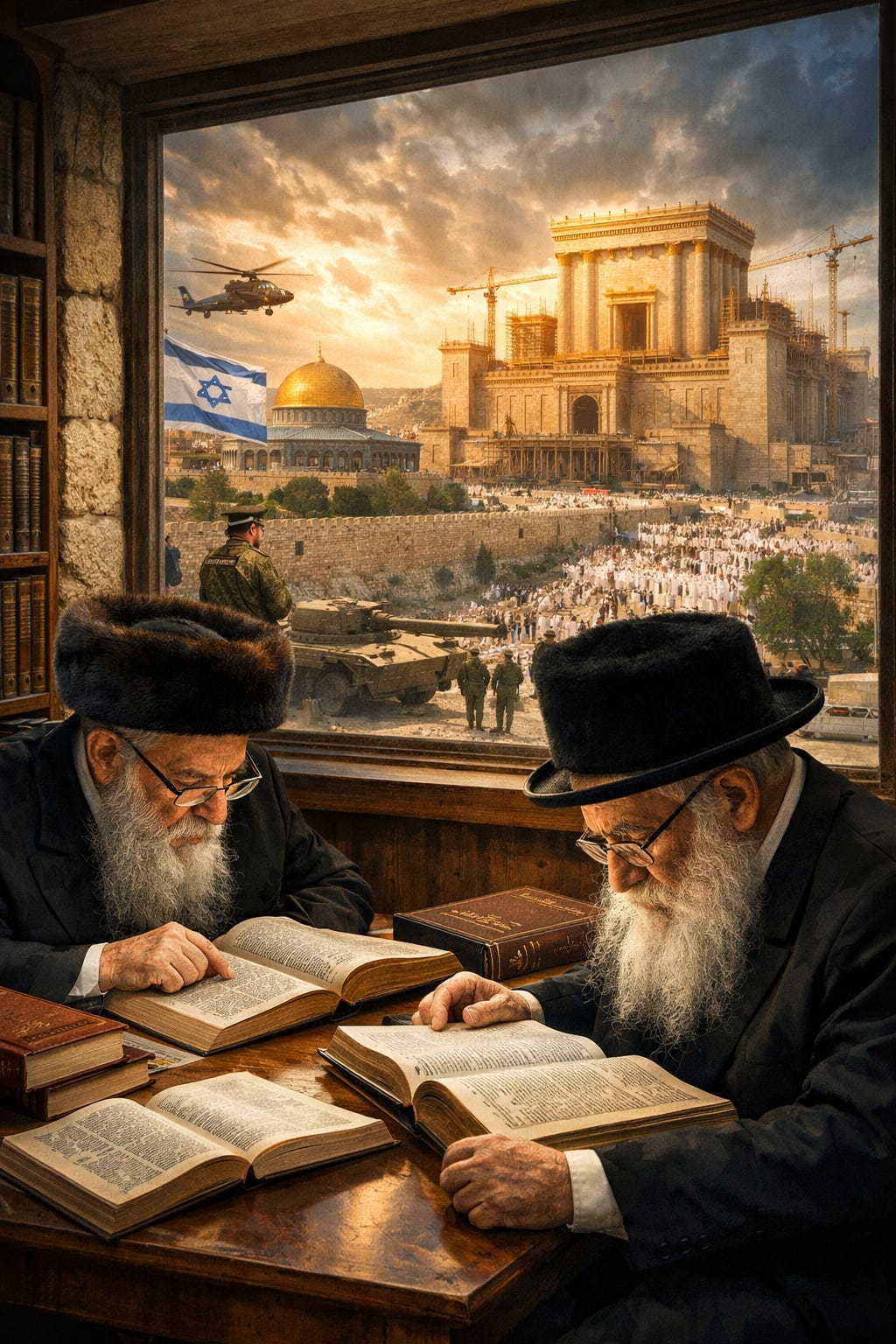
Today, for the first time in two thousand years, the Jewish people possess something our ancestors could barely imagine: sovereignty in the Land of Israel. There is a functioning Jewish state. There is a Jewish army. Jewish pilots fly Jewish fighter jets over Jewish skies defending Jewish cities. Hebrew is once again the language of daily life. Millions of Jews have returned home. And for the first time in two millennia, Jews once again have access to the very place where the Beit HaMikdash stood — the Temple Mount itself.
None of this fits neatly into the old categories. There is no fifth section of the Shulchan Aruch titled Hilchot Medinat Yisrael—the laws of a restored Jewish commonwealth. There is no codified chapter explaining how a sovereign Jewish army should operate. There is no handbook describing the religious implications of a nation returning to its ancestral land after millennia of exile. Yet this is precisely the world we now inhabit.
Instead of confronting these unprecedented realities, much of the rabbinic establishment—both in the diaspora and even within Israel itself—continues to operate as if we are still living in the shtetl. The conversation remains trapped in exile mode.
Questions that once defined Jewish life in the ghetto are still treated as the central issues of the age. Meanwhile, the monumental transformation taking place around us barely enters the halachic discourse. The return of the Jewish people to sovereignty in their homeland is not a marginal development. It is the single most significant shift in Jewish history since the destruction of the Second Temple. And yet one struggles to find rabbinic leadership willing to say it plainly.
Where are the rulings about the obligations of Jews in a redemptive era? Where are the declarations about national responsibility now that Jews possess power, territory, and an army? Where are the halachic frameworks guiding a generation that is no longer merely surviving exile but actively rebuilding Jewish civilization?
And just as important—what we do not need right now is another prayer. We do not need another declaration that Jews around the world should add a few more chapters of Tehillim after Shacharit. We do not need another circular instructing synagogues to insert a special supplication into the siddur.
Prayer has always been part of Jewish life. No one is questioning that. But prayer without direction can become a substitute for leadership. What the Jewish people desperately need from their rabbinic leadership today is not another Psalm to recite, but an actionable vision. A plan. Guidance. Direction.
I can already hear the response that will come from some corners: This is not our role. Rabbis do not run the state. Legislators make laws. Governments decide policy. That argument misses the point entirely.
It has always been the role of rabbinic leadership to guide the Jewish people through new historical realities. The sages of every generation did not merely answer kitchen questions about kashrut or technicalities about ritual. They interpreted events. They gave direction. They helped the nation understand what G-d was asking of them in that moment.
When Ezra returned from Babylon, he did not say that political questions belonged only to the Persian administration. When the Maccabees fought for Jewish sovereignty, they did not wait for a secular legislature to determine the future of the nation. Rabbinic leadership historically meant far more than adjudicating private religious practice. It meant guiding the destiny of the people.
Our generation has been presented with a once-in-two-thousand-years opportunity. The Jewish people have returned home. Sovereignty has been restored. Jewish power has re-entered history.
That reality demands something more from our spiritual leadership than minor adjustments to the prayer book. It demands vision.
If the rabbis of Israel do not begin articulating what Jewish life should look like in the early stages of redemption—what national responsibilities accompany sovereignty, what spiritual steps must be taken to advance toward Geula—then an entire generation may pass through this historic moment without anyone providing the guidance it desperately needs.
History has opened a door that remained sealed for two millennia. The question now is whether our leaders will walk through it—or continue discussing exile-era questions while the world outside has already changed.