
By Rabbi Josh Wander
What makes a political party religious? Black coats, beards, peyot, and declarations of allegiance to Torah? Or fidelity to Torah principles, even when they conflict with political interests? For decades, Agudat Yisrael, Degel HaTorah, and Shas have presented themselves as representatives of religious Judaism. Yet religious appearance and political authority are not synonymous with Torah. When institutional interests appear to take precedence over Jewish lives and national responsibility, difficult questions must be asked.
Consider the Oslo Accords. In September 1993, five Shas MKs abstained as the agreement passed the Knesset 61–50. The following years brought devastating terrorism. Although responsibility for Oslo cannot be assigned to Shas alone, its parliamentary conduct deserves scrutiny, as do subsequent political arrangements in which institutional funding appears to compete with national-security considerations. Those claiming Torah authority should explain how their decisions serve the wider Jewish people.
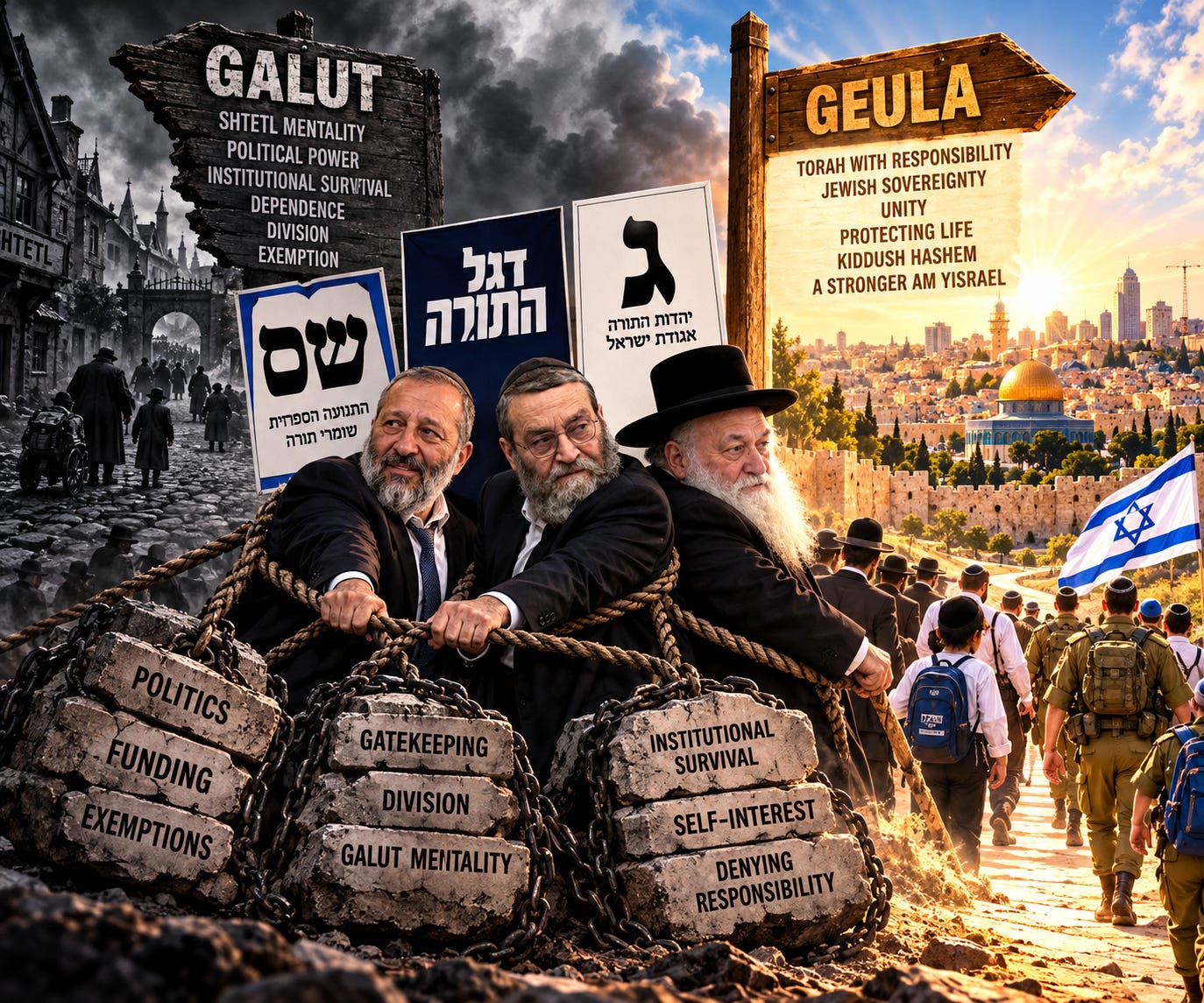
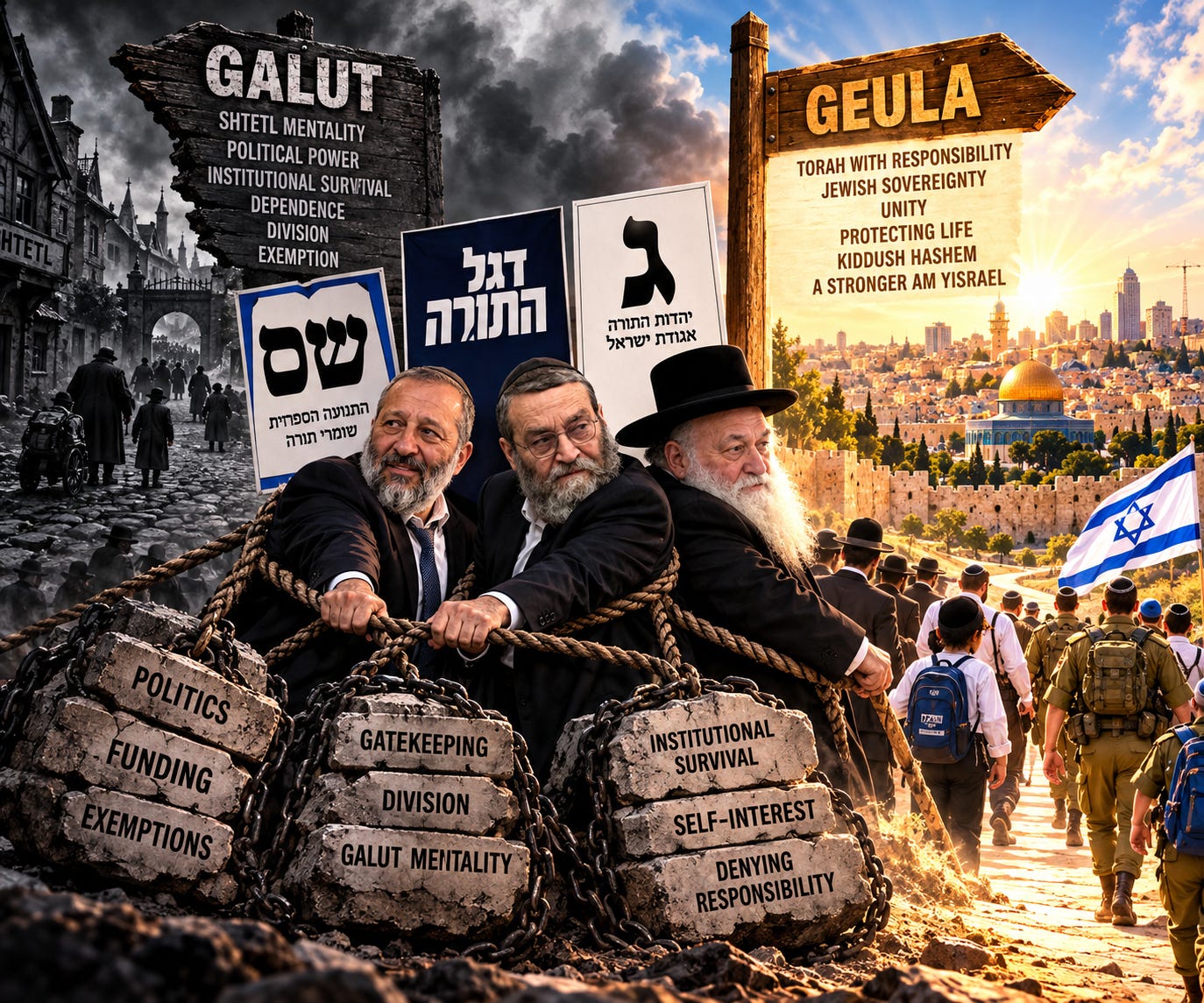
For nearly two thousand years, Jews prayed for the return to Zion, Jewish sovereignty, and the rebuilding of Jerusalem. Today, by the grace of Hashem, we have returned to Eretz Yisrael and established the means to defend ourselves. Yet some political attitudes remain rooted in Galus. The Third Jewish Commonwealth cannot be treated as merely another European shtetl. These parties invoke the ideal of להחזיר תורה ליושנה — restoring Torah to its former glory. But which past are we trying to restore? The Torah-centered national life of Am Yisrael in Eretz Yisrael, or the defensive institutions of a people living under foreign rule? Those institutions were essential for survival, but they were never meant to become permanent substitutes for Jewish sovereignty. If restoring Torah means perpetuating the mentality of exile, are we bringing the Jewish people closer to Geula—or back toward Galut?
This produces a striking contradiction. In one limited respect, I find greater ideological consistency among those Neturei Karta adherents who reject both Israeli elections and state funding, despite my profound rejection of their anti-Zionism and the conduct of those who associate with Israel’s enemies. But how can movements question the religious significance of Jewish sovereignty while participating in its government, demanding its resources, and influencing its decisions? Can the State be religiously insignificant when discussing responsibility yet politically indispensable when negotiating benefits?
History reminds us that Jewish destiny cannot be divided along ideological lines. During the 1929 Hebron massacre, Arab attackers murdered Jews, including Slabodka Yeshiva students. The Nazis murdered observant and secular Jews alike. On October 7, 2023, Hamas terrorists made no distinction between Jews who kept Shabbat and those who did not. Our enemies have repeatedly demonstrated that ideological differences offer no protection against those determined to murder Jews.
Tragically, national catastrophe often accomplishes what years of discussion cannot. Suddenly, political labels and communal barriers begin to disappear, and Jews recognize their shared destiny. Yet when the immediate danger passes, old divisions return. Why must Jewish blood be spilled before we remember that we are one people? The Torah’s demand for Achdut and Areivut applies during peaceful times no less than during national emergencies.
What happened to וחי בהם — V’Chai Bahem, the commandment that we live by the mitzvot, not die by them (Vayikra 18:5; Yoma 85b)? What happened to Pikuach Nefesh, which overrides nearly every other commandment? Consider the slogan heard at some anti-conscription demonstrations: ״נמות ולא נתגייס״ — “We will die rather than enlist.” While protesters may intend it as an expression of determination rather than a literal halachic ruling, its wording raises serious questions. Halacha specifies exceptional circumstances requiring martyrdom; military conscription is not inherently one of them. The Rambam teaches that Torah’s laws are intended to bring life and compassion, not destruction (Hilchot Shabbat 2:3). How should such a slogan be reconciled with the Torah’s emphasis on preserving life?
There is an inconvenient historical precedent. During Israel’s 1948 War of Independence, Chareidi yeshiva students participated in national defense through organized units and arrangements approved by rabbinic authorities. Gdud Tuvia demonstrated that Torah study and military participation were not necessarily mutually exclusive. Even the young Rav Chaim Kanievsky zt”l reportedly undertook defensive duties. Contrast that with the March 2024 declaration by Rav Yitzhak Yosef, then Sephardic Chief Rabbi and Rishon LeZion, warning that Chareidim would leave Israel rather than submit to compulsory military service. A publicly funded Chief Rabbi, holding an official position within the State, raised the prospect of leaving that State over its conscription policy. Legitimate concerns about religious observance in the military deserve consideration, but so do the obligations accompanying Jewish sovereignty. What explains the difference between these two generations?
Equally troubling is the political use of Daas Torah. Respect for Chachamim is fundamental, but the Mishnah in Horayot recognizes that religious authorities can err. In some political environments, questioning a party position is treated as questioning Torah itself. Yet Torah scholarship and political judgment are not interchangeable, and loyalty to an organization cannot substitute for independent moral responsibility.
Information gatekeeping compounds the problem. In Chareidi communities where internet access is restricted or discouraged, newspapers, community publications, and trusted intermediaries wield considerable influence. Who determines what information reaches ordinary Jews, what reaches the Gedolim, and which rabbinic statements are released publicly? If advisers selectively present facts or political intermediaries filter religious guidance, both leaders and followers risk being misled. Daas Torah must never become a substitute for Torah itself, nor should access to Torah authorities become a means of shielding political decisions from scrutiny. The Torah commands us, מדבר שקר תרחק — to distance ourselves from falsehood (Shemot 23:7).
The contradictions become particularly troubling when demonstrations ostensibly defending Torah involve property destruction, blocked roads, or interference with emergency services. Peaceful protest is legitimate, but religious convictions do not exempt anyone from the prohibitions against damaging property or endangering others. Where is Pikuach Nefesh when an ambulance cannot reach someone requiring urgent treatment?
Beyond physical responsibility lies כל ישראל ערבים זה בזה — Kol Yisrael Areivim Zeh Bazeh. Every Jew bears responsibility for every other Jew, spiritually as well as physically. When less-observant Jews perceive religious politicians as hypocritical, self-interested, or indifferent to national suffering, they may conclude, “If this is Torah Judaism, I want nothing to do with it!” They may not be rejecting Torah, but rather the institutional behavior they associate with it. Instead of being mekarev, such conduct risks pushing Jews further away.
The Gemara in Yoma 86a teaches that the conduct of those associated with Torah shapes whether others honor Hashem’s name. What have we accomplished if we preserve our yeshivot while alienating the very Jews those institutions should inspire? Religious leadership must consider not only budgets and political influence, but whether its public example creates Kiddush Hashem or Chilul Hashem.
A black coat is not a certificate of righteousness, nor does quoting Gemara absolve anyone of responsibility for political decisions. The Chareidi world possesses extraordinary strengths: devotion to learning, family, charity, and tradition. Imagine those strengths contributing more fully to the responsibilities of the entire Jewish people and the unfolding Geula. Agudat Yisrael, Degel HaTorah, and Shas are political organizations, not Judaism itself. Their policies, like those of every political party, deserve examination against the principles they profess.
There is a bitter irony in writing this article: I am largely preaching to the choir. Many of those I most hope to reach may never encounter these words because they do not use the internet or the platforms on which this article circulates. My hope is that readers will print it and share it with Chareidi friends, neighbors, and relatives—not to provoke hostility, but to encourage an honest conversation about Torah, truth, and our collective responsibilities.
Perhaps one of the greatest dangers of Chilul Hashem is that those claiming to represent Torah may inadvertently give other Jews reasons to turn away from it. At this extraordinary moment in the Geula, authentic Torah leadership must be measured not merely by its ability to preserve institutions, but by its commitment to protecting Jewish lives, accepting responsibility for Klal Yisrael, and inspiring Jews to draw closer to Hashem.