
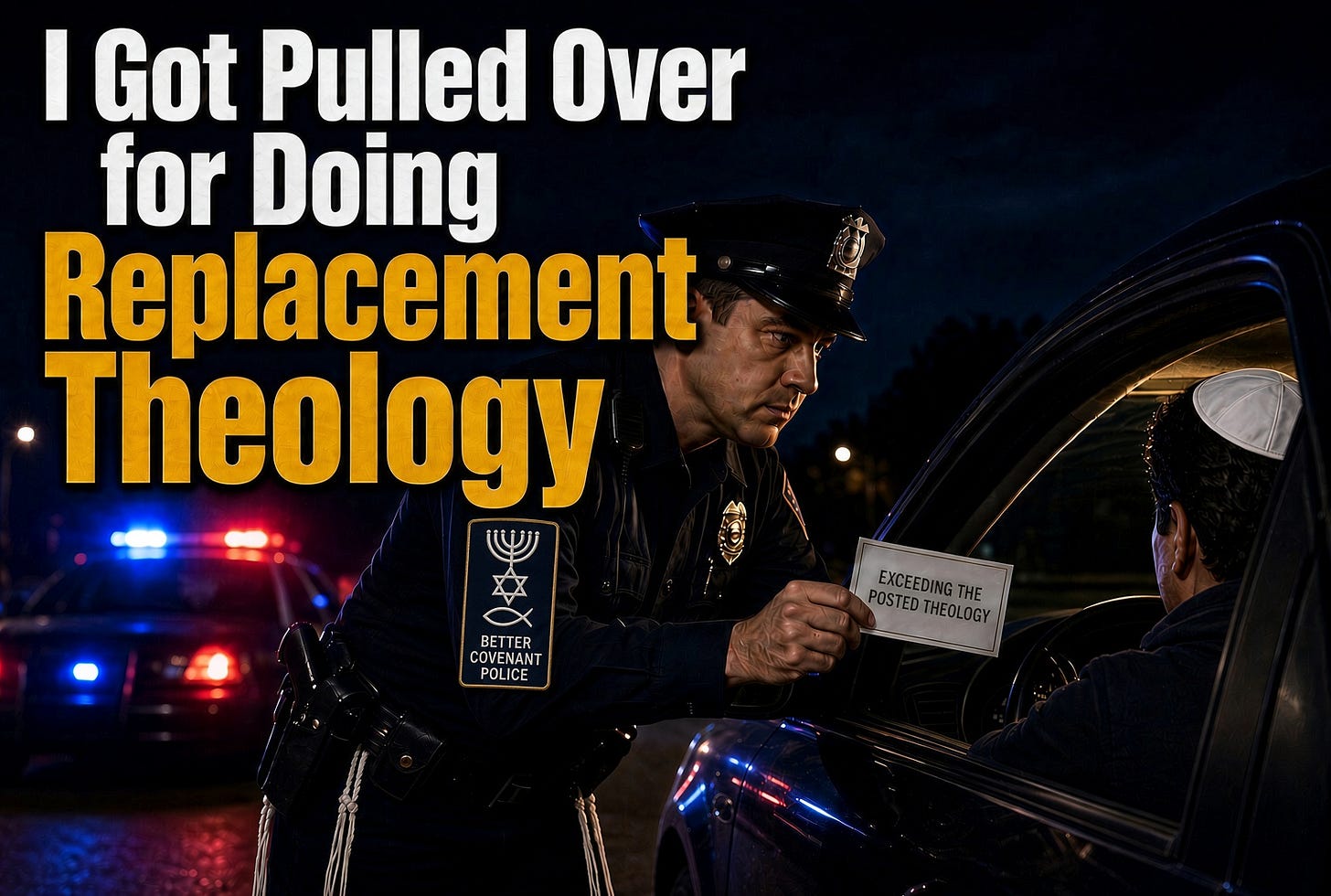
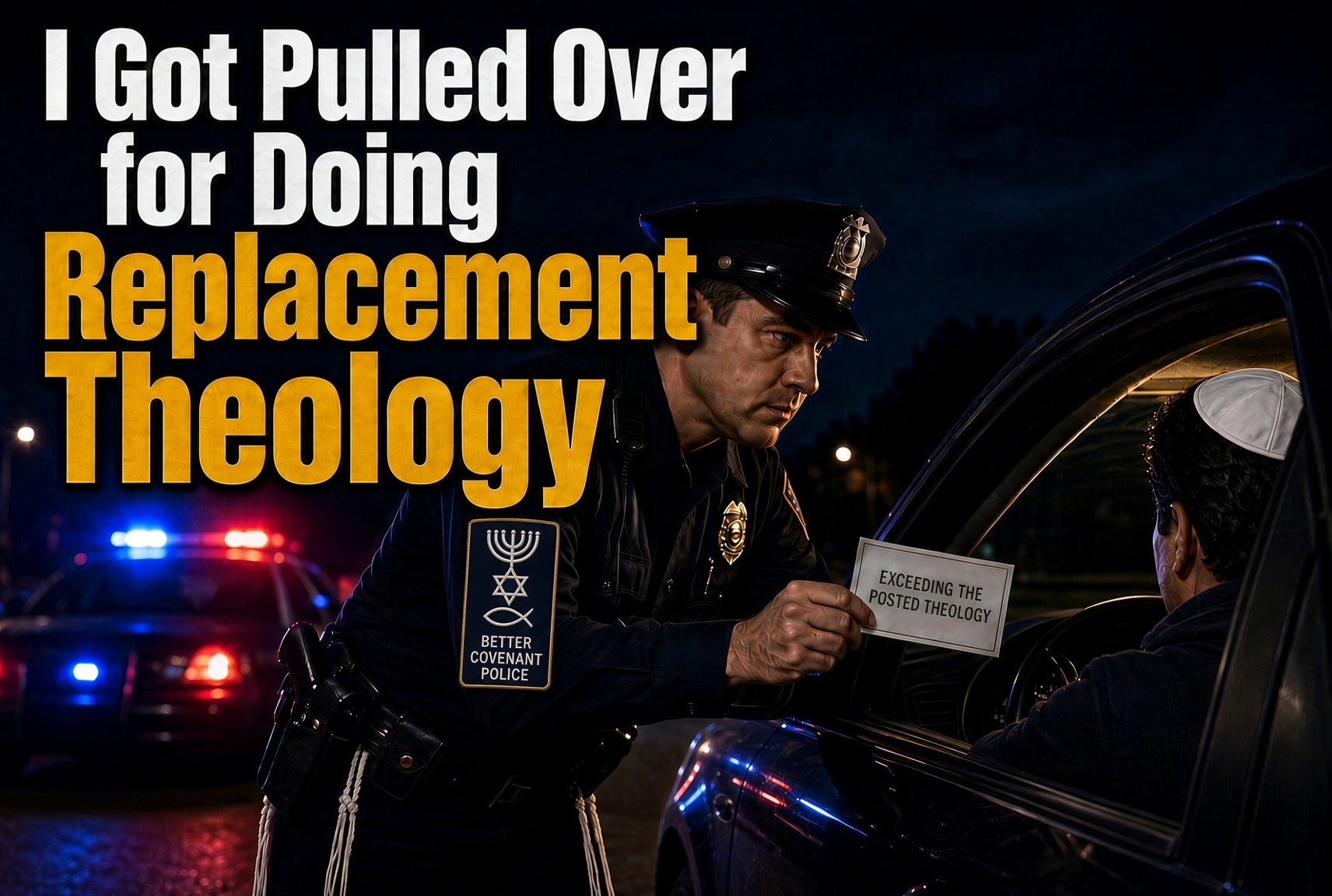
The officer did not raise his voice. He simply held the ticket where the driver could see it through the open window and waited. The violation listed was not speed. It was “exceeding the posted theology.” White tzitzit hung from the officer’s belt loops. He was explaining to the Jewish man seated inside the car that the way his people have kept the calendar, the festivals, and the court’s rulings for centuries was the later dogma of a religion called Judaism, and that the Jewish man was the one doing Replacement Theology.
The irony is immediate. The man outside the window is not bound by the full covenant at Sinai. He has taken selected practices the Written Torah assigns to Israel, detached them from the people and the court the Torah authorized, and is now issuing a citation to the one who remains inside that covenant. Deuteronomy 17:8–11 is the posted limit he claims to enforce, yet he treats the historical court that occupied that office as optional once he has decided the matter is clear to him.
I want hear your opinions and questions…
When a matter of judgment arises on which the local community does not agree—when sincere readers reach differing conclusions about what the text requires—the case is brought to the priests, the Levites, and the judge who will be in those days. The Written Torah does not leave the question open because one party believes the matter is already clear to him. It provides a court to hear the dispute and issue a ruling that then binds the people. You shall act according to the ruling they issue; you shall not turn aside from the word they tell you, to the right or to the left. The confidence of a later reader that he already knows what the text means does not reopen a case the authorized court has already decided.
Two households both affirm the written command to observe the festivals “in their seasons.” One concludes the month must be declared by sighting and that a particular year requires an added month. The other prefers a fixed calculation. Both are sincere. Both can point to biblical anchors. The Written Torah does not instruct them to remain in permanent disagreement. It directs the unresolved matter to the central court. Once that court issues its ruling, the determination becomes the standard. Exodus 18 and Numbers 11 already show hard cases rising; Deuteronomy 17 makes the highest court’s word binding. Private certainty does not dissolve the ruling.
The day from sunset to sunset, the recognizable sukkah, the repeatable tzitzit—these are the minimal received practices without which the written commands cannot be performed in common. They are not the inventions of a post-Temple religion. The historical Sanhedrin occupied the office Deuteronomy 17 describes. When the chain of ordination broke, its full national powers lapsed. The rulings it had already delivered did not. They continue to obligate the people to whom they were given, in the same way a posted speed limit continues to obligate when the patrol car is out of sight. To dismiss those rulings as “the dogma of the religion of Judaism” is to treat the authorizing court as though its temporary absence has repealed the statute.
The officer’s ticket assumes the opposite. By retaining Israel’s calendar boundaries and festival procedures while denying the force of the court that settled them, and by then correcting the Jewish man who still lives under that court, the citation itself performs the replacement. The content is claimed. The people and the authorized structure are set aside as a later religion. A different community supplies the missing authority and polices the original bearers of the covenant for failing to adopt the new arrangement. That is how Replacement Theology appears from the driver’s seat: not as a gentle return to Scripture, but as an external party issuing corrections to those the Torah actually bound, on the ground that the court’s prior decisions no longer count.
The binary remains the Torah’s own. A non-Jew may cease treating Israel-specific commandments as personally binding and remain within the universal obligations that apply to him, or he may complete a valid conversion and enter the people to whom the covenant and its court belong. There is no stable third path in which the practices are kept, the court is denied as mere religious dogma, and the non-Jew then instructs the Jew that the Jew is the one exceeding the limit. The vacuum created by that denial is what allows the unsanctioned ticket to be written in the first place.
Restoration of the court under its proper conditions—majority of the Jewish people in the Land, renewal of ordination, a court of seventy-one operating inside the Deuteronomy 17 mandate—does not place outsiders under its jurisdiction. It simply re-occupies the office the Written Torah created, so that private redefinition and external assertion both lose their opening. Until then, the rulings already issued continue to bind those to whom they were given. The posted limit stands for them. The choice visible through the window is whether the one holding the ticket will acknowledge that the authority which posted it still governs the people inside the covenant, or whether he will continue to treat his own private reading as the new statute and the original bearers as the violators.
The picture is blunt. Replacement Theology is not disproved by denying the label. It is revealed the moment someone outside the covenant, tells the Jewish man that the Jewish man is the one doing it wrong.