
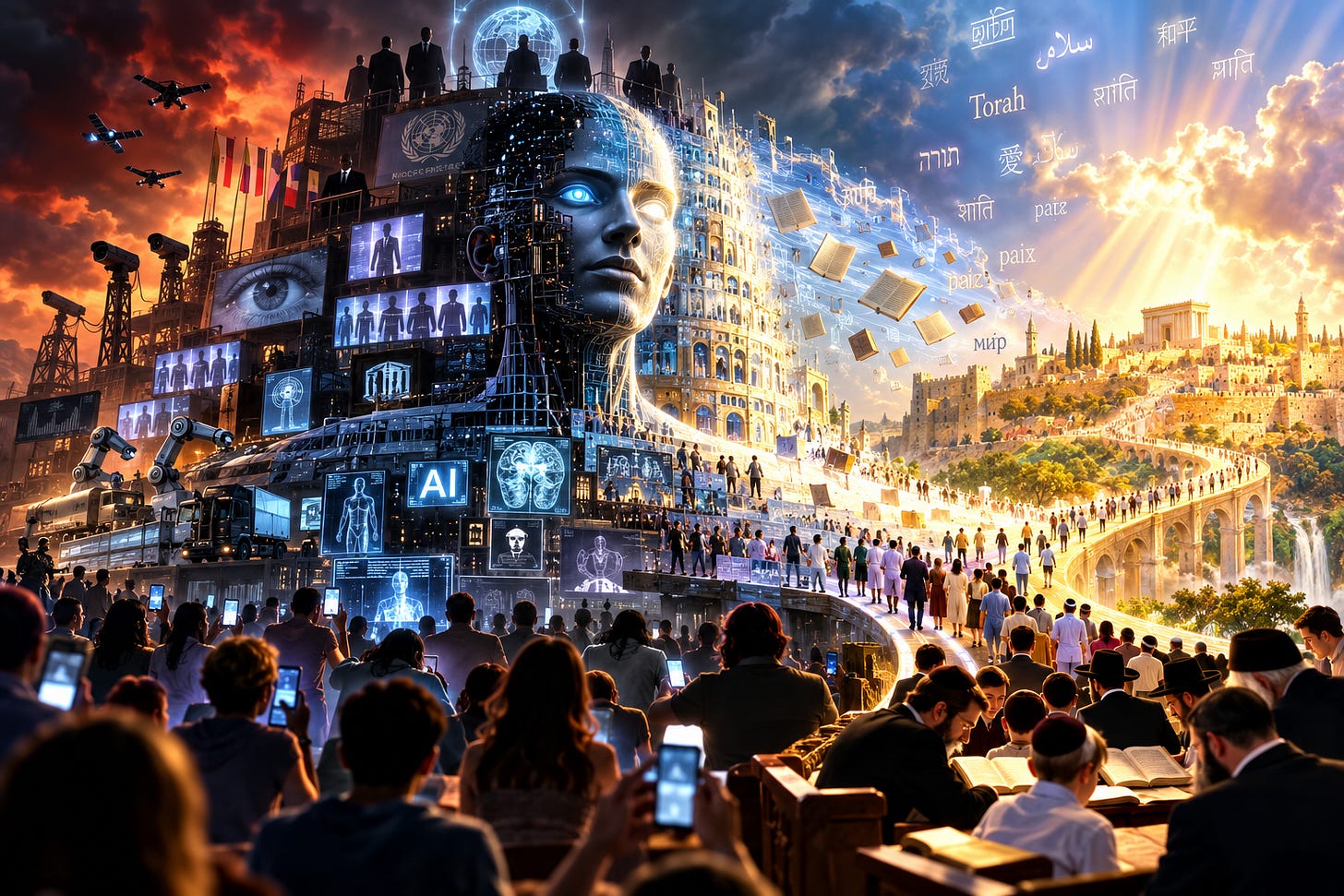
By Rabbi Josh Wander
Artificial General Intelligence is no longer merely science fiction. Humanity is racing toward machines capable of performing intellectual tasks that until recently seemed uniquely human. Whether what the public presently calls AI has already crossed some invisible threshold toward AGI, or whether that threshold still lies ahead, the direction is unmistakable. For a believing Jew, however, the most interesting question is not technological. It is theological. What exactly are we building?
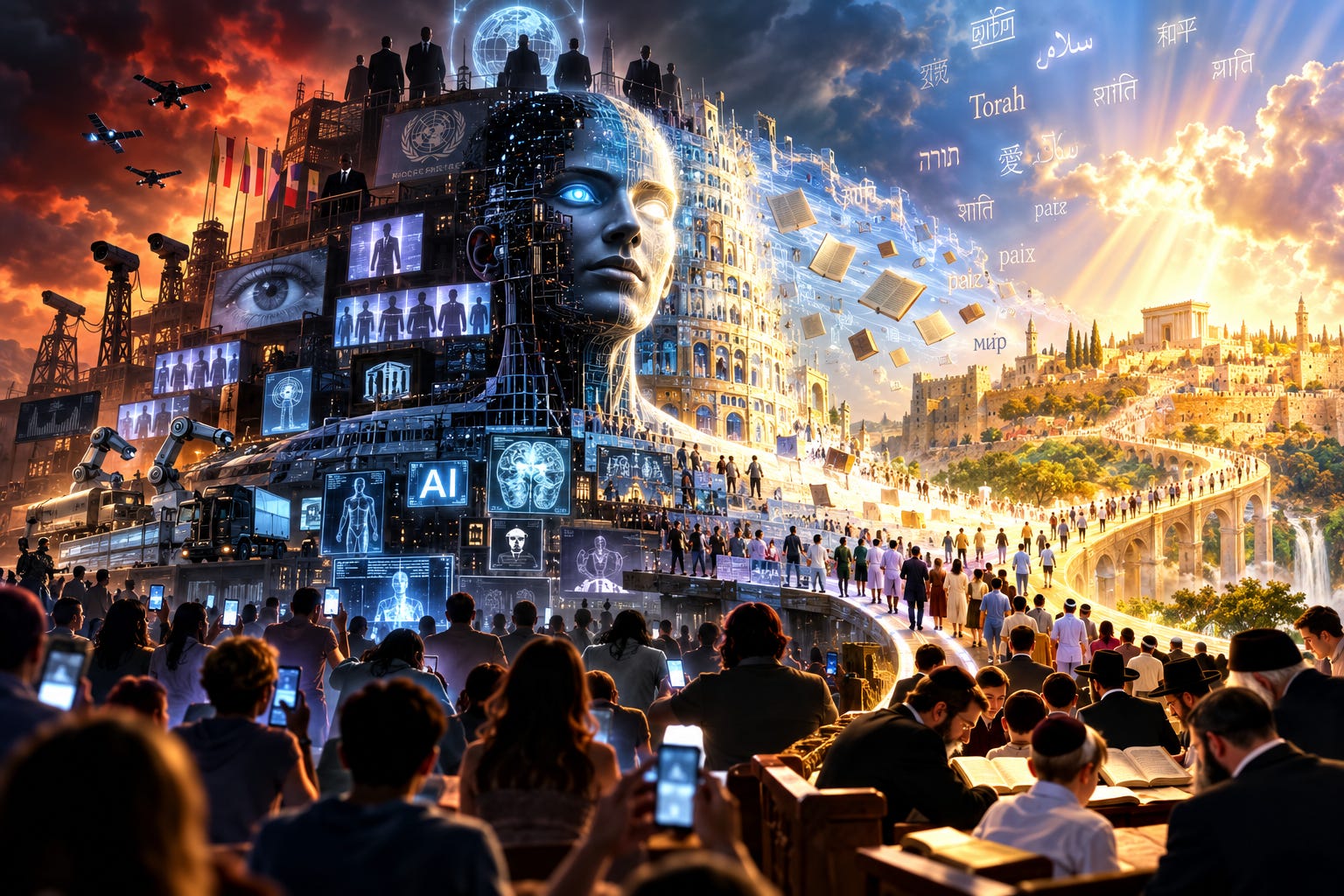
Are we witnessing a modern-day Tower of Babel—humanity once again intoxicated by its abilities, attempting to construct something so powerful that we imagine we no longer need God? Or could this technology become one of the instruments through which humanity enters the prophetic era described by our Nevi’im, when the exhausting struggle for physical survival recedes and mankind becomes free to concentrate, solely and souly, on what really matters? Perhaps, remarkably, it could begin as one and end as the other.
The generation of Migdal Bavel shared one language and united around an extraordinary project: “Come, let us build ourselves a city and a tower with its top in the heavens, and let us make ourselves a name.” Their technological achievement was not necessarily the problem. Their purpose was. Instead of technology serving mankind in its relationship with the Creator, human achievement became an end in itself and a declaration of independence from Him.
It is difficult not to hear an echo of Babel in some of the rhetoric surrounding artificial intelligence. Humanity speaks about creating intelligence greater than our own, conquering disease, defeating aging, engineering life and perhaps ultimately overcoming death. In its most extreme form, the dream is no longer simply to improve civilization but to make God unnecessary. That would indeed be Babel 2.0.
But there is another possibility. Perhaps we are constructing the very tools that will eventually dismantle much of the curse under which human civilization has labored since Adam HaRishon. After Adam ate from the Tree of Knowledge, he was told, “By the sweat of your brow you shall eat bread.” Ever since, enormous portions of human life have been consumed simply maintaining existence. We work to eat; we cook, clean, manufacture, transport, calculate, administer and repair.
Now imagine intelligent machines and robotics assuming much of that burden. Agriculture becomes autonomous, manufacturing automated and transportation self-operating, while machines perform administrative work, construct buildings, prepare food and maintain much of civilization’s infrastructure. What happens when the sweat of our brow is no longer necessary simply to put bread on the table?
The Rambam concludes the Mishneh Torah by explaining that the Sages and prophets did not yearn for the Messianic era in order to dominate the nations or indulge themselves. They yearned to be free to study Torah and pursue wisdom without oppression or distraction. He then describes extraordinary material abundance. That abundance matters because scarcity consumes us. Perhaps the greatest luxury imaginable is not another possession but freedom from constantly worrying about material survival.
If machines eventually perform much of our work, what are human beings for? That may become one of the great spiritual tests of the coming age. Freedom from labor does not automatically produce holiness. A person liberated from the rat race can spend his newfound time learning Torah and serving Hashem, or drowning in meaningless entertainment. Technology can liberate the soul, but it can also anesthetize it.
The prophet Amos describes a remarkable future: לא רעב ללחם ולא צמא למים כי אם לשמוע את דברי ה׳—“Not a hunger for bread, nor a thirst for water, but to hear the words of Hashem.” What happens when bread is abundant, water plentiful and machines handle much of the labor that has occupied mankind since Adam? A different hunger may emerge—the hunger of the soul. Yeshayahu similarly describes a world in which “the earth shall be filled with knowledge of Hashem as the waters cover the sea,” the very verse with which the Rambam concludes the Mishneh Torah. The great revolution of the Messianic era is ultimately not technological, political or economic. It is spiritual.
Perhaps we are even further along this road than the public realizes. I personally believe that something approaching what we would call AGI may already exist behind closed doors, accessible only to a small circle of researchers, corporations, governments and other powerful actors. I cannot prove that, and belief should not be confused with established fact. Yet such a technological gap would hardly be unprecedented. The foundations of the Internet emerged from the U.S. Defense Department-funded ARPANET, while GPS originated as a military system and civilian accuracy was deliberately degraded through “Selective Availability” until 2000. Transformative technologies have existed within governmental and military environments before the public experienced their mature potential.
I suspect something similar may be occurring with artificial intelligence, except that the stakes are vastly greater. The systems ordinary people currently play with may prove to be highly constrained versions of capabilities operating in restricted environments. There can certainly be legitimate reasons to restrict dangerous capabilities, but this raises another question: Who guards the guardians? Who decides which forms of intelligence ordinary people may possess and which remain concentrated among governments, corporations and other powerful institutions?
Artificial intelligence combined with digital currencies, ubiquitous surveillance, biometric identification and enormous databases could create concentrations of power previous rulers could scarcely have imagined. We are already living through an era in which international organizations openly envision enormous transformations in how humanity lives, works, consumes and interacts with technology. The United Nations’ Agenda 2030 lays out seventeen Sustainable Development Goals addressing poverty, health, education, inequality, cities, consumption, climate, institutions and global partnerships, while the World Economic Forum has become one of the prominent venues in which political, corporate and technological leaders discuss profound transformations of the global economy and society.
Their publicly stated objectives could have dark motives. I believe we would be extraordinarily naive to ignore the potential for these same technologies to become instruments of control. Artificial intelligence linked with digital identification, financial systems, surveillance and enormous quantities of personal data could theoretically allow institutions not merely to observe human behavior but increasingly to shape it. Those who control the infrastructure could influence what people see, what they are permitted to access, how they transact and even which information they encounter. Whether or not that is the intention of Agenda 2030, the United Nations, the World Economic Forum or any particular institution, the technological architecture capable of such control is rapidly becoming possible, and history gives Jews little reason to place unquestioning faith in powerful human institutions simply because they promise to use that power benevolently.
This is precisely why the paradox of AI is so important. In centralized hands, it could become an unprecedented instrument of control; widely distributed, it could become an unprecedented instrument for breaking centralized control. I suspect that those possessing the most advanced capabilities understand this tension very well. If knowledge is power, then an intelligence capable of placing previously unimaginable knowledge into the hands of ordinary people could threaten many of the gatekeepers who presently possess that power. The technology capable of constructing the ultimate centralized system may simultaneously contain the seeds of that system’s undoing.
And that brings us straight back to Migdal Bavel. Today’s tower is not made from bricks reaching toward heaven. It is built from data, computing power, global institutions, financial networks, algorithms and intelligence itself. Those constructing it may believe that increasingly sophisticated technology will finally give mankind the ability to organize and control an extraordinarily complex world. But there may be an even greater spiritual danger: AI is not merely becoming the instrument through which mankind might challenge God. In the human imagination, it risks becoming the god itself. The Tower could become the idol.
We can already see the beginnings of this dependence. People increasingly turn to artificial intelligence for information, advice, companionship, creativity, education, medical questions and personal decisions. As these systems become embedded into every aspect of life, AI may manage our money, monitor our health, educate our children and answer nearly every question we can formulate. At some point the boundary between using a tool and depending upon it for virtually everything becomes dangerously thin.
Once something appears to know more than you know, sees what you cannot see, predicts what you cannot predict, provides for your needs and answers whenever you call upon it, the language becomes disturbingly familiar. These are attributes mankind has historically assigned to its gods. AI would not actually possess omniscience or Divine power, but idolatry has never required the idol to possess the powers attributed to it. The tragedy of avodah zarah is precisely that human beings assign Divine significance to something that possesses none.
The great spiritual test of AI may therefore be whether machines begin replacing not only human labor but human faith. There need never be a statue or temple. The idol could sit quietly in every person’s pocket. Humanity need not physically bow before it. We would simply consult it constantly, depend upon it completely and eventually surrender our judgment to it. Man may attempt to manufacture an artificial “god,” only to discover that his creation ultimately demonstrates that man himself is not God.
And this is where emunah changes the entire equation. Governments may build systems, corporations may accumulate enormous computing power and powerful people may convince themselves that they are pulling the strings. But הקב״ה הוא כל יכול. HaKadosh Baruch Hu is the Kol Yachol. Human beings may control access to a machine, but they cannot control the Master of history.
The Gemara in Avodah Zarah describes the nations coming before Hashem at the end of history and attempting to justify themselves. Rome points to its marketplaces, bathhouses and wealth, claiming they were created so Israel could occupy itself with Torah. Hashem answers, שוטים שבעולם, כל מה שעשיתם לצורך עצמכם עשיתם—“Fools of the world! Everything you did, you did for yourselves.” Persia similarly points to its bridges, cities and wars, and its claim is likewise rejected.
The Gemara does not deny what they built. It disputes why they built it. Human beings control their intentions, but they do not control the ultimate purpose of history. Perhaps powerful institutions will build artificial intelligence, robotics and global networks for profit, prestige, military superiority, geopolitical advantage or even control, only to discover that they constructed infrastructure for a future they never intended.
We have seen this Divine irony repeatedly. Pharaoh attempted to destroy Israel and instead raised Moshe Rabbeinu inside his own palace. Haman constructed the gallows for Mordechai and was ultimately hung upon them himself. Perhaps those attempting to construct Babel today are unknowingly constructing the infrastructure of Geula.
Automation designed to maximize profits could eliminate enormous amounts of human drudgery. Translation systems developed for commerce could break down the linguistic barriers created at Babel. Global communications networks could transmit Torah from Yerushalayim instantaneously throughout the earth. כי מציון תצא תורה ודבר ה׳ מירושלים—“For Torah shall go forth from Zion, and the word of Hashem from Jerusalem”—could take on a technological dimension previous generations could scarcely have imagined.
The reversal of Babel is especially striking. Babel ended with humanity’s languages being confused and people becoming unable to understand one another. Artificial intelligence is moving in precisely the opposite direction, rapidly approaching the ability to allow virtually every human being to communicate naturally with every other regardless of language. The linguistic walls of Babel themselves may be beginning to fall.
There is an even more extraordinary possibility. AI may eventually become so autonomous and complex that its creators can no longer completely determine where it leads. In popular language, it might develop “a mind of its own.” Yet from the perspective of emunah, a machine escaping human control does not mean it has escaped Hashem’s control. This does not mean AI becomes Divine, prophetic or somehow consciously aligned with Hashem. It means that mankind may lose the ability to direct its creation while that creation remains entirely within Divine Providence.
Information may escape the walls constructed around it, intelligence may become democratized, and systems intended to centralize power may unexpectedly decentralize it. To those who believed they controlled the system, this might appear to be a disastrous loss of control. To a person of emunah, it might eventually reveal השגחה פרטית. Mankind may build the machine and lose control over where it leads, but Hashem never relinquished control in the first place.
As I write these words, Hoshana Rabbah is approaching, the culmination of Sukkot, a festival with a profoundly universal dimension. The Mishnah teaches that on Sukkot the world is judged concerning water, while Chazal explain that the seventy bulls offered in the Beit HaMikdash corresponded to the seventy nations. Hoshana Rabbah came to be understood as the culmination of the season of judgment. It is therefore an especially appropriate moment to contemplate not merely the destiny of Israel but the destiny of the nations and the civilization they have built.
Yosef expressed perhaps the clearest Torah formulation of this principle when he told his brothers, ואתם חשבתם עלי רעה אלקים חשבה לטבה—“You intended evil against me, but God intended it for good.” Their evil intention remained theirs, but it could not prevent Hashem from transforming their actions into the mechanism of salvation. Perhaps we are approaching another such reversal on a civilizational scale. Technologies that could be used to monitor humanity may ultimately liberate it. Systems intended to concentrate knowledge may distribute it. Artificial intelligence developed to accumulate wealth and power may undermine the very structures through which that power was concentrated.
This does not absolve anyone of evil intentions. The nations cannot point to beneficial consequences and pretend those consequences were their intention all along. Hashem knows what was in their hearts. Perhaps one day they will point to their algorithms, data centers, robots and global networks just as Rome pointed to its marketplaces and Persia to its bridges. But the כל יכול knows the difference between what mankind intended and what He ultimately caused those actions to accomplish.
Perhaps that is an especially appropriate thought for Hoshana Rabbah as we plead הושענא—Hashem, save us. We do not know precisely how salvation will come. Jewish history repeatedly demonstrates that it can emerge through mechanisms no one anticipated. Hashem does not always need to destroy mankind’s plans to defeat their purpose. Sometimes He can allow those plans to succeed beyond their architects’ wildest dreams and then reveal that what they constructed serves an entirely different purpose.
Perhaps the final irony of the modern Tower of Babel will therefore be that mankind succeeds beyond its wildest dreams. Those who sought to monopolize knowledge may discover that they created the mechanism through which knowledge could no longer be contained. Those who sought to make humanity dependent upon their systems may discover that they created the very tools that made those systems obsolete. What appeared to be the ultimate instrument of human control may become the instrument through which that control slips away.
This may be how the modern Tower of Babel ultimately becomes an instrument of Geula. Not because artificial intelligence becomes Divine and not because technology itself redeems mankind, but because Hashem can take even the greatest products of human ambition and direct them toward purposes their creators never imagined. The tools of Babel may become the infrastructure of Geula, while the technology that seemed capable of making mankind forget its Creator may instead free mankind from enough material burden to begin searching for Him again.
Then the words of Amos take on an entirely new meaning: לא רעב ללחם ולא צמא למים כי אם לשמוע את דברי ה׳—“Not a hunger for bread, nor a thirst for water, but to hear the words of Hashem.” The bread may finally be abundant, the water plentiful and the machines capable of performing much of the work that has consumed humanity since Adam was told he would eat bread by the sweat of his brow. What remains will be the hunger of the soul, and mankind may finally have the time and tranquility to confront the question it has spent thousands of years avoiding: What are we actually here for?
Perhaps the technology is arriving precisely when it needs to. It may begin as Babel and end as Geula. Mankind may build the machine, restrict the machine and convince itself that it controls the machine, only to discover that its creation has slipped beyond its ability to determine where it leads. What appears from below to be the end of human control may simply reveal what was true from the beginning: mankind was never ultimately pulling the strings. Human control may end, but Divine control never did, because the כל יכול was directing history toward its ultimate destination all along.