
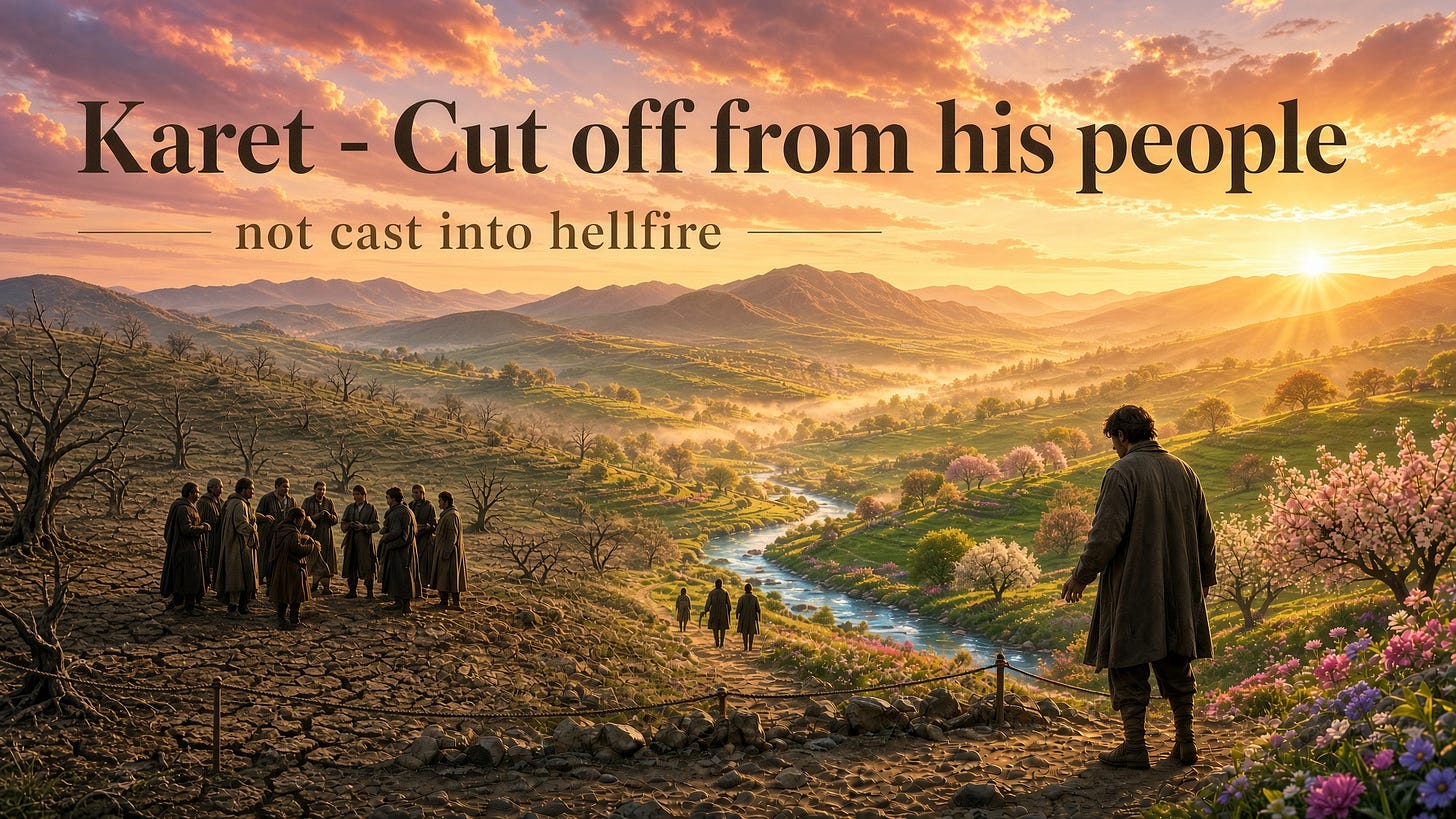
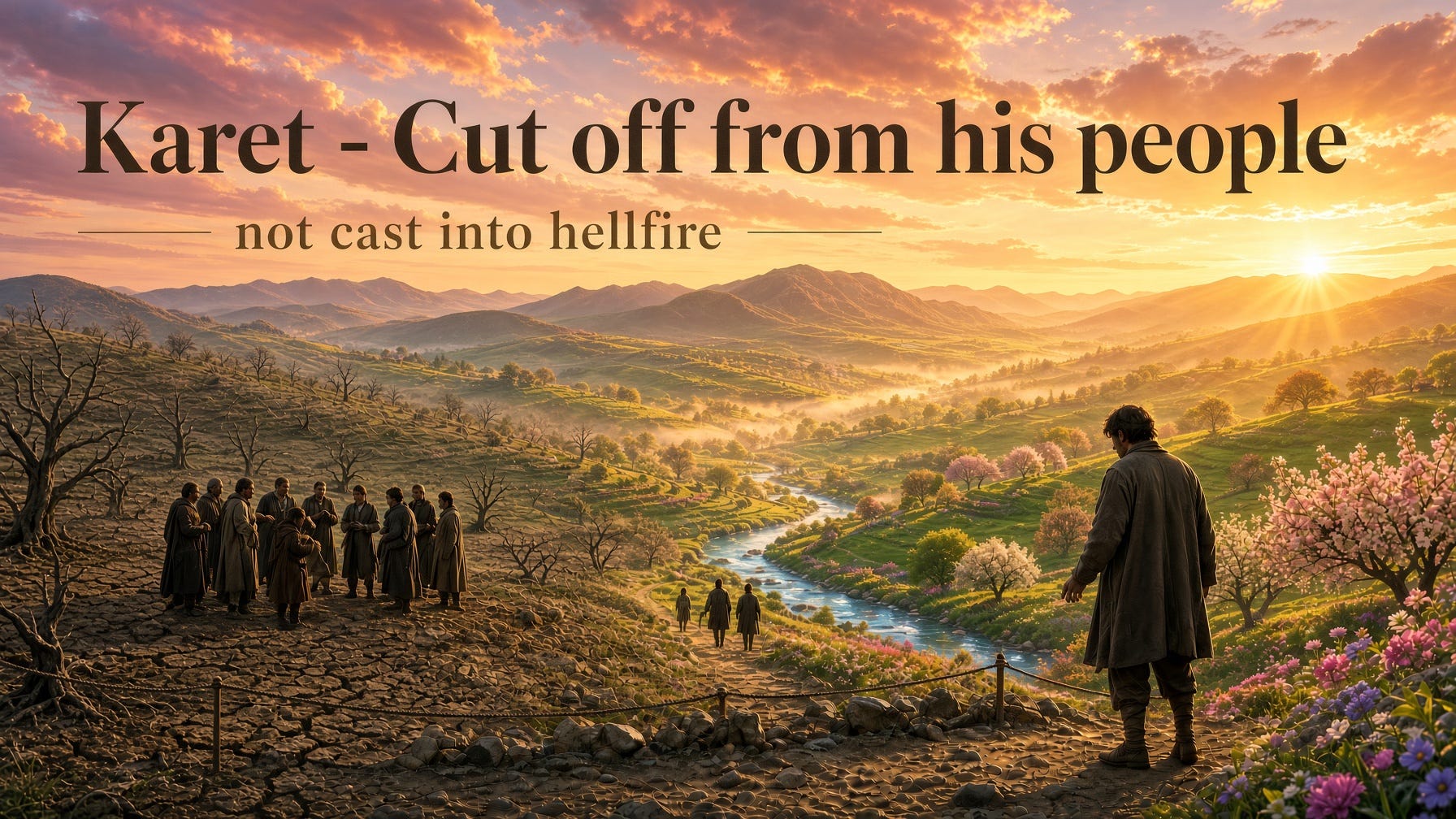
They told you that karet (the Torah’s penalty of being “cut off”) is the Bible’s most serious judgment, and that “cut off” reaches past death into destiny. Some named it the second death. Some named it hellfire. Some said even a decent life cannot stand before God unless a later covering is added. The ten spies brought a report like that: the land cannot be entered; the Judge is too terrible; we are grasshoppers.
The Torah, the Five Books of Moses, uses plainer words, and they are hard in a different way. “Cut off from his people.” “Cut off from Israel.” That soul. Not a furnace borrowed from another age. Not a sentence upon every person outside Israel’s covenant.
Hashem, the Name of the God of Israel, has already spoken about how He saves. He proclaimed who He is: merciful and gracious, abundant in kindness and truth, and He will not acquit the wicked. He is not hunting blood. He says He does not desire the death of the wicked, but that the wicked turn from his way and live. A man dies for his own sin. If that is His mouth, then hellfire as many pulpits preach it is not the meaning of karet, and “the good are lost unless they accept our report” is not a din of Israel. Din means the law as decided: what the Torah requires, forbids, or penalizes in practice. Later pictures of judgment may explain themselves. They may not write the din.
What, then, does “cut off” not mean for the Jew, for the ger tzedek, for the ger toshav, for the righteous among the nations, and for the wicked? And which report will you carry: the ten who made fear into a doctrine, or the two who said only this: Hashem is with us?
What the Torah wrote
The Torah does not say “cast into everlasting fire.” It says karet, to cut off. The refrain belongs to a people under covenant. Covenant here means the binding relationship God made with Israel at Sinai, when He gave them commandments and they became a holy nation.
“Any uncircumcised male who is not circumcised in the flesh of his foreskin, that soul shall be cut off from his people; he has broken My covenant” (Genesis 17:14).
“Whoever eats leavened bread from the first day until the seventh day, that soul shall be cut off from Israel” (Exodus 12:15).
“Whoever does work on it [the Sabbath], that soul shall be cut off from among his people” (Exodus 31:14).
“Whoever does any of these abominations, the souls that do them shall be cut off from among their people” (Leviticus 18:29).
“The soul that does with a high hand, whether of the native or of the stranger, he blasphemes Hashem; that soul shall be cut off from among his people. For he has despised the word of Hashem and broken His commandment; that soul shall be utterly cut off; its iniquity is upon it” (Numbers 15:30–31).
Read the phrases again. From his people. From Israel. Among his people. The penalty is named inside a people who received commandments at Sinai. The Torah is not here writing a map of endless fire. It is writing covenant judgment.
The word ger, “stranger,” in Numbers 15:30 sits next to ezrach, the native of Israel, and next to karet and the sin offering of the same chapter. The Sages rule that this ger is the ger tzedek, the convert who has entered Israel. One law for the native and for him. Do not lay the ger toshav onto that verse. That would treat a different legal status as if it were this one.
The same Torah already told you how guilt works. “Fathers shall not be put to death for children, nor children put to death for fathers; each man shall be put to death for his own sin” (Deuteronomy 24:16). Guilt is not transferred by slogan. Each soul stands before the One who spoke.
And the same Torah already told you how He rescues. Israel cried out in Egypt, and He said, “I have surely seen the affliction of My people… I have come down to deliver them” (Exodus 3:7–8). He passed over the houses marked as He commanded (Exodus 12). He split the sea. He gave bread and water. He placed His Name in their midst. When they made the calf, Moses pleaded, and Hashem pardoned according to His word (Numbers 14:19–20). He saves by His own arm and by His own speech. That is not a theory. It is the plot of the book.
What the Prophets added, without changing the words
The Tanakh is the Hebrew Bible: Torah, Prophets, and Writings. After Sinai, Hashem passed before Moses and proclaimed His Name: “Hashem, Hashem, God merciful and gracious, slow to anger, abundant in kindness and truth, keeping kindness for thousands, forgiving iniquity, transgression, and sin, and He will not acquit” (Exodus 34:6–7). Both halves are His Name. Mercy without justice is not His Name. Justice without mercy is not His Name.
Isaiah refuses worship that keeps the hands dirty. “Why do I need the multitude of your sacrifices? says Hashem. I am full of burnt offerings of rams” (Isaiah 1:11). “Wash yourselves, purify yourselves, remove the evil of your deeds from before My eyes; cease to do evil, learn to do good” (Isaiah 1:16–17). “Seek Hashem while He may be found; call upon Him while He is near. Let the wicked forsake his way, and the man of iniquity his thoughts; let him return to Hashem, and He will have compassion on him, and to our God, for He will abundantly pardon” (Isaiah 55:6–7). Micah asks what Hashem requires, and it is not a river of oil: do justice, love kindness, walk humbly with your God (Micah 6:8).
Ezekiel speaks as clearly as a prophet can speak when he is repeating law. “The soul that sins, it shall die. The son shall not bear the iniquity of the father, nor the father the iniquity of the son. The righteousness of the righteous shall be upon him, and the wickedness of the wicked shall be upon him” (Ezekiel 18:20). “Have I any pleasure at all that the wicked should die, says the Lord Hashem, and not that he should return from his ways and live?” (Ezekiel 18:23). “As I live, says the Lord Hashem, I have no pleasure in the death of the wicked, but that the wicked turn from his way and live. Turn, turn from your evil ways; for why will you die, house of Israel?” (Ezekiel 33:11).
Jonah was sent to Nineveh, a city that was not Israel. They turned from their violence, and God relented of the disaster He had spoken (Jonah 3:10). That is Hashem saving by His own mouth: He warned, they returned, He had compassion.
Teshuvah is that turning. It is not a mood. It is return: putting the sin down and coming back to Hashem. That is the Judge of karet. He cuts off. He also commands return. He has already said how life is recovered. Hear Him.
What the Mishnah settled, and what it did not
The Mishnah is the Sages’ first written code of the received law, the Oral Torah as they organized it for practice. It lists thirty-six matters for which the Torah assigns karet (Keritot 1:1). Willful violation, when a human court has not completed its process, is Heaven’s penalty. For the same act done by mistake, the Torah assigned a sin offering. That is a closed legal list, not a feeling. It includes the Sabbath, Yom Kippur (the Day of Atonement), eating leaven on Passover, certain forbidden relations, idolatry, blasphemy, neglect of circumcision, and sins that touch the Sanctuary.
When they accept a ger tzedek, they tell him the other side of that list. Before you entered Israel, these penalties were not yours. Now that you are Israel, if you eat forbidden fat you are liable to karet; if you profane the Sabbath in the manner the law names, you are liable as a Jew is liable (Yevamot 47a). That is din. The convert is legally bound to Israel. He is not a visitor standing near the covenant. He is of the people. Karet can reach him because the people can reach him.
Here the reason of the camp may be said. Several of these cases guard the rest of the congregation. The Torah says that an impure person who eats holy food, or who enters the Sanctuary while impure, defiles the Dwelling of Hashem. “Cut off” in those verses is not theater. Heaven is protecting the camp from a breach one person would carry into their midst. That is true, and it is enough. It is not the whole of every case, and it is not hellfire.
The Mishnah also said: “All Israel have a share in the World to Come” (Sanhedrin 10:1). The World to Come, Olam HaBa, is the life God grants the righteous beyond this world. The convert who is Israel is inside that sentence. The Mishnah then named who forfeits that share: one who says there is no resurrection of the dead from the Torah, one who says the Torah is not from Heaven, and the apikoros, the one who denies those foundations. Ordinary sin is not that forfeiture. The Sages did not write that Israel is lost unless it accepts a later report. They wrote a presumption of a share, and they defined exceptions.
Gehinnom is not the same heading as karet. Gehinnom is the Sages’ name for judgment after death. Of most of the wicked they spoke of a limited term, twelve months (Eduyot 2:10). They also named a class that descends and does not ascend. That is how the Sages spoke of judgment after death. It is not a definition of every verse that says “cut off,” and it is not a din that karet means endless hellfire.
Where Rambam is needed
Rambam is Maimonides, who organized the received law so that the din can be stated in one place.
The ger tzedek who has been circumcised (if male), immersed, and received is like Israel in every matter (Hilchot Issurei Biah 12:17). That is the legal bond. He keeps the Sabbath as Israel keeps it. He is liable as Israel is liable. He has the share as Israel has the share.
The ger toshav is a different status. A non-Jew who accepts before a court of three the seven laws of the children of Noah, and who is permitted to dwell in the Land of Israel, is a ger toshav (Avodah Zarah 64b; Rambam, Hilchot Issurei Biah 14:7–8). He remains a non-Jew. Israel must sustain him so that he may live (Leviticus 25:35), and Israel is commanded to deal with him in kindness (Hilchot Melachim 10:12). Rambam ties the formal institution of this status to the time when the Jubilee is in force (Issurei Biah 14:8). The seven laws themselves were given to all mankind. Do not confuse the convert bound to Sinai with the resident bound to the seven.
A Gentile who accepts those seven and is careful to do them, because God commanded them in the Torah and made them known through Moses, is among the pious of the nations of the world, and he has a share in the World to Come (Hilchot Melachim 8:11). The seven laws are: no idolatry, no cursing God, no murder, no forbidden sexual relations, no theft, no eating a limb torn from a living animal, and the duty to establish courts of justice. If he does them only because they seem reasonable, Rambam does not give him that title.
That ruling is why a life lived before Hashem on the path He gave the nations cannot be dismissed as empty. A man who refuses foreign worship, will not curse the Name, will not shed blood, will not take forbidden relations, will not steal, will not eat from the living animal, and upholds justice is walking what Hashem already commanded mankind.
Rambam also describes karet, in the laws of Teshuvah (return), as the cutting off of the soul from the life of the World to Come. Other Sages described early death, childlessness, or a distinction according to the person’s weight of good and evil. That disagreement is inside Israel. It is not a din that karet means hellfire.
Jew, ger tzedek, ger toshav, nations, wicked
A born Jew stands inside Sinai. The thirty-six apply. Karet applies. The share in the World to Come is presumed. Teshuvah is commanded. The Day of Atonement, return, and a changed life are the repair Hashem already wrote. Fear of a furnace is not the commandment.
Name the ger tzedek. He is legally bound to Israel. He took the yoke. The court received him. He is Israel for Sabbath, for Passover, for the Sanctuary laws, and for karet. He is Israel for the share. There is no half-covenant and no half-hell invented for him.
A ger toshav accepted the seven before Israel’s court and may dwell in the Land. He is not the convert of Numbers 15:30. He is not liable to Israel’s karet for eating leaven on Passover, for the Sabbath as Israel’s sign, or for neglecting circumcision as Israel’s mark. Call his failure what it is: violation of the seven he accepted.
A Gentile among the nations who keeps the seven because God commanded them is the pious of the nations. He has a share. He has not taken the convert’s bond, and he may not have taken the ger toshav’s seat in the Land. Hashem already said how the nations live before Him.
A Gentile who keeps those bounds only as ethics is not given Rambam’s title. Heaven still judges knowledge and deed. That limit is Rambam’s ruling. It is not a furnace.
The wicked of the nations are judged for their commandments. Idolatry remains idolatry. Bloodshed remains bloodshed. Ezekiel still prefers that they turn and live.
The Jew who is wicked, born or converted, is not the same case as a wicked Gentile. He can forfeit the presumed share by the Mishnah’s denials and by defined corruption. He is not lost by every stumble. Karet is one severity inside the covenant.
One who never knew, and the child, belong to Heaven’s judgment. Do not invent a din Hashem did not speak.
The report you must not carry
Ten spies said the land eats its inhabitants, and we cannot go up. Two said: “The land is very, very good. If Hashem delights in us, He will bring us into this land and give it to us. Only do not rebel against Hashem. Do not fear the people of the land, for they are our bread. Hashem is with us. Do not fear them” (Numbers 14:7–9).
Hellfire as the meaning of karet is a ten-spy report. So is the claim that Hashem cannot bring a soul near unless the ten first declare the land impossible. The Torah named a people, a penalty, and a command to return. The Prophets named His pleasure: not the death of the wicked, but their turning. He has already saved by His own mouth: “Return to Me, and I will return to you” (Malachi 3:7). “I have blotted out, as a thick cloud, your transgressions, and as a cloud your sins; return to Me, for I have redeemed you” (Isaiah 44:22).
Hashem is not the god of the ten spies. He does not need you terrified of a furnace in order to be holy, and He does not acquit the wicked in order to be kind. Karet is His warning inside Israel’s covenant. It is not their hell. The ger tzedek is bound to that covenant by law. The nations have the seven from His mouth. A Jew who returns is doing what Hashem asked on the Day of Atonement and every day after it. Those are not rumors. They are His words.
The two said Hashem. If He delights in us, He will bring us. Do not fear. Hashem is with us.
We are Jews who want the wicked to repent, to come near, and to receive the portion He appointed, not because we collect fear, but because He has shone His light and we will not hide it. If you will take the good report, learn with us at PerfectingTheWorld.com. Come close to Hashem. Leave the evil report. Claim what the two claimed: Hashem.