
By Rabbi Josh Wander

This year’s Fourth of July is unlike any other. Americans will gather to celebrate 250 years since the signing of the Declaration of Independence, marking a remarkable milestone in the life of a nation. While fireworks, parades, and patriotic celebrations are certainly appropriate, this anniversary should also invite something far more valuable: reflection. History has much to teach those who are willing to listen.
History has a way of repeating itself. While every civilization is unique, nearly every great empire has followed a remarkably similar pattern. It begins with vision, sacrifice, hard work, and a shared sense of purpose. Those qualities produce prosperity, military strength, innovation, and global influence. Eventually, however, success often gives way to complacency. Governments expand beyond their means. Debt replaces fiscal discipline. Political factions become more interested in defeating one another than preserving the nation. Confidence in public institutions erodes, social cohesion weakens, and the empire slowly begins consuming the very foundations that made it great.
One of the most fascinating aspects of this cycle is that those living through it rarely recognize what is happening. The citizens of Rome did not wake up one morning and declare that their empire had begun to collapse. The British did not celebrate the beginning of imperial decline. People naturally assume that the world they know today will continue tomorrow. It is only with the benefit of hindsight that historians identify the turning points that were almost invisible to those living through them.
Whether America has already reached such a turning point is something reasonable people can debate. Yet few would deny that the United States today faces challenges unlike those that characterized its rise. Record levels of national debt, increasing political polarization, declining trust in institutions, growing cultural fragmentation, and mounting economic uncertainty have caused many Americans to wonder whether the nation’s greatest days still lie ahead or whether they now belong to the past. If asked whether the American Dream is ascending or declining, I suspect that a great many people would acknowledge that something fundamental has changed.
None of this diminishes America’s extraordinary accomplishments. Quite the opposite. The United States has been one of the most generous nations the Jewish people have ever known. It provided unprecedented religious liberty, economic opportunity, personal freedom, and security to millions of Jews. Entire generations were able to build thriving communities, establish world-class Torah institutions, and openly live as Jews without fear. American Jews owe an enormous debt of gratitude to this remarkable country for the blessings it has bestowed upon them for nearly two and a half centuries.
But history teaches another lesson that is just as important: gratitude should never be confused with permanence.
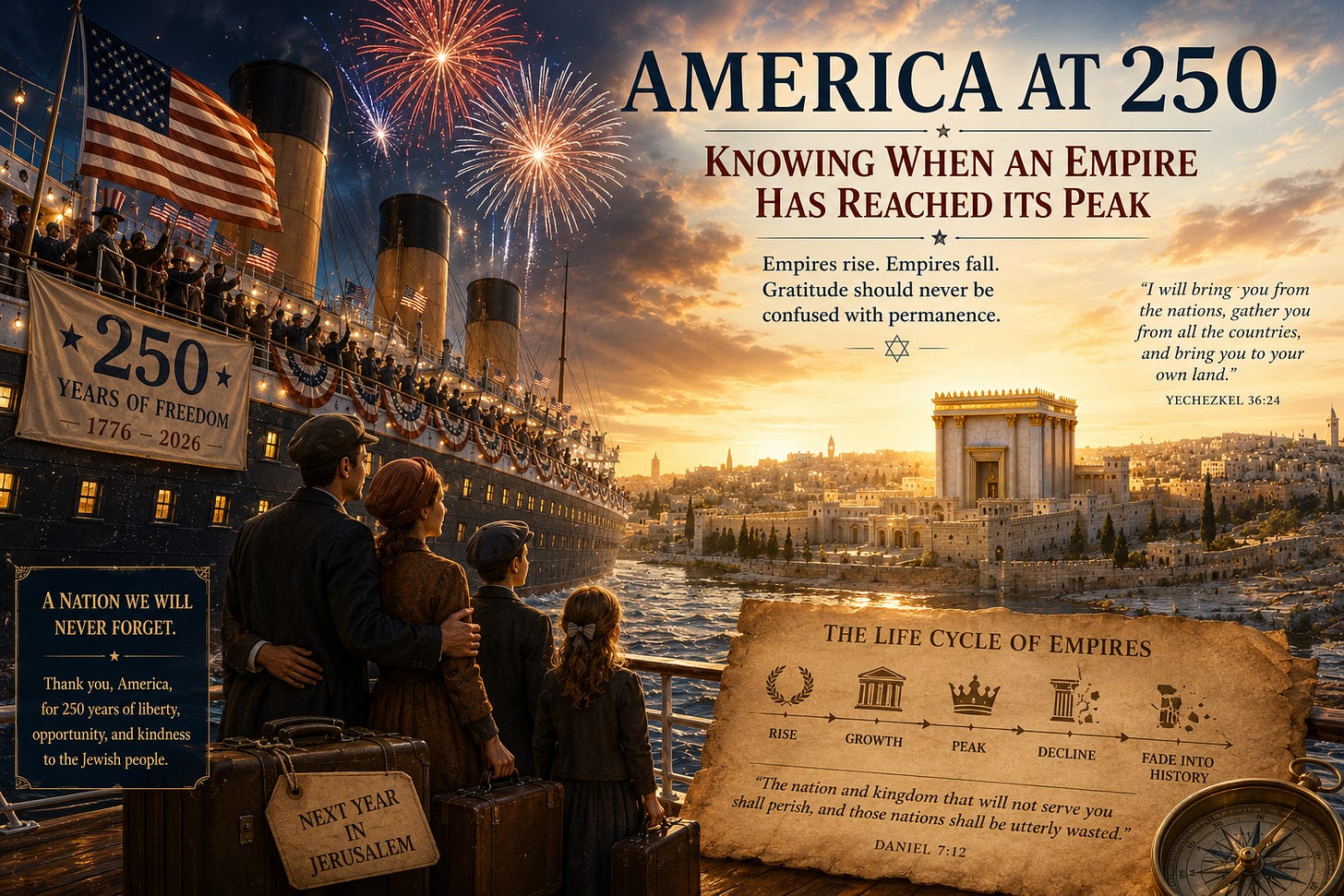
A traveler may forever appreciate the ship that safely carried him across the ocean. Yet when the voyage reaches its destination, remaining aboard out of nostalgia no longer makes sense. The purpose of a ship is to bring its passengers home, not to become their permanent residence. Throughout Jewish history, exile has often provided periods of relative tranquility and prosperity. Jews built magnificent communities in Babylonia, Spain, Poland, Germany, and America. Yet every chapter of exile, regardless of how comfortable it became, eventually came to an end.
For nearly two thousand years, Jews prayed three times each day for the ingathering of the exiles and the return to Zion. At the conclusion of every Pesach Seder we proclaimed, “Next Year in Jerusalem.” Those words were never intended to remain poetic aspirations. They expressed the eternal destination of the Jewish people. Today, for the first time in nearly two millennia, those prayers are no longer theoretical. Jewish sovereignty has been restored. Millions of Jews have returned home. The Land of Israel has been rebuilt. Hebrew has once again become the spoken language of an entire nation. The gates are open.
The Torah teaches that history is not random. Hashem guides the rise and fall of nations according to His plan. As the prophet Daniel explained to Nevuchadnezzar, even the mightiest kingdoms ultimately give way to those that follow. No empire, regardless of its wealth or military power, has ever proven permanent. The Jewish people have lived under Babylon, Persia, Greece, Rome, Spain, the Ottoman Empire, Britain, and countless other powers that once appeared invincible. Every one of them eventually passed from the world stage, while Am Yisrael endured.
Perhaps the greatest mistake is not failing to predict the exact year an empire begins its decline. The greatest mistake is assuming that the empire in which we happen to live will somehow be the exception to history. Wise people do not wait until the storm has already arrived before preparing. They recognize the signs while there is still time to act.
As America celebrates 250 extraordinary years, let us express our sincere gratitude for all that this remarkable nation has done for the Jewish people. America deserves our appreciation, our respect, and our thanks. But it also deserves an honest recognition that no earthly empire lasts forever. The center of Jewish history is no longer in the great communities of the Diaspora. It has returned to the hills of Judea, the streets of Jerusalem, and the Land that Hashem promised to Avraham, Yitzchak, and Yaakov. The greatest celebration in Jewish history is not behind us. It is unfolding before our very eyes. The question is whether we will recognize the moment and know when it is time to come home.