
By Rabbi Josh Wander
Most people look at Israel’s massive infrastructure projects and see nothing more than economic development. They see new airports, railways, highways, hotels, and public transportation designed to accommodate a growing population and increasing tourism. But if we step back and look at the bigger picture, something extraordinary begins to emerge. It is becoming increasingly difficult to ignore the possibility that Hashem is quietly preparing the physical infrastructure for one of the greatest events in Jewish history—the return of millions of Jews to Jerusalem.
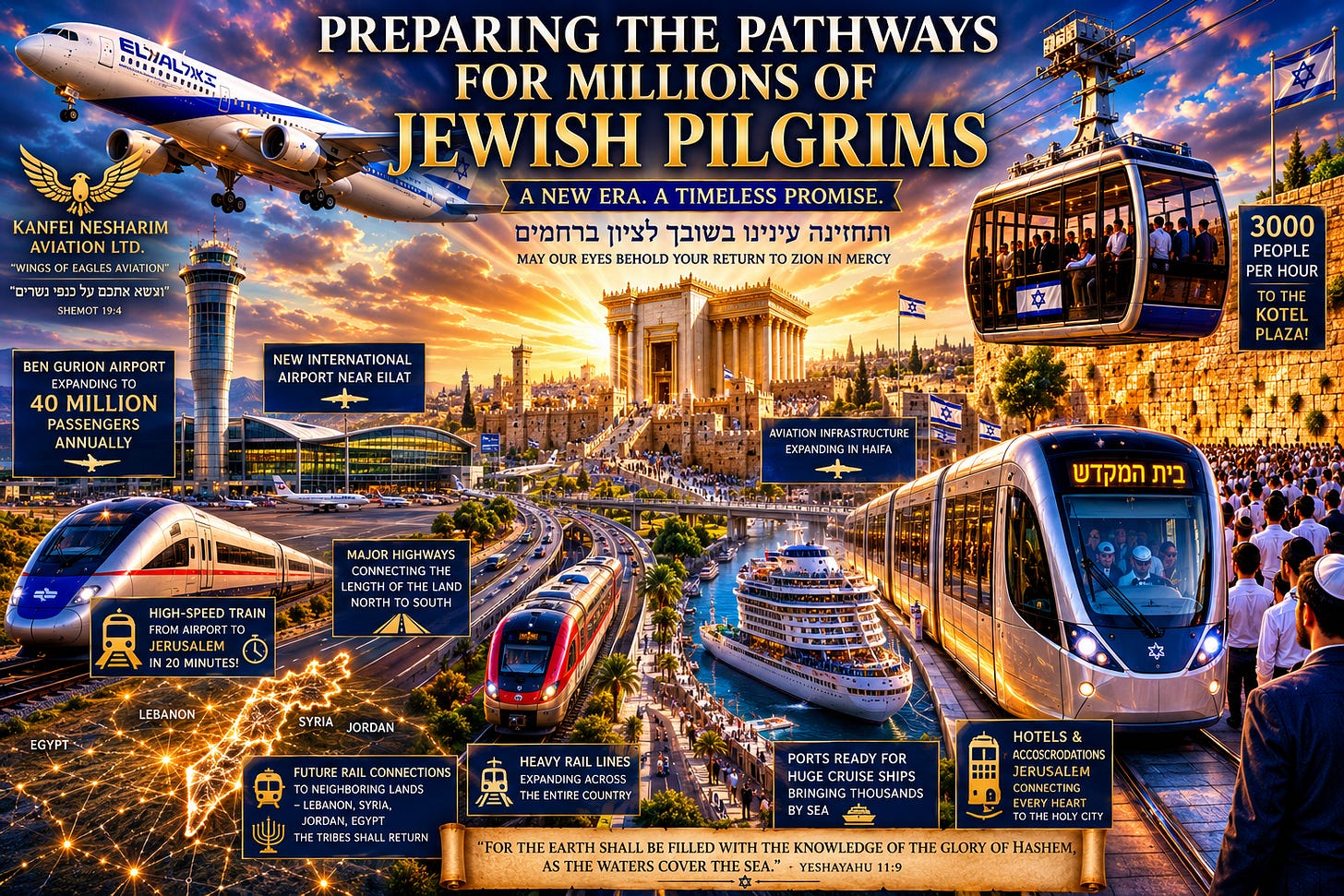
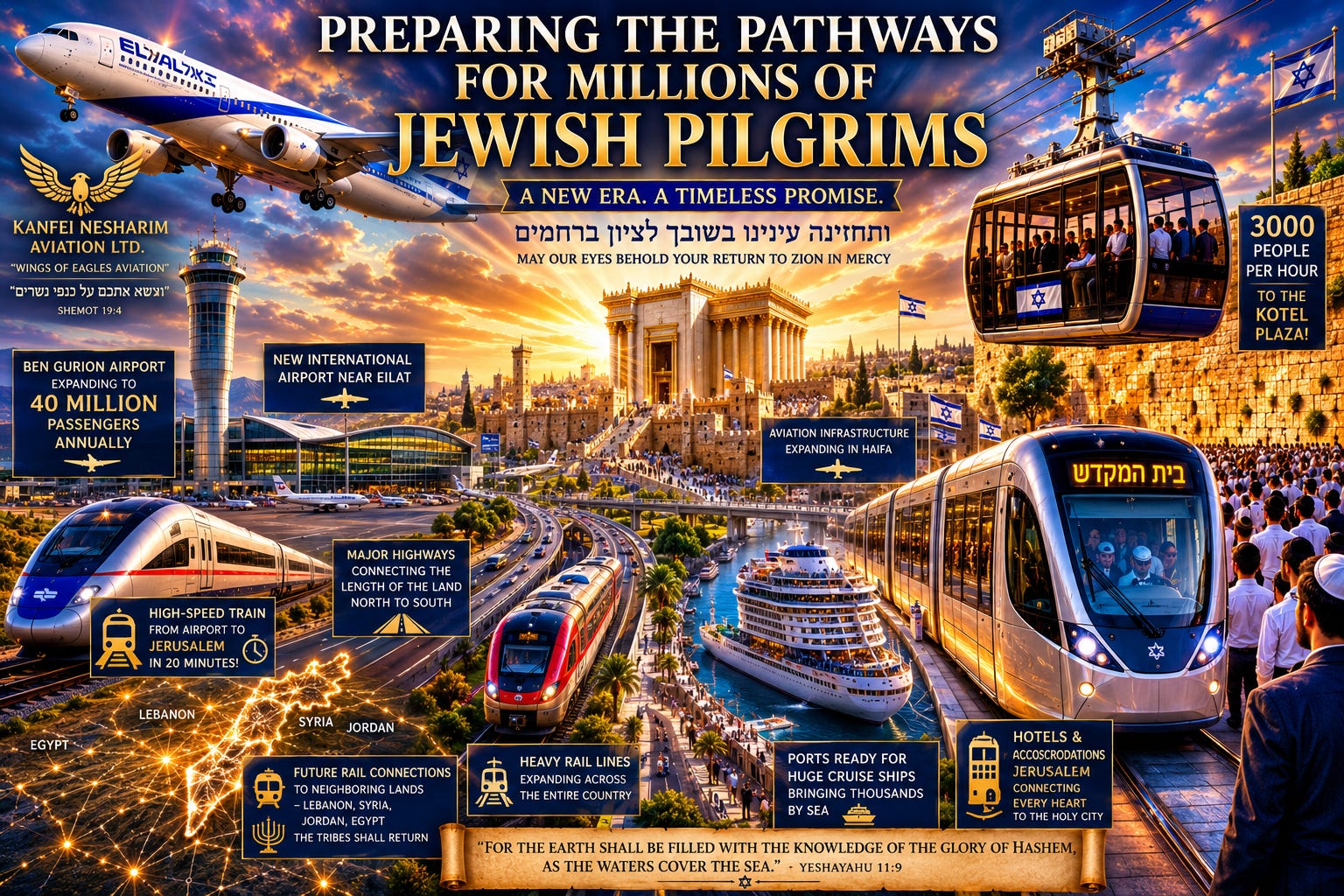
A press statement was recently released announcing plans for another major expansion of Ben Gurion Airport, increasing its capacity to accommodate approximately forty million passengers annually. At the same time, Israel has opened the new international airport near Eilat in the south while continuing to expand aviation infrastructure in the north through Haifa. Individually, these are impressive national projects. Collectively, they begin to paint a remarkable picture.
The transportation network being built across Eretz Yisrael is unlike anything our ancestors could have imagined. High-speed rail now transports passengers from Ben Gurion Airport to Jerusalem in approximately twenty minutes. Heavy rail lines continue to expand throughout the country, connecting the north and south with unprecedented efficiency. Modern highways stretch from one end of the Land to the other, making travel easier than at any point in Jewish history. Looking ahead, it is not difficult to envision rail connections extending into the neighboring lands of modern-day Lebanon, Syria, Jordan, and Egypt. These are not merely neighboring countries; they are the very regions once inhabited by many of the tribes of Israel and central to our biblical history. As the ingathering of the exiles continues, it is not difficult to imagine these transportation corridors one day extending far beyond Israel’s present borders.
The same pattern is evident by sea. Israel’s ports are continually being expanded to accommodate enormous cruise ships capable of bringing thousands of passengers at a time. Once those visitors arrive in Jerusalem, an entirely new transportation system awaits them. Light rail lines are rapidly crisscrossing the city, connecting neighborhoods and major destinations with increasing efficiency. The planned cable car system to the Old City will be capable of transporting approximately 3,000 passengers every hour directly to the vicinity of the Kotel Plaza, dramatically increasing access to one of Judaism’s holiest places.
Nor does the preparation end with transportation. Hotels are rising throughout Jerusalem and across the country at an unprecedented pace. Thousands of new rooms are being added every year. On the surface, these projects appear to answer growing tourism and business demands. Yet when viewed together with the expanding transportation network, they seem to provide exactly the kind of infrastructure that would be necessary to receive millions of Jewish pilgrims.
For nearly two thousand years, Jews dreamed of ascending to Jerusalem for the Shalosh Regalim. In the days of the Beit HaMikdash, pilgrims journeyed on foot, by donkey, or by camel. Traveling from Babylonia, North Africa, Europe, Yemen, and beyond often required weeks or even months of difficult travel. Today, millions of Jews could theoretically arrive from every corner of the globe within hours. They could land at Ben Gurion Airport, board a high-speed train, arrive in Jerusalem in minutes, and then continue throughout the city using a modern light rail system or cable car. Never before in Jewish history has such a reality even been conceivable.
There is yet another remarkable detail that is easy to overlook. The controlling shareholder of Israel’s national airline, El Al, is Kanfei Nesharim Aviation Ltd.—literally, “Wings of Eagles Aviation.” The name immediately recalls Hashem’s promise at Sinai: “וָאֶשָּׂא אֶתְכֶם עַל כַּנְפֵי נְשָׁרִים”—“I carried you on eagles’ wings.” For generations, Jews dreamed of returning home on the “wings of eagles.” Today, that dream has become routine, so familiar that we barely stop to appreciate it.
Perhaps the day is not far away when booking a flight to Israel will involve more than choosing between a window seat and an aisle seat. Perhaps another question will appear on the reservation screen: “Are you traveling as a Jewish pilgrim ascending to Jerusalem?” One can even imagine our national airline offering priority boarding or special pilgrimage fares during the Shalosh Regalim for those fulfilling the ancient mitzvah of aliyah la’regel. Such an idea may sound fanciful today, but so too would a twenty-minute train ride from the airport to Jerusalem or a cable car transporting thousands of worshippers every hour have sounded only a generation ago.
None of these projects, taken individually, prove anything. Airports are built because demand grows. Railways are laid because cities expand. Hotels are constructed because tourism increases. Every project can be explained through economics, engineering, or demographics. Yet believing Jews recognize that the Ribbono Shel Olam often prepares the stage long before the audience realizes what play is about to begin. Looking back through Tanach, events that appeared ordinary at the time repeatedly revealed themselves to have been carefully orchestrated steps in a far greater Divine plan.
Perhaps that is precisely what we are witnessing today. Piece by piece, year after year, the physical framework is quietly being assembled. Airports. Railways. Highways. Ports. Hotels. Urban transportation. Individually they appear unrelated. Collectively they resemble preparations for the return of an entire nation to its spiritual center.
Every day we pray, “ותחזינה עינינו בשובך לציון ברחמים.” We are not merely asking Hashem to bring the Geulah. We are asking Him to open our eyes so that we recognize it while it is unfolding before us. Sometimes the greatest miracle is not that Hashem performs wonders, but that He performs them so naturally that we mistake them for ordinary progress.
One would have to be remarkably blind not to notice the convergence taking place before our eyes. The physical barriers that once prevented the ingathering of millions of Jews are disappearing one after another. The logistical challenges that would have seemed insurmountable throughout nearly all of Jewish history are quietly being solved. The roads are being paved, the railways are being laid, the airports expanded, the ports enlarged, and Jerusalem itself is being prepared to receive unprecedented numbers of visitors.
As we prepare to enter the period of the Three Weeks, beginning with the Seventeenth of Tammuz, our attention naturally turns to what we have lost. We mourn the breaching of Jerusalem’s walls, the destruction of the Beit HaMikdash, and nearly two thousand years of exile. But mourning does not require us to ignore what Hashem has already begun to restore before our very eyes. On the contrary, appreciating what is still missing should sharpen our awareness of how much has already returned. The Jewish people have come home. Jerusalem has been rebuilt. The roads have returned. The railways are being laid. The airports are expanding. The city is quietly preparing itself once again to receive millions of Jews from around the world. As we mourn the past, we should also lift our eyes toward the future and recognize just how far we have come—and perhaps, just how close we are to the final redemption. May we merit to see these days of mourning transformed into days of joy, speedily in our days, with the rebuilding of the Beit HaMikdash and the complete Geulah.