
By Rabbi Josh Wander

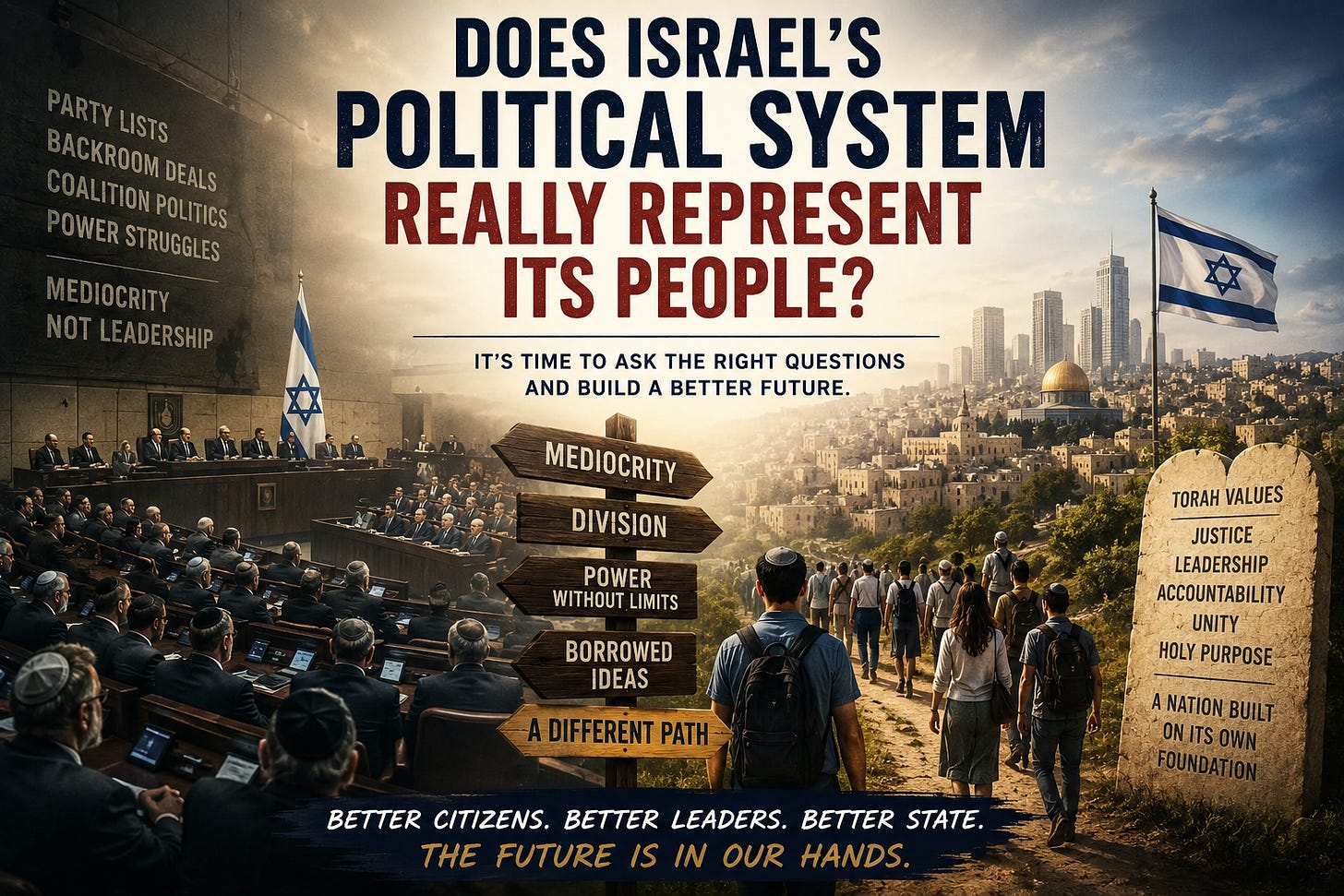
One of the most important questions facing the State of Israel is almost never asked. We simply assume that because Israel is a democracy, its elected officials naturally represent the people. But do they? Does our political system actually produce the best leaders the Jewish people have to offer, or have we simply become accustomed to accepting whatever the system produces?
Unlike countries such as the United States, Israelis do not vote directly for individual representatives or even for their prime minister. We vote for political parties. The candidates on each party’s list have already been selected, often by a relatively small group of insiders or through limited party primaries. After the election, the President assigns one member of Knesset the task of forming a coalition government. The prime minister is therefore not directly elected by the people but emerges through political negotiations between party leaders. By the time the average citizen casts a ballot, most of the important decisions have already been made.
This helps explain one of the most common responses whenever criticism of Israel’s leadership arises: “Who else is there?” But perhaps that is the wrong question. The real question is whether our political system is designed to attract and elevate the very best people. Is it really conceivable that among nearly ten million Israelis, this is the strongest leadership we can produce? Or have we created a system that rewards political maneuvering more than vision, competence, and integrity?
At what point do we stop accepting mediocrity? Israel faces extraordinary military, diplomatic, economic, and spiritual challenges. We should expect extraordinary leadership. Yet many of our most capable citizens avoid politics altogether, leaving the field to professional politicians who have mastered party politics rather than national leadership.
The problem extends beyond elections. Israel also lacks a formal constitution clearly defining the limits of governmental authority. As a result, the executive, legislative, and judicial branches are locked in a perpetual struggle over power. Every major political disagreement quickly becomes a constitutional crisis because the rules themselves remain unsettled.
Part of the challenge is historical. Israel is a nation of immigrants who arrived from every political system imaginable. Many came from communist regimes or Arab dictatorships with little experience of democratic institutions. Others came from Western democracies with very different traditions. Unsurprisingly, Israelis often disagree not only about policy but even about what democracy means.
That raises another question rarely asked. Who decided that a liberal democracy is necessarily the ideal model for the Jewish state? Even the United States is not a pure democracy but a constitutional republic with carefully designed limits on governmental power. If other nations developed systems rooted in their own histories, why shouldn’t Israel develop institutions rooted in ours?
The same question applies to our legal system. Much of modern Israeli law traces its roots to British common law and European legal traditions. But the Jewish people possess one of the oldest and most sophisticated legal systems in human history. Torah contains detailed principles governing justice, leadership, civil law, commerce, national responsibility, and the balance between authority and individual rights. Certainly, applying those principles to a modern state requires wisdom and serious scholarship. But why is that conversation so often dismissed before it even begins?
Perhaps this is the real issue. We have spent decades debating personalities while ignoring the system itself. We argue over which politician should lead instead of asking whether the political structure is producing the leaders we actually need. More fundamentally, we have failed to ask whether the Jewish state should be built upon borrowed political philosophies or upon the values of our own civilization.
Before my American readers use this article as another reason not to make Aliyah, let me stop you there. If Israel’s political system is flawed, then you share some responsibility for that as well. Imagine if millions of Jews from North America, bringing generations of experience participating in constitutional government, had come home and helped shape the institutions of the Jewish state. Democracies are not improved by spectators. They are improved by citizens who are willing to become part of the process. You cannot sit comfortably in the Diaspora criticizing Israel while refusing to help build it.
The same challenge applies to Torah Jews everywhere. Imagine where Israel would be today if one million productive, idealistic, Torah-observant Jews had devoted their talents to strengthening the institutions of the Jewish state instead of only those of the exile. How different would our education system be? Our courts? Our public discourse? Our political leadership? Our army and our Rabbinate?
Perhaps we have been asking the wrong question all along. Instead of asking why Israel does not better represent our values, perhaps we should first ask why we have not done more to ensure that it does. Nations are not transformed by criticism alone. They are transformed by citizens willing to take responsibility for their future. If we want a better Jewish state, the first step is not merely electing better leaders. It is becoming the kind of citizens who are prepared to build one. The greatest reform Israel could experience may not begin in the Knesset at all. It may begin with another million Jews coming home.