
By Rabbi Josh Wander
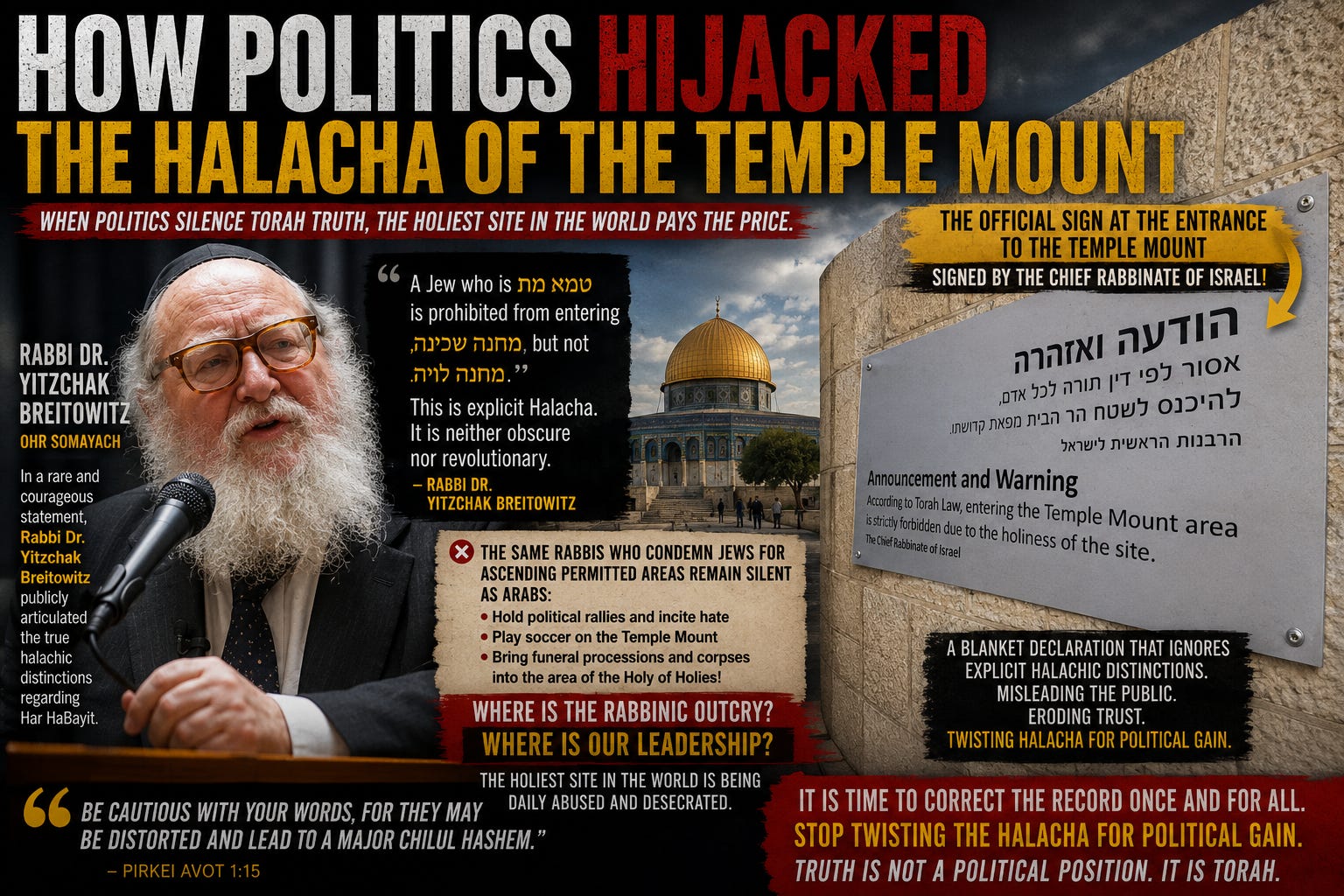
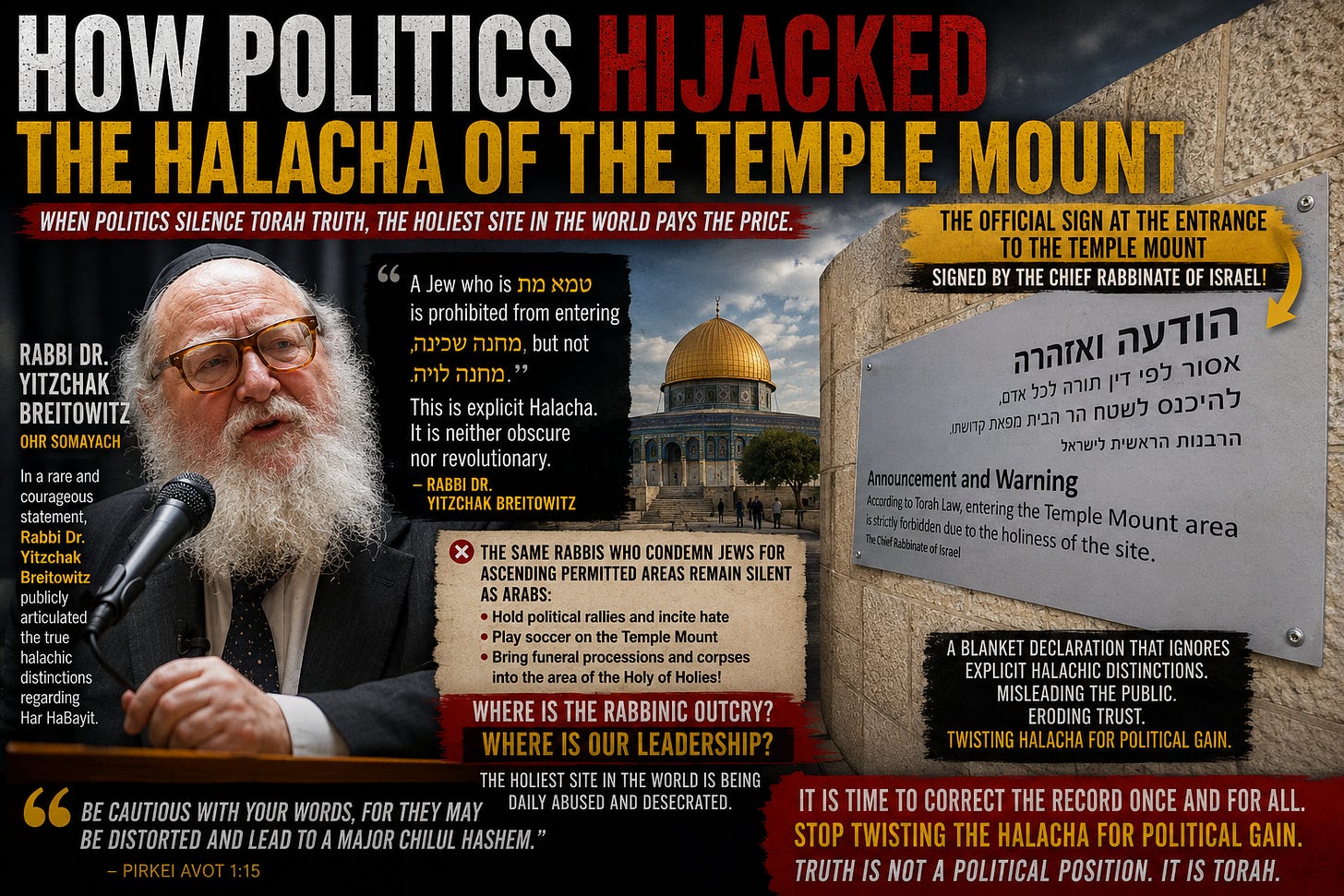
The recent statement by Rabbi Dr. Yitzchak Breitowitz of Ohr Somayach regarding the permissibility of ascending parts of the Temple Mount sent shockwaves through portions of the Haredi world. The article framed it as rare and surprising. In one sense, it is. Not because the Halacha he presented is novel or controversial, but because it has become exceedingly rare for prominent rabbis in certain circles to publicly articulate the actual halachic distinctions regarding Har HaBayit. The real story is not that Rabbi Dr. Yitzchak Breitowitz was willing to state the Halacha openly. The real story is that so few rabbis today are willing to teach this subject with precision and honesty.
For decades, the public has been conditioned to hear a simplistic slogan: “It is forbidden for Jews to enter the Temple Mount.” This blanket statement has been repeated so often that many assume it represents the unanimous and undisputed position of Halacha itself. But anyone who seriously studies the Mishnayot in Keilim, the Rambam’s Hilchot Beit HaBechirah, and the halachic discussions surrounding tumah and the various sanctified zones of the Mikdash quickly discovers something important: the Halacha is far more nuanced than the slogans. There is a critical distinction between מחנה שכינה and מחנה לויה. A Jew who is טמא מת is prohibited from entering the areas corresponding to מחנה שכינה — the holiest inner areas associated with the Azarah and the location of the Beit HaMikdash itself. But that same state of impurity does not prohibit entry into מחנה לויה. This is explicit Halacha. It is neither obscure nor revolutionary.
The overwhelming majority of Jews today possess the status of טמא מת due to the absence of the ashes of the Para Aduma. Yet according to classical Halacha, that status alone does not create a prohibition against entering every square meter of Har HaBayit. The prohibition applies specifically to certain sanctified zones. This distinction matters enormously. And yet many rabbis, intentionally or unintentionally, erase that distinction entirely when speaking to the public. Instead of carefully teaching the actual halachic parameters, they issue sweeping declarations about the entire Temple Mount. Complex halachic geography is reduced to bumper stickers. Precision disappears. Nuance vanishes.
The irony is extraordinary. In virtually every other area of Torah law, we insist upon exact measurements and exact definitions. Jews debate millimeters in the dimensions of a sukkah. We analyze the precise size of a kezayit. We calculate astronomical minutiae for zmanim. Entire libraries are dedicated to distinctions between categories of purity and impurity. Yet suddenly, when it comes to the holiest place on earth itself, many abandon specificity entirely. No serious authority advocating ascent claims Jews may simply wander indiscriminately across Har HaBayit. Responsible rabbinic figures who permit ascent require immersion in a mikvah and adherence to carefully mapped routes designed specifically to avoid areas of possible מחנה שכינה. The discussion has never been about reckless behavior. The discussion is about whether the public deserves to know what the Halacha actually says.
That is what made Rabbi Dr. Yitzchak Breitowitz’s statement so significant. Not because he invented a new leniency, but because he publicly acknowledged a distinction already embedded within the halachic sources themselves. But the problem runs even deeper. Once politics becomes intertwined with Torah, the distortion does not remain isolated to one issue. It begins to seep into the entire religious discourse, often producing deeply troubling consequences. The same rabbinic voices that repeatedly issue fiery condemnations against Jews ascending permitted areas of Har HaBayit often remain astonishingly silent regarding the daily desecrations occurring there under Muslim control. Day after day, the holiest site in Judaism is used for nationalist demonstrations, political incitement, riots, soccer games, and open displays of contempt for Jewish sovereignty. Worse still, funeral processions and corpses are regularly brought onto the Mount itself, including into areas many believe correspond to the vicinity of the Kodesh HaKodashim.
One cannot help but notice the imbalance. When religious Jews immerse in a mikvah, study the halachic boundaries carefully, and walk according to permitted routes, there are endless condemnations and warnings. But when the Temple Mount is transformed into a platform for political demonstrations or funeral ceremonies involving tumah far more severe and direct, suddenly the silence becomes deafening. If the concern is truly the sanctity of the place, then that sanctity should not depend on the identity of the violator. Where are the emergency gatherings? Where are the public protests? Where are the declarations of חילול המקום? Where is the leadership when the holiest place on earth is being openly abused and desecrated on a daily basis?
Perhaps the most disturbing example of this confusion is the giant official sign posted at the entrance to Har HaBayit itself. The sign, issued in the name of the Chief Rabbinate of Israel, declares broadly that entering the Temple Mount constitutes a Torah prohibition. Not a caution. Not a nuanced halachic explanation. Not a warning regarding specific sanctified areas. A blanket declaration. How can rabbinic leadership expect to maintain public trust when demonstrably inaccurate statements are promoted in their name? One may argue for stringencies. One may advocate caution. One may even personally oppose ascent for policy reasons. But presenting a sweeping claim as if the entirety of Har HaBayit is universally prohibited on a Torah level ignores the actual halachic distinctions discussed explicitly in the sources themselves.
This is not a small matter. When rabbinic institutions promote oversimplifications that serious תלמידי חכמים know are at minimum deeply disputed, it creates a crisis of confidence. People eventually begin asking a dangerous question: if the public narrative surrounding Har HaBayit can so openly ignore nuance and complexity, where else is politics shaping the presentation of Torah? That question leaves a stain on the rabbinic establishment itself. Pirkei Avot already warned about this danger nearly two thousand years ago. Avtalyon cautioned the sages to be exceedingly careful with their words lest their teachings become distorted and lead to a חילול השם. The responsibility of rabbinic leadership is not merely to preserve authority. It is to preserve truth. The moment political calculations, public relations concerns, or institutional pressure begin reshaping the presentation of Halacha, trust in Torah leadership itself begins to erode.
And that erosion is devastating. Torah is not strengthened by hiding complexity from the public. It is not strengthened through exaggeration. And it is certainly not strengthened through declarations that blur or ignore explicit halachic distinctions for the sake of maintaining political consensus. It is time to correct the record once and for all. It is time to stop twisting the Halacha for political gain.
For generations in exile, Jewish consciousness adapted itself to distance from Har HaBayit. The Temple became abstract. The laws of the Mikdash became theoretical. Entire communities developed psychologically around absence. But history has changed. Jews have returned to Jerusalem. Jewish sovereignty has returned to the Temple Mount. The questions are no longer theoretical footnotes buried in masechtot. They are practical realities. And once people begin honestly studying the Halacha of Har HaBayit, many discover that the greatest obstacle is not necessarily ritual impurity at all. It is fear. Fear of controversy. Fear of changing long-standing communal assumptions. Fear of confronting how deeply exile mentality has shaped modern religious discourse.
The tragedy is not that one Haredi rabbi finally spoke publicly. The tragedy is that there are so few willing to teach the truth of the Halacha clearly, consistently, and without apology.