
By Rabbi Josh Wander
There is something deeply unsettling about entering the month of Iyar if a person is being honest with himself. Nissan allows for a certain distance, a reflective comfort as we retell ancient miracles and celebrate a redemption that took place thousands of years ago. But Iyar removes that distance entirely. It places a mirror in front of us and forces a far more uncomfortable confrontation—not with the past, but with the present. This is the month of יום העצמאות and יום ירושלים, dates that mark not stories we inherited, but realities we are living. A scattered nation returned to its land, a desolate city restored to Jewish sovereignty, a people once powerless now capable of defending itself in its ancestral home. These are not abstract ideas or theological concepts; they are concrete, historical, undeniable developments unfolding within a single lifetime.
And yet the real tension of Iyar is not whether these events are miraculous. That question, if approached with intellectual honesty, is almost beside the point. The far more dangerous question is what happens if we admit that they are. Because the moment a person recognizes that these are not random political developments but part of a larger unfolding process of Geula, everything becomes inconvenient. Life can no longer remain comfortably detached. One cannot continue treating Eretz Yisrael as optional, as symbolic, as a secondary arena of Jewish life, while simultaneously acknowledging it as the מרכז of divine history. Recognition carries consequences, and those consequences demand change—of priorities, of perspective, and often of life itself.
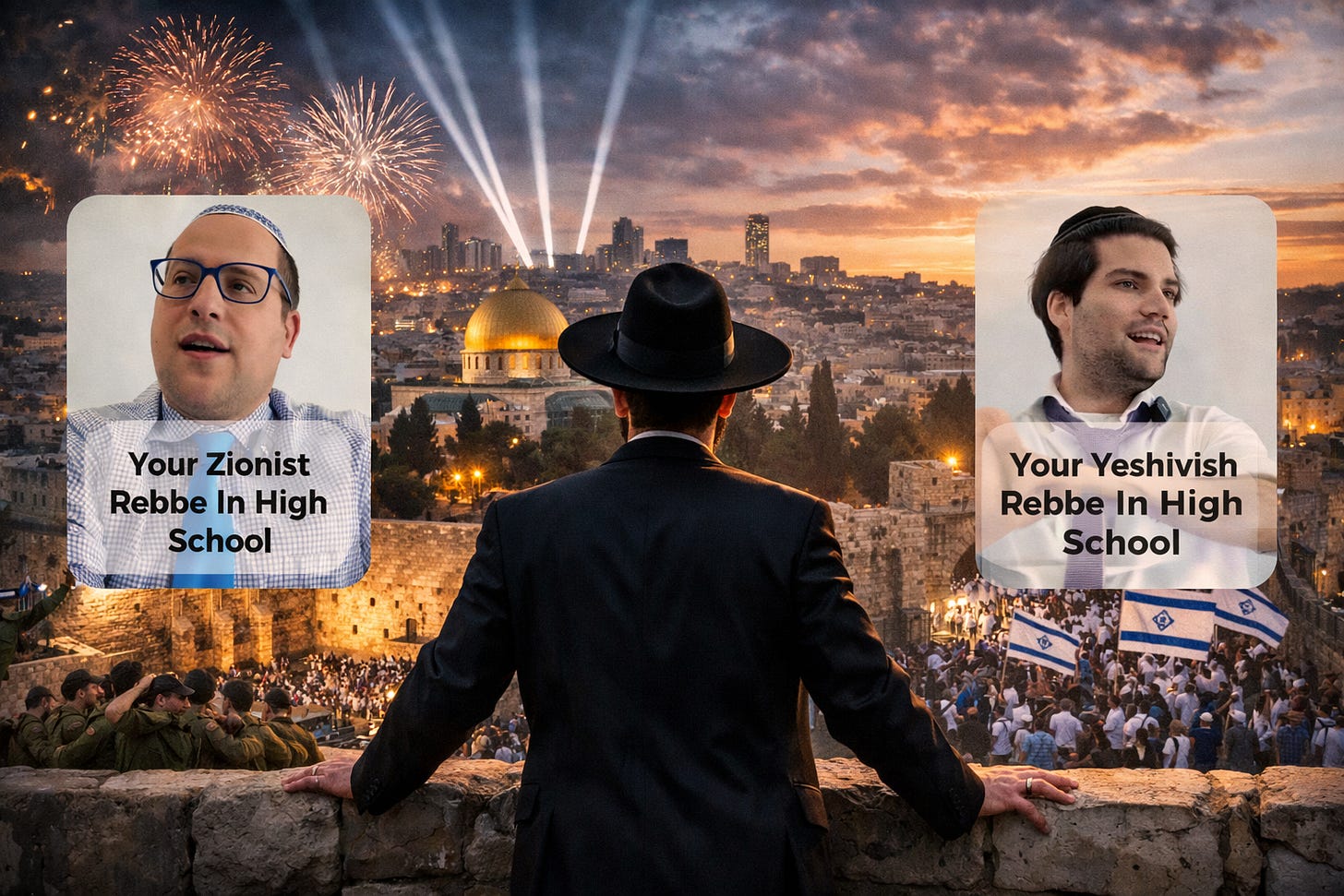
That is why denial has become so sophisticated. It is no longer a simple rejection of facts, but a reframing of them. Miracles are reinterpreted as politics. Destiny is reduced to coincidence. Even within religious circles, the same reality can be split into opposing narratives, each carefully constructed to neutralize the implications. A recent viral video portraying two rebbes—one “Zionist” and one “yeshivish”—offering completely different takes on יום העצמאות was amusing on the surface, but deeply revealing underneath. The same event, the same historical reality, processed in contradictory ways that allow each audience to walk away unchanged. What should have been a moment of collective clarity becomes just another debate, another perspective, another excuse to avoid confronting what is actually happening.
The Gemara in Talmud Bavli teaches a principle that feels almost tailor-made for this moment: אין בעל הנס מכיר בנסו—the one experiencing the miracle often fails to recognize it. Not because the miracle is hidden, but because familiarity breeds blindness. When a person lives inside something extraordinary, it quickly becomes normal. The impossible becomes routine. What should shake a generation to its core becomes background noise. That is the psychological refuge that allows a person to continue living unchanged even while standing in the middle of history being rewritten.
But Iyar does not allow that refuge to remain comfortable. It presses the question with increasing urgency: if this is Geula, even in its early stages, where exactly do we stand in it? Are we participants or observers? Are we aligning our lives with it, or constructing explanations to avoid its demands? The danger is not that people deny miracles outright; the danger is that they acknowledge them just enough to feel inspired, but not enough to feel obligated. At a certain point, continuing to explain away reality requires more effort than simply facing it.
This is the quiet power of Iyar. Not just the miracles themselves, but the demand they place on anyone willing to see them clearly. Because once a person truly recognizes the נס, neutrality is no longer an option. The only question that remains is whether one is prepared to respond—or will continue, like so many before, to stand inside the miracle and pretend there is nothing to see.