
By Rabbi Josh Wander
There is something almost unbearable about the timing of Yom HaShoah this year. Not because it is different on the calendar—it always falls in these same days—but because of where we are standing as a people. This is not remembrance from a place of comfort, nor is it history observed at a safe distance. This is memory colliding with reality, as the Jewish nation once again finds itself staring into the face of an existential threat while the world shifts uneasily around us.
We are not remembering the ashes of Europe from the security of a settled future. We are remembering them while missiles fall, while global tensions rise, while the same ancient hatred resurfaces in modern language. When the siren sounds and the country freezes, it does not feel like a ceremony but like a rupture in time itself. The helpless Jew of Europe and the armed Jew of Israel stand side by side, forcing a question that many assumed had already been answered: has anything fundamentally changed, or have we simply traded one form of exile for another under the illusion of sovereignty?
At the same time, the calendar refuses to stand still. These are the final days of Nissan, the month of redemption, the time when we declare that just as we were redeemed, so too will we be redeemed again. The atmosphere should feel charged with anticipation, with a quiet but unmistakable sense that history is moving toward something inevitable. Instead, we find ourselves suspended in tension, caught between memory and destiny, between destruction and promise, between what was and what is beginning to unfold before our eyes.
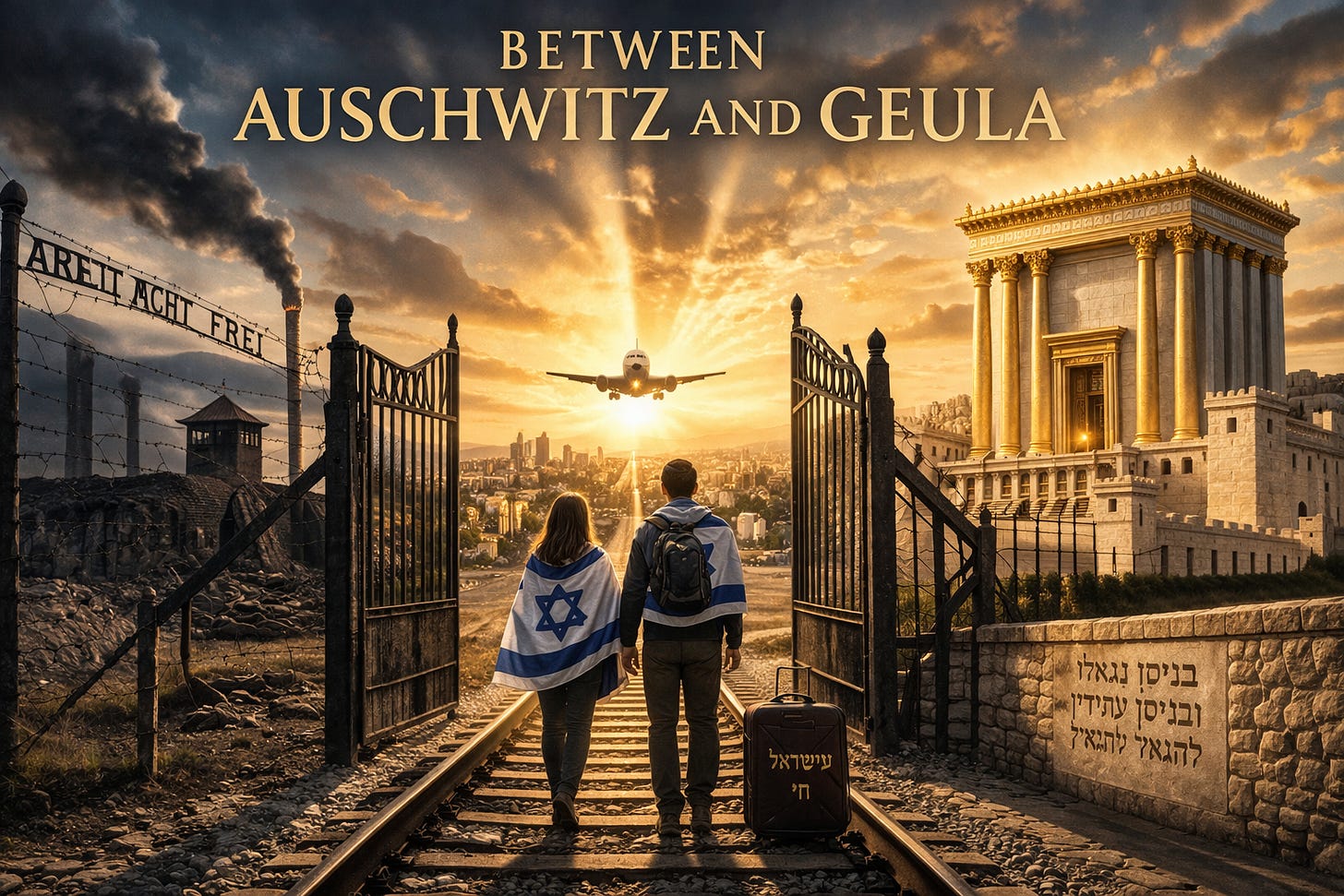
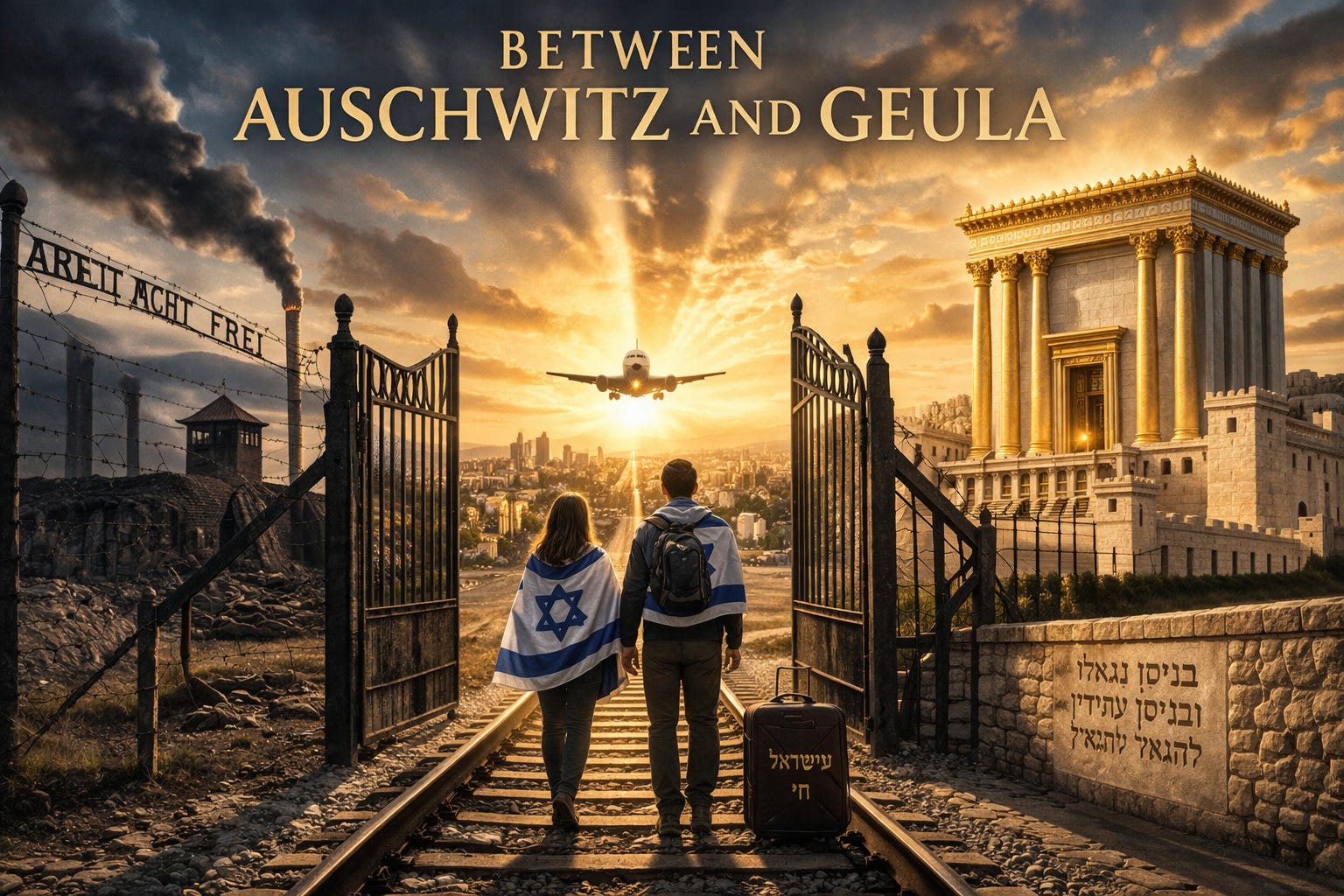
We are living in between. Not in exile, but not yet fully redeemed. Not powerless, but not at peace. We stand in a narrow corridor between Auschwitz and Geula, between the crematoria and the Beit HaMikdash, and a corridor is not a place designed for permanence. It is a place of transition, a space that forces movement, that demands a decision, that refuses to allow a person or a nation to remain neutral.
Into that tension came October 7, not only as an attack and not only as a tragedy, but as a wake-up call that shattered illusions many did not even realize they were holding. It exposed how fragile assumptions can be, how quickly a sense of security can unravel, and how dangerous it is to believe that history has already settled into a stable pattern. Yet at the same time, something deeper was revealed through that rupture. It became clear that the Jewish people are no longer inherently at the mercy of the nations unless they choose to place themselves back into that posture, and that distinction defines this moment in a way that is impossible to ignore.
For generations, Jewish history was marked by הסתר פנים, a concealment of the Divine presence that left events feeling chaotic, unjust, and beyond our control. Today feels fundamentally different, not because suffering has disappeared, but because the framework has changed. This is not concealment but גלוי שכינה, a revelation unfolding in real time, sometimes through crisis and sometimes through clarity, but always with an unmistakable sense that the Jewish people have been returned to the center of their own story. The existence of a Jewish army, a Jewish government, and a Jewish state that can respond, act, and shape its destiny is not a minor historical detail but part of that revelation itself, and the real question is whether we are willing to recognize it or whether we retreat back into an exile mentality while physically living in a redeemed reality.
Against that backdrop, almost as if history itself is choreographing the moment, the gates are opening. After weeks of war, of closed skies, and of a nation partially cut off from the world, the runways of Ben Gurion Airport are coming back to life as flights resume and planes once again begin to land. Jews who were stranded abroad now have a path back, and what sounds like a technical development is in truth something far more profound. For a period of time, the gates were literally shut, a sovereign Jewish state existing yet temporarily inaccessible, a generation capable of returning home yet unable to do so, and now that barrier has been lifted.
The question has shifted in a way that should not be ignored. It is no longer a question of whether Jews can return but whether they will return. There will always be reasons to hesitate, always arguments for waiting, always a desire for perfect conditions and guaranteed safety, yet Jewish history has never operated under such conditions and never will. The very day that forces us to remember a time when Jews had nowhere to go now confronts us with a moment in which the doors are open, even if imperfectly, even if cautiously, even if accompanied by uncertainty.
In this context, Yom HaShoah is not only about mourning the past but about confronting the present with honesty. It challenges the instinct to delay, to assume that there will always be another opportunity, another moment, another chance to act. Nissan pulls in the opposite direction, insisting that redemption is not a passive experience but an unfolding process that demands participation, awareness, and response.
The tension between memory and destiny is not a contradiction but the defining feature of this moment. The weight of six million voices is not meant to paralyze but to propel, and the reality of a generation that has been given a land, a המדינה, a ירושלים, and the ability to return is not meant to be taken lightly or treated as inevitable. The doors that were once sealed are now open again, not perfectly and not without risk, but open enough to demand a decision that cannot be postponed indefinitely.
History is no longer asking whether redemption is coming, because that process is already underway. The real question being asked, quietly but relentlessly, is whether we are prepared to recognize it, step into it, and walk through the gates while they are still open.