
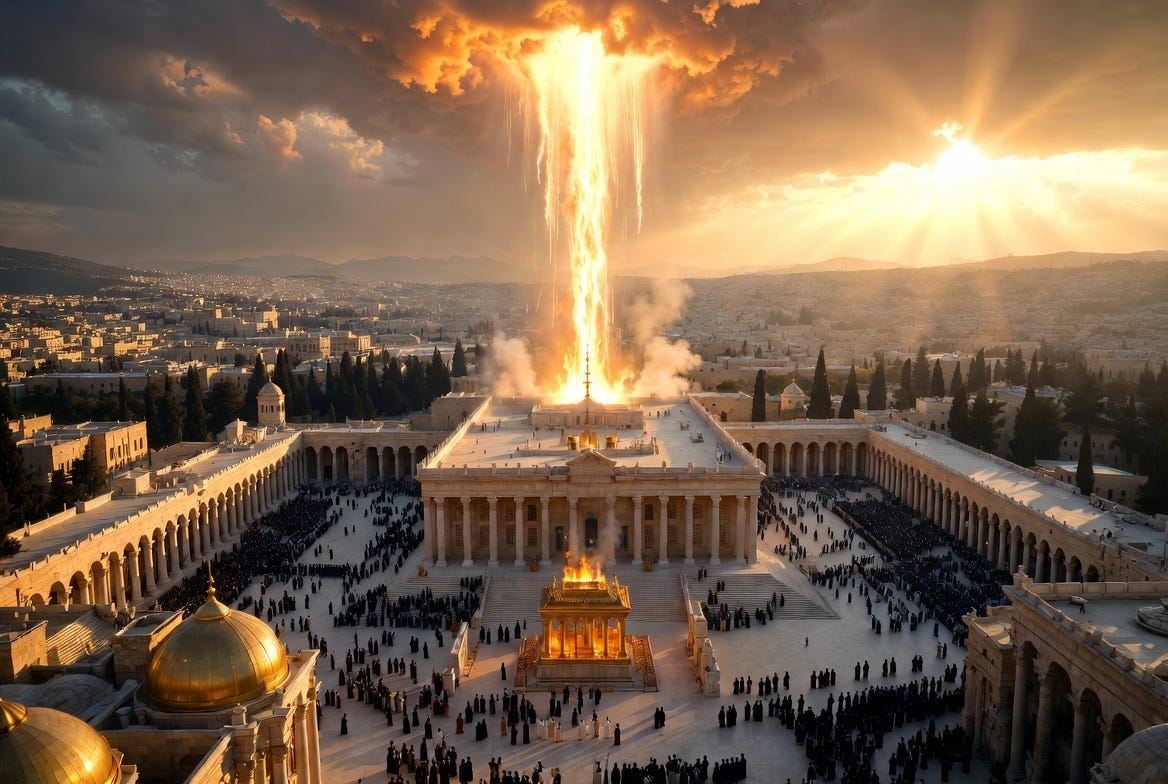
The Sages teach this principle without exception. What enters the commanded service through proper contact with the holy remains elevated forever. No reversal exists. No dismantling follows. No return of the site to common use. Any plan that treats the altar as temporary, erected for an offering and then removed so the location reverts, violates the tavnit (divine blueprint) at its foundation. Zeal to see offerings resume stands commendable. Yet where known elements align while the critical foundation and permanence stand wrong, the entire service collapses into danger. The risk need not be taken. Where protocol stands recorded in the Bible and the words of the Sages it must be kept exactly. Where gaps appear the duty is to learn and rehearse until mastery is complete before any fire ascends.
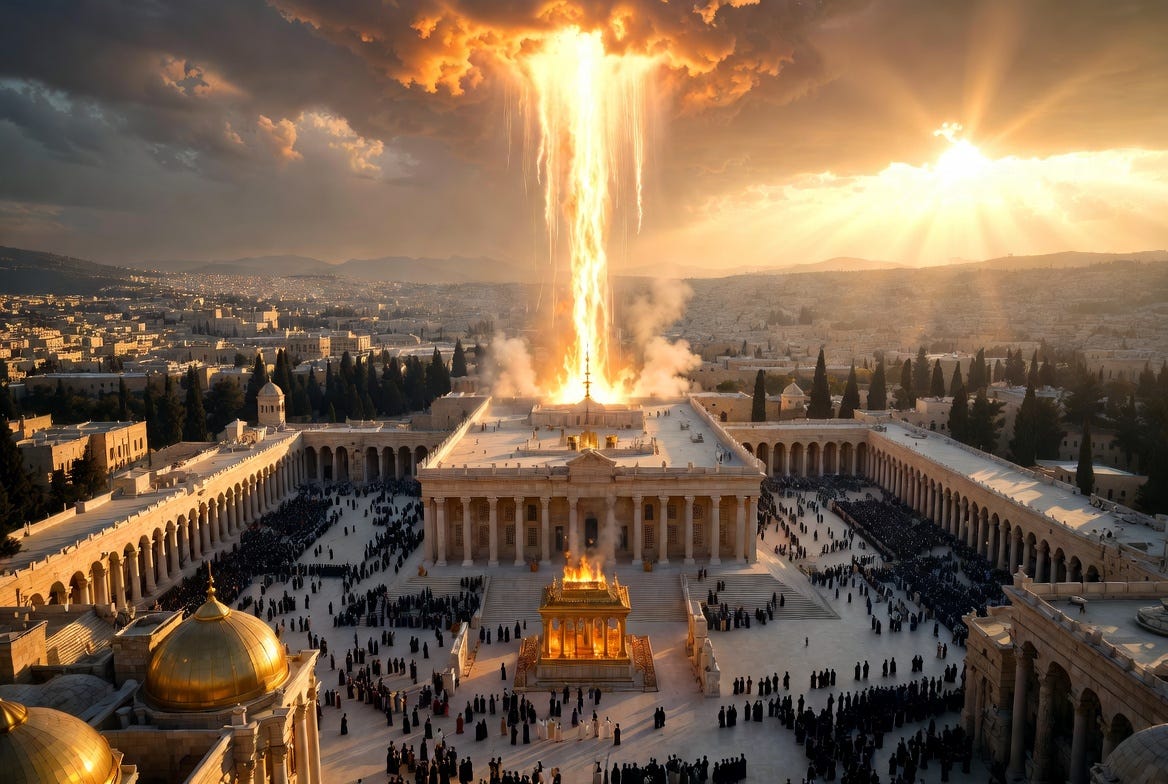
The Fire That Struck Uzzah
The fire from heaven struck Uzzah dead beside the Ark. He reached out only to steady it when the oxen stumbled. David and the people froze. What began as a day of bringing the Ark to Jerusalem with music and rejoicing ended in sudden death and fear. David named the spot Perez Uzzah. He halted the procession. The lesson burned into him. Protocol in avodah, the service to Hashem, cannot bend to human impulse, no matter how protective or zealous the motive.
The Torah commanded that the Kohathite Levites carry the Ark on their shoulders with poles, never touching the holy object itself. Numbers chapter 4 verse 15 states clearly that touching it brings death. David and the people placed the Ark on a new cart instead, a method borrowed from the Philistines. When the oxen stumbled at the threshing floor of Nacon, Uzzah put out his hand to steady it. Fire came from Hashem and he died there beside the Ark. The Sages in the Talmud explain that the entire transport violated the tavnit. The Ark was meant to carry its carriers, not the other way around. Human improvisation, even with the best of motives, broke the protocol and brought immediate judgment.
Nadav and Abihu: Zeal in the Right Place, Wrong Fire
The same pattern appears with Nadav and Abihu on the very day the Mishkan (Temple) was inaugurated. These two sons of Aaron had just witnessed heavenly fire consume the correct offerings. Yet they each took his fire pan, placed fire in it, laid incense upon it, and brought near before Hashem unauthorized fire which He had not commanded them. And fire came forth from before Hashem and consumed them, and they died before Hashem. (Leviticus 10:1-2)
The Sages in Sanhedrin and Eruvin lay out the precise deviations. They ruled a halachic decision in the presence of their teacher Moses without consulting him. They brought ordinary fire alongside the heavenly fire. They entered while intoxicated with wine or failed to wear all the required garments or acted without mutual consultation. The plain text centers on the fire that Hashem had not commanded. Their zeal to draw near was real. They stood in the right place at the right moment. Yet deviation from the exact tavnit brought death by the same divine fire that had just accepted the proper service. The Sages stress that kavanah, intention, does not override the commanded method. The service must match the blueprint exactly or it becomes alien and lethal.
Korah’s Fire Pans: Holiness That Cannot Be Undone
Korah and the 250 chieftains provide another clear case. They challenged the appointed roles in avodah and brought incense in fire pans before Hashem as a test. The earth swallowed Korah and his household. Fire from Hashem consumed the 250 men who offered the incense. Yet even in judgment the holiness that attached to their fire pans could not be undone. Hashem commanded Eleazar: Take up the fire pans from the midst of the blaze and scatter the fire far away, for they have “become holy”. The fire pans of these men who sinned at the cost of their lives, hammer them into sheets to overlay the altar, for they were presented before Hashem and have become holy. Let them be a sign to the Israelites. (Numbers 17:2-3)
The Sages explain that once the pans were presented before Hashem in the context of avodah, even though the offering was unauthorized, the vessels themselves ascended into permanent sanctity. They could not return to common bronze. They were hammered flat and fixed onto the altar itself as an eternal reminder. The act of presentation transferred them out of the mundane realm forever. This teaches a foundational rule: what is elevated through contact with the holy service stays elevated. There is no reversal, no return to ordinary use. Holiness acquired in avodah is irreversible.
The same rule binds the altar itself. Once it stands on the correct foundation and an offering rises upon it, the structure remains Hashem’s. No plan to dismantle and return the site fits the commanded permanence. There is no such thing as tavnit light. We cannot obey Hashem in the service and then return the site to the Waqf as soon as we are done.
The Permanent Place Commanded in Deuteronomy
The Torah fixes the permanence of the chosen place in Deuteronomy 12. The text states: “But you shall seek the place that Hashem your God will choose from all your tribes to set His name there for His dwelling; you shall come there. And there you shall bring your burnt offerings and your sacrifices, your tithes and the contribution of your hand, your vow offerings and your freewill offerings, and the firstborn of your herd and of your flock. And there you shall eat before Hashem your God, and you shall rejoice in all that you put your hand to, you and your households, in which Hashem your God has blessed you.” (Deuteronomy 12:5-7)
The chapter repeats the restriction six additional times. All offerings and service occur only at that single spot. Once activated through avodah, the sanctity locks in. Maimonides rules the location must never change. The Sages derive that the chosen site unites with the Divine Presence in a way temporary locations never did. After Shiloh’s destruction no holiness lingered. Jerusalem and its altar retain enduring sanctity even in desolation. This rules out any hit-and-run arrangement. The elevation through service leaves no path back to the common.
The Bedrock Foundation That Cannot Be Skipped
The bedrock requirement follows directly. The altar in the Mishkan and First Temple rested in direct contact with natural bedrock. Plaza stones today sit roughly six cubits above that level. Surface placement without excavation to reach and establish contact with the actual bedrock deviates from the tavnit in the same way the new cart deviated for the Ark or the alien fire deviated for Nadav and Abihu. Even if other elements align, the wrong foundation renders the whole service invalid and dangerous. Partial compliance does not sanctify. The Sages insist the full pattern must stand before any offering ascends.
Orientation That Honors the Holy of Holies
Orientation in the Azarah carries equal weight. The tavnit requires Kohanim to face west toward the Holy of Holies. Mishnah Tamid describes the daily slaughter and blood handling with faces turned west. Turning the back to the Sanctuary profanes the act. Ezekiel recorded the abomination of men between the porch and the altar with their backs toward the Temple of Hashem while facing east to the sun. The Sages link such posture to the sins that drove the Divine Presence away.
In recent practice runs the Kohanim turned backs to the west while rehearsing in off-site locations. That suits temporary rehearsal spaces. Yet when simulating the actual service, the Kohanim must treat the portion of the altar that would face west as west in practice. They learn the correct orientation now so no mistake occurs inside the sanctified Azarah. The practice must be perfect before the true service begins. Kohanim can face north or south and move eastward by backing up or through steps that never produce a full turn away from the direction of the Holy of Holies. The principle mirrors a Torah procession. No one turns his back fully on the scroll. Participants adjust according to position yet maintain respect without complete reversal. Practice must honor the future reality.
Washing That Guards the Boundary
Washing of hands and feet stands non-negotiable. The Torah commands: “When they enter the Tent of Meeting they shall wash with water, that they may not die; or when they approach the altar to serve, to turn into smoke an offering by fire to Hashem, they shall wash their hands and their feet, that they may not die. It shall be a law for all time for them, for him and his offspring throughout their generations.” (Exodus 30:20-21)
The Sages in Zevachim detail the motion: right hand over right foot, left over left, washing from the kiyor, the copper laver. The act repeats if the Kohen leaves the area or after bodily needs. Defecation requires full immersion before renewed washing. These steps guard the boundary between ordinary life and holy service. Where practice leaves uncertainty, the response is to study until the protocol matches exactly.
The Korban Pesach and the Risk of Incorrect Offering
The korban Pesach exposes how easily error slips in despite preparation. The Torah limits the Passover lamb to the central place, slaughtered in the Azarah with blood on the altar and meat roasted according to precise rules. The question presses today. How does no one recognize when a korban Pesach stands ready to be offered outside the full tavnit, on the wrong foundation, with incomplete protocol, or including plans for retreat? The Sages recorded every incident so later generations would not repeat the pattern of zeal without knowledge.
The Lottery: Hashem Chooses the Role
The daily tamid service used lotteries to assign tasks fairly among the Kohanim present. Mishnah Tamid chapter 3 describes the second lottery that divided the core tasks: who slaughters, who dashes the blood, who clears the inner altar ashes, who trims the menorah, who carries the limbs up the ramp, and more. The drawing happened shortly before the actions began, sometimes mere moments prior to each step. Once the lot fell, the assigned Kohen stepped forward and executed his exact portion without hesitation or coaching inside the Azarah. The Sages understood the lot as Hashem’s direct choice of role for that day.
The incense offering operated under a stricter sub-lottery limited to Kohanim who had never offered it before. No ordinary Kohen ever performed the daily ketoret (incense offering) more than once in his lifetime. The system required that every Kohen master every possible role intimately, including those he might perform only once. Every Kohen trained in all roles because the lot could assign any portion, including the rare ketoret, to any eligible Kohen at any moment. Mastery had to be universal and flawless, with no room for on-the-spot instruction once the service began in silence inside the Azarah.
The core priestly actions proceeded largely in silence, broken only by the Levites singing the daily psalm on the duchan (raised platform between the altar and court of Israel) and the priestly blessings. The service flowed from internalized knowledge and precise execution. No on-the-spot teaching occurred inside the Azarah.
Mastery Required of Every Kohen
The High Priest’s preparation week before Yom Kippur underscores the same standard. Mishnah Yoma states that the elders read the entire order of the day’s service before him repeatedly so he would be familiar and practiced in every detail. Even the Kohen Gadol trained intensively in advance. The Sages required this level of mastery across the entire priesthood so the service could flow without deviation.
These points represent only a few of the withdrawals from the tavnit noticed with horror in current preparations. The drive to restore avodah burns strong. That zeal deserves respect. Yet commendable intention does not excuse known deviations. Where protocol stands recorded it must be kept without change. Where gaps appear the training must ramp up now… today, through repeated, perfect simulation so the real avodah proceeds without error. Recent practice runs show growing competence in individual actions such as slaughter technique, garment handling, and basic movements, yet reveal errors as well, dangerous ones. Yet the seamless, silent integration under lottery-style assignment, the universal mastery of every role, and the flawless execution without verbal cues remain distant. The tavnit demands internalized knowledge so that when the lot falls in the real Azarah, each Kohen steps into his portion, whether daily or once-in-a-lifetime, without prompting.
David halted after Uzzah and corrected the method. When the Levites carried the Ark on shoulders exactly as commanded, joy returned. The same correction stands open now. The altar must rise on bedrock. The Kohanim must wash and face as required. The offerings must ascend at the single place without any plan of reversal. Every role must be mastered so that when the lot falls, the service flows in silence and precision. Once the altar ascends in avodah it does not descend. That fact governs everything.
The generation that aligns every element will see the service accepted and the Presence return BzH (G_d Willing). The generation that substitutes partial zeal for full precision could witness the same outcomes the Bible records without hesitation. The tavnit protects. Deviation endangers. The choice before those who love the House of Hashem could not be clearer.