
By Rabbi Josh Wander
History has an address.
That is the Jewish claim. Not that redemption is a mood. Not that it is a metaphor. That it happens somewhere.
The prophets describe the end of days in stubbornly physical terms: exiles gathered, sovereignty restored, Jerusalem rebuilt, the Divine Presence revealed there once again, and nations streaming upward to learn. First Zion. Then the world.
That is fundamentally different from how Christianity and Islam frame the culmination of history. Christianity anticipates salvation and a kingdom of heaven, but there is no serious movement praying for the political restoration of Rome as the seat of God’s manifest presence. No MRGA. Islam reveres Mecca deeply, yet its end-times vision is not built around an ethnic covenant people regathered to ancestral soil in fulfillment of land-bound prophecy. No MMGA.
Judaism is almost embarrassingly specific.
Three times a day, Jews pray for ingathering. For Jerusalem rebuilt. For the restoration of Davidic sovereignty. Geography is embedded in our liturgy. The covenant with Abraham names land. Exile in Tanach is displacement, not destiny.
And redemption in Judaism is not a spectator sport.
Abraham is told to leave — his land, his birthplace, his father’s house — and walk toward a place God will show him. Ezra does not wait for perfect conditions in Babylon; he gathers those willing and moves. The pattern is clear: when the door opens, you step through it.
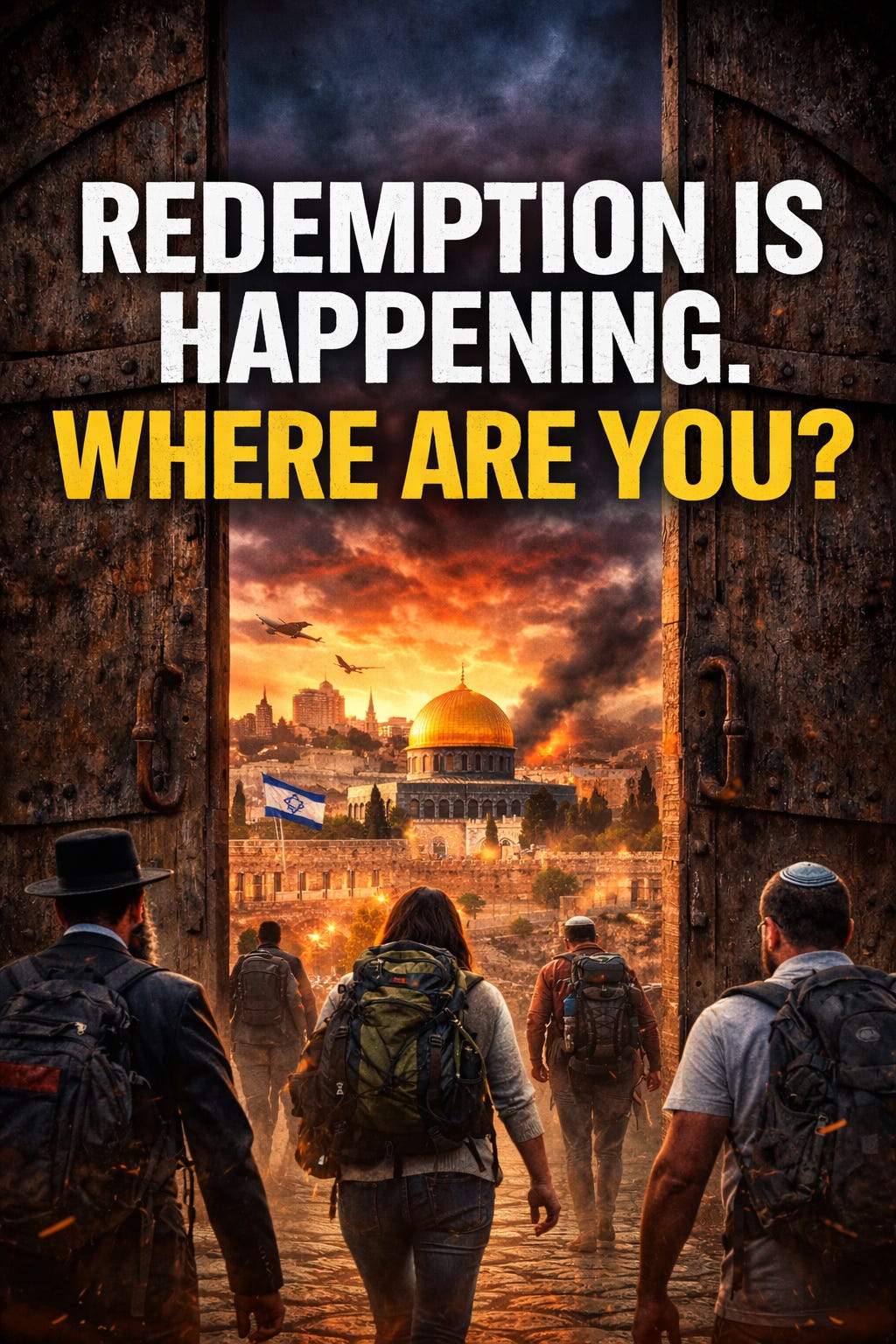
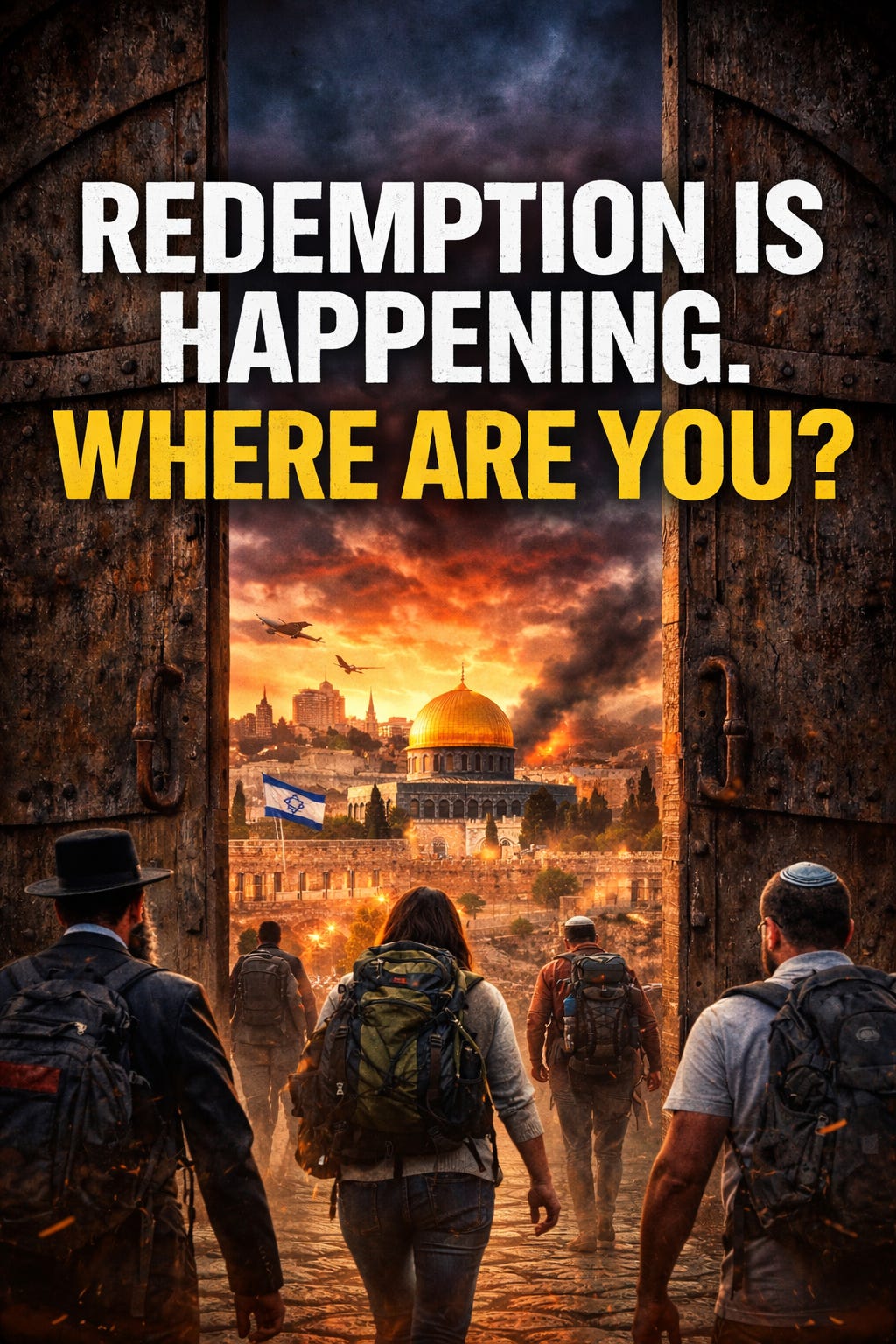
In our generation, that door opened.
A sovereign Jewish state emerged. Hebrew was revived. Exiles began returning from the four corners of the earth. For nearly two thousand years Jews prayed for this. Then it became operational. Planes land daily. Families unpack. Children grow up speaking the language of the prophets as their mother tongue.
It is no coincidence that many of those who made Aliyah — who left comfortable lives in New York, Paris, or Buenos Aires — are also those visibly engaged with Jerusalem’s epicenter, including ascending Temple Mount. Listen carefully on the Mount and you will hear English, French, Spanish. People who already rejected diaspora inertia are rarely satisfied spiritualizing everything into abstraction. They are not waiting on the sidelines.
At the same time, something else has shifted quietly: a resurgence of Jews learning Tanach. For decades, large parts of the yeshiva world centered almost exclusively on Gemara. Brilliant minds mastered Talmudic dialectics while the prophetic books — the blueprint of national destiny — often receded into the background.
Now, living in a sovereign Jewish state, watching exiles return, watching Jerusalem sit at the center of global tension, Tanach feels less like ancient literature and more like a live broadcast. Passages that once seemed opaque are unfolding in real time. Nations gathering against Jerusalem. Israel flourishing after desolation. A scattered people regathered. Scenarios that were nearly impossible to visualize for centuries are suddenly obvious.
For those who see it, it is almost jarring in its clarity.
For others, normalcy is more comfortable. Careers. Suburbs. Familiar exile narratives. It is easier to treat redemption as a distant theological concept than to admit it may be advancing in real time.
And then the gates close.
COVID froze global movement overnight. October 7 reshaped reality in a single morning. The twelve-day war tightened airspace again. How many times in recent years have the borders of Israel felt suddenly fragile? The message should not be ignored: the gates are not permanently open.
For centuries Jews prayed for the doors of Zion to open. Now they exist — airports, highways, a functioning Jewish state — and we have already tasted what it means when access narrows.
History closes windows.
What does it feel like watching this from New York or Miami? You are witnessing the acceleration of Jewish destiny. Jerusalem at the center of the world’s attention. Biblical language bleeding into geopolitical briefings. You are watching history.
Those who are here will tell you something unexpected: yes, it is intense. Sirens, politics, uncertainty. But it is also electric. Meaningful. It feels like living inside Tanach rather than studying it.
Is it scary? Sometimes. But for many, it is more exhilarating than frightening. To stand in the land promised to Abraham, to see prophecy feel less theoretical and more immediate, to know that whatever unfolds is under the Hand that has guided Jewish history for millennia — that produces not panic, but gratitude.
The Jewish vision of the end of days is not about escaping the world. It is about rebuilding it — from Jerusalem outward. It assumes agency. Movement. Participation.
The only truly unsettling thought is not that history is accelerating.
It is the possibility of remaining comfortably in a self-imposed exile while the gates you meant to walk through quietly close behind you.