
By Rabbi Josh Wander
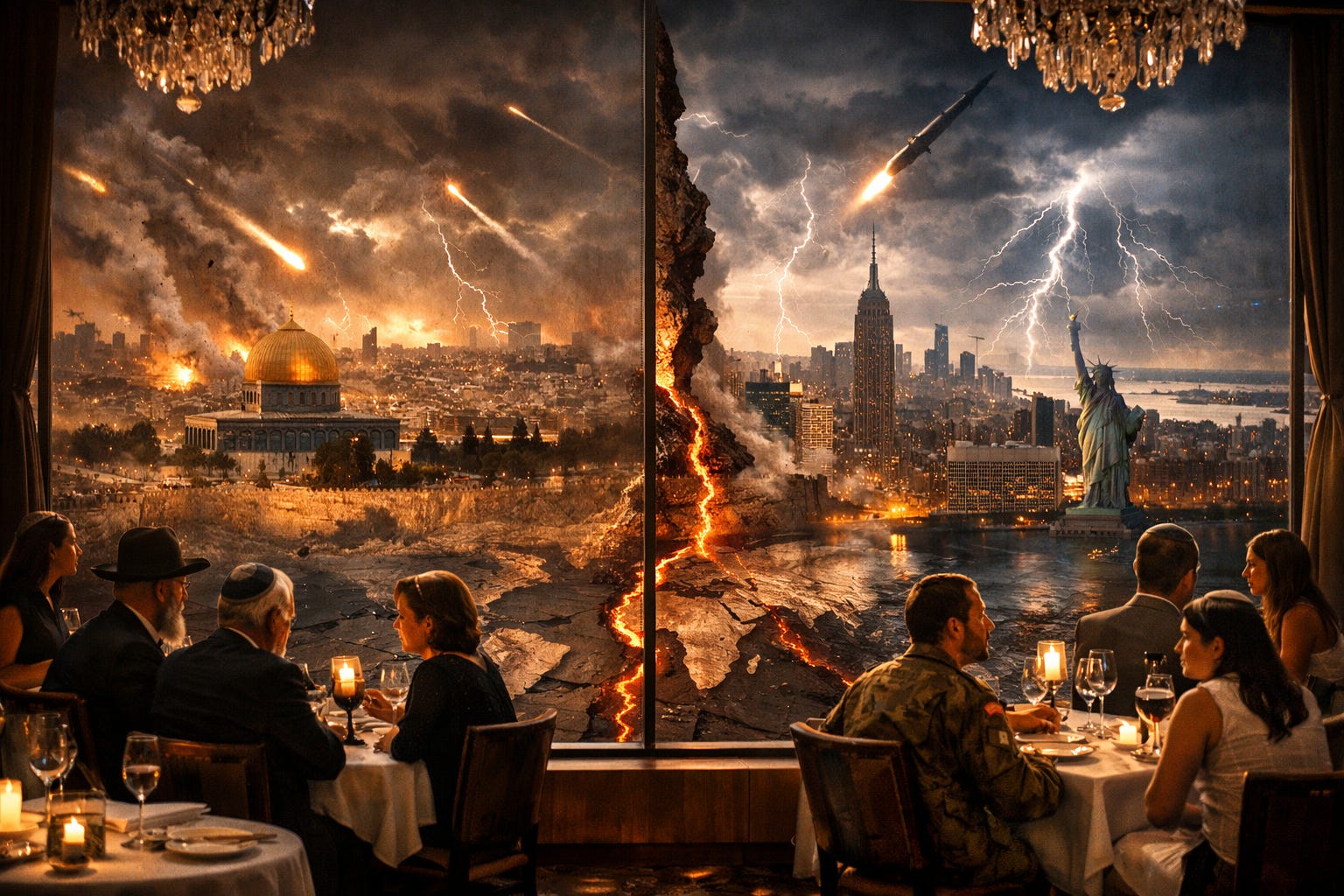
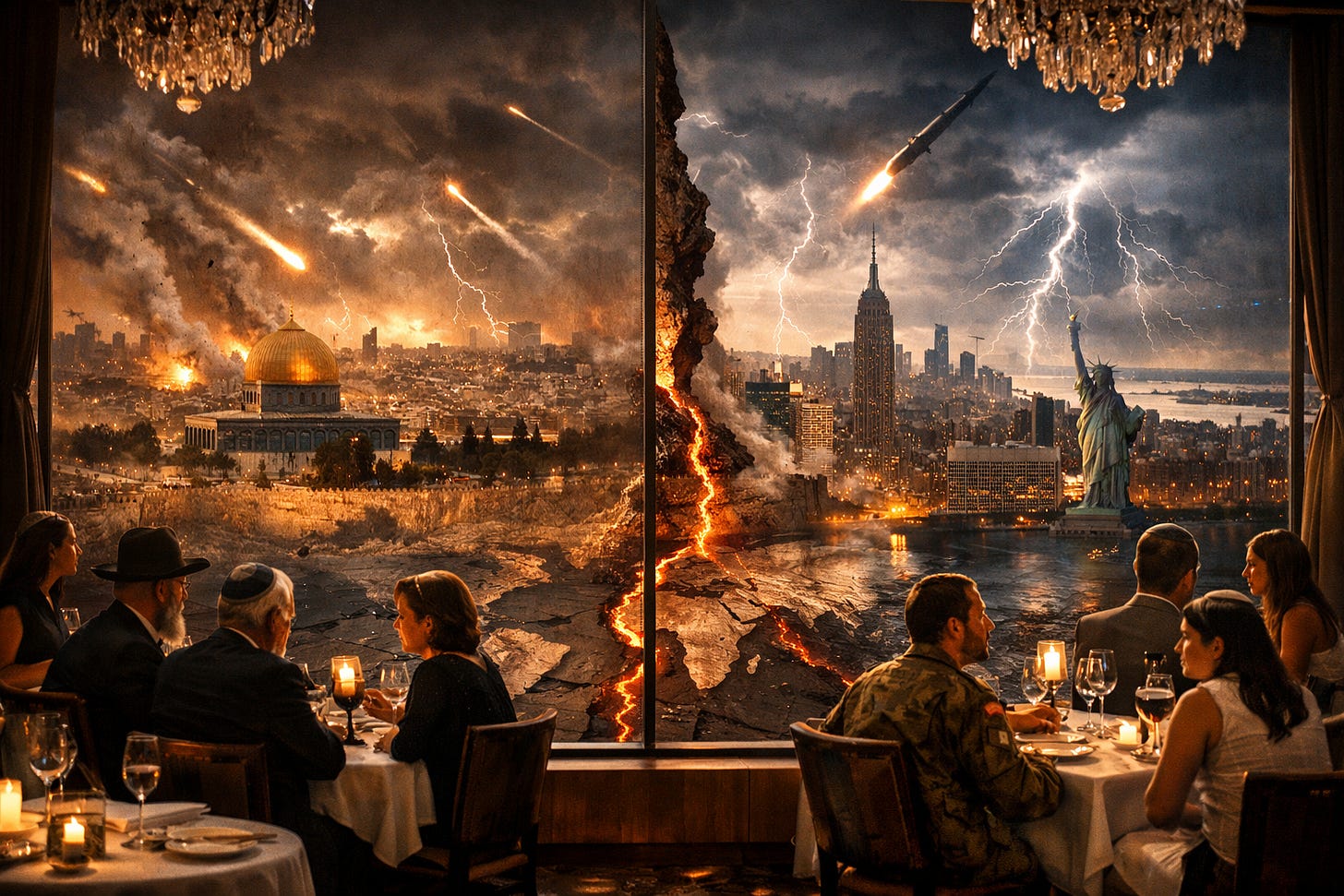
There’s a scene in The Restaurant at the End of the Universe where diners sit calmly at white-clothed tables, sipping drinks, watching the cosmos implode outside panoramic windows. The universe ends on schedule. Dessert is served on time. The band keeps playing.
Comedy, yes. But satire only works because it’s uncomfortably close to home.
We are living in that restaurant.
Markets wobble. Alliances fracture. Nuclear thresholds blur. Iran inches forward. Russia grinds on. China watches. The United States staggers under debt it cannot mathematically repay. The Middle East rearranges itself in real time. Borders harden. Drafts are whispered about. Gold surges. Shipping lanes choke. Words like “escalation” and “regional conflict” begin to sound quaint.
And yet.
Reservations are full. Flights are booked. Vacation plans proceed. Real estate seminars continue in Teaneck and Los Angeles as if the dollar were an eternal law of physics. Weddings are planned for summer 2027. Retirement portfolios are discussed with the serene confidence of people who assume the grid will always hum and the ATM will always spit out twenties.
Normalcy bias is the name psychologists give to this phenomenon. It’s the tendency to assume that because something catastrophic has not yet happened to us personally, it therefore will not happen. The brain prefers continuity. It edits out danger signals that threaten the story it has been telling itself. The mind is conservative in the literal sense: it wants to conserve yesterday.
History does not share that preference.
European Jewry in the 1930s did not wake up one morning to barbed wire and cattle cars. They woke up to inconvenience. To rhetoric. To uncomfortable laws. To minor humiliations. To “this will pass.” They ate dinner. They read newspapers. They reassured one another. Civilization, after all, was too advanced for medieval regression.
We know how that film ends. Now zoom forward.
Jews in America speak about instability in Israel as though it is a disqualifying defect. Rockets, drafts, regional war—too risky, they say. Meanwhile the United States edges toward strategic overstretch, internal fracture, and a debt spiral that requires perpetual expansion to survive. In a multipolar world, empires do not gently retire. They snap. When manpower runs thin, drafts return. When currencies falter, capital controls follow. Borders close faster than people imagine.
The unspoken assumption is that exile is stable because it has been stable. That is not an argument. That is a memory.
And here’s the harder truth: complacency is not limited to the diaspora.
In Eretz Yisrael, there is another flavor of normalcy bias. Café tables in Tel Aviv are full. Tech conferences proceed. Political infighting consumes headlines. We argue about judicial reform as though the strategic environment is static. We scroll. We post. We assume that whatever storm is gathering will unfold slowly, politely, within the boundaries of our expectations.
It will not.
If a broader war erupts—call it regional, call it global, call it what you like—the tempo will be disorienting. Supply chains will not politely taper; they will snap. Airspace will not gradually narrow; it will close. Financial systems will not dim; they will seize. Diaspora Jews may wake up one morning to discover that leaving is no longer simple. Israeli Jews may wake up to a scale of mobilization that makes previous rounds feel like rehearsals.
The eerie part is not the danger. Danger is familiar to Jewish history.
The eerie part is the calm.
This is the quiet hum before generators kick on. The stillness before sirens. The strange, almost theatrical composure of a world that senses something approaching but refuses to name it.
There is a theological layer here as well. Purim approaches and we speak of ונהפוך הוא—sudden reversals. History in Tanach rarely drifts; it pivots. Egypt collapses in plagues. Babylon falls in a night. Empires believe themselves permanent until they are footnotes. The nations gathering against Jerusalem is not a poetic metaphor; it is a recurring pattern of geopolitical gravity.
Whether one frames the coming upheavals in prophetic language or purely strategic terms, the pattern is the same: systems under stress reach a breaking point. The longer instability is denied, the sharper the correction.
Normalcy bias is comforting because it allows us to outsource responsibility to tomorrow. Preparation is uncomfortable. It forces decisions. It disrupts lifestyle. It demands clarity about where one stands and where one belongs.
So people linger in the restaurant. They order another drink. They reassure each other that the windows are reinforced. The orchestra sounds lovely tonight.
But the horizon is not quiet because it is safe. It is quiet because storms gather beyond the range of polite conversation.
The calm before the storm is not peace. It is tension held in suspension.
And suspension cannot last forever.