
By Rabbi Josh Wander
There are numbers that inform, and there are numbers that haunt. 25,648 is not a statistic. It is not a line in a report or a figure to be processed and moved past. It is a living, breathing reality that presses itself into the consciousness of an entire nation. As Yom HaZikaron approaches, that number is not read—it is felt. It echoes in homes, in schools, in shuls, in the silent glances exchanged between strangers who understand, without words, that they are carrying something shared and unbearably heavy.
In other countries, even the most devastating national tragedies can feel distant to many. The attacks of September 11 attacks shook the world and scarred a nation, yet even in New York, countless people did not personally know someone who was lost. The grief was national, but often abstract. In Israel, that abstraction does not exist. Here, the circles are too tight, the threads too intertwined. If one does not know the soldier who fell, then one knows a sibling, a parent, a neighbor, a friend from the unit. And if not directly, then one knows someone who does. The distance between “them” and “us” collapses until it no longer exists at all. There is no “other.” There is only family.
This is what it means to live as a nation again. Not as scattered communities navigating foreign streets, not as isolated enclaves surviving in the margins of other civilizations, but as a people rooted in their land, sharing a single, collective heartbeat. מי כעמך גוי אחד בארץ is not a poetic phrase here; it is a daily reality. The pain of one is the pain of all, and the loss of one reverberates through the entire body.
And yet, there is something else—something that is almost impossible to explain to those who have not lived it. Life here is not just intense; it is electric. It is a constant ascent and descent, a relentless movement between extremes that would exhaust most people but somehow sustains those who are part of it. Israel is not a place of emotional stability—it is a place of emotional truth. The highs are higher, the lows are deeper, and nothing is dulled by distance or indifference.
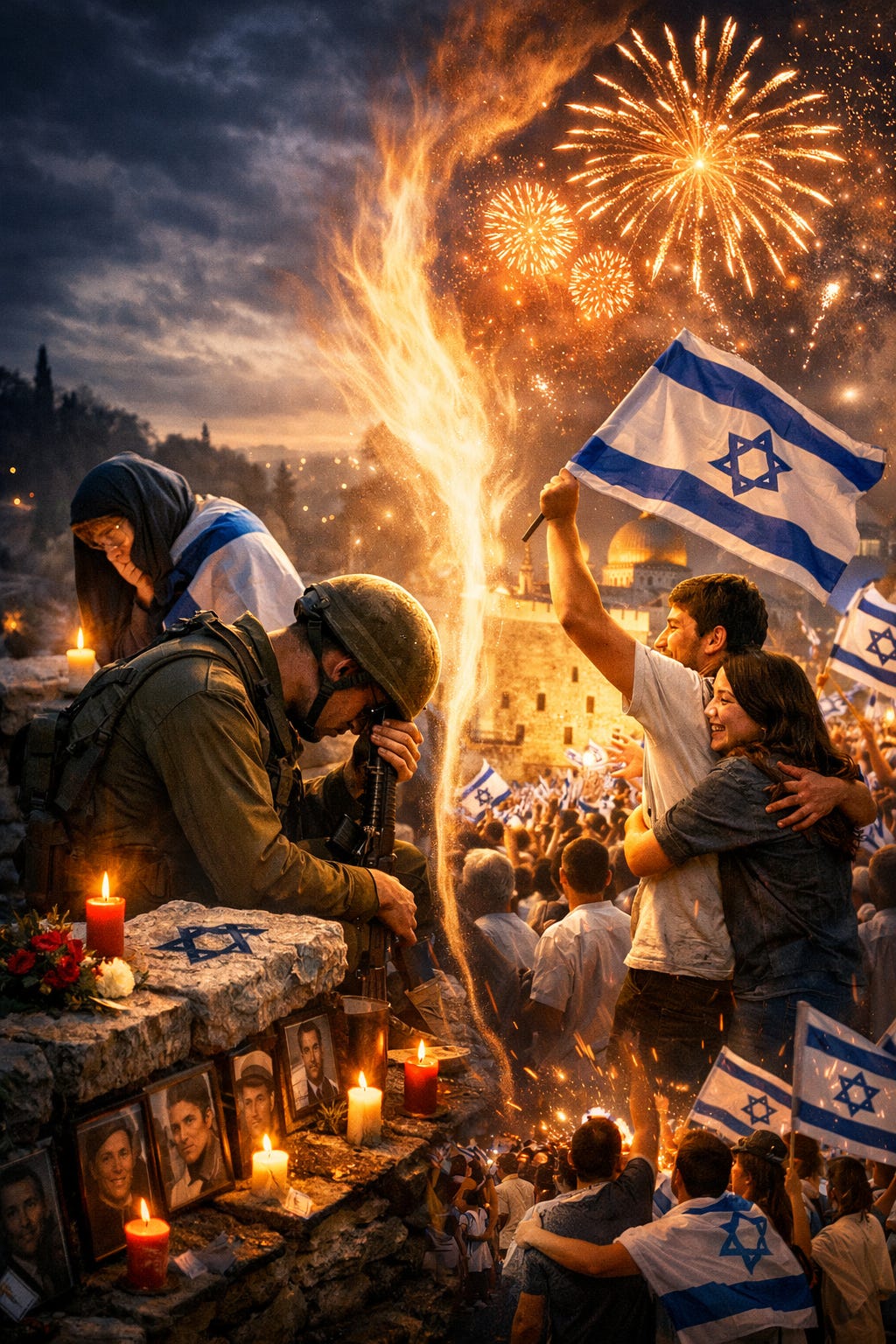
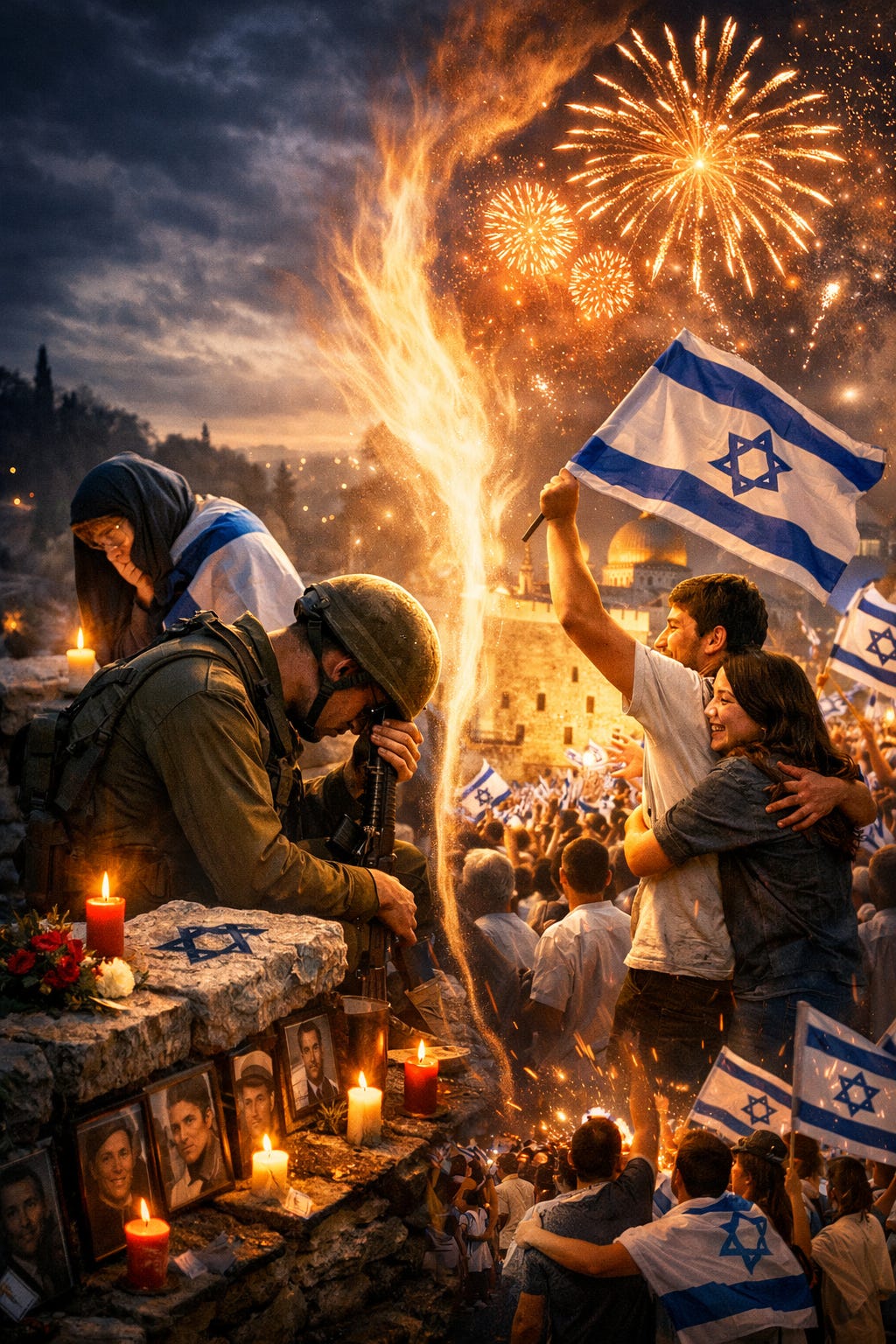
Nowhere is this more evident than in the transition that defines these days. Within the span of 24 hours, the country moves from the depths of mourning into the heights of celebration. From sirens that freeze traffic and pierce the soul, to fireworks that light up the sky. From standing over fresh graves to dancing in the streets. It is a shift so abrupt that it would seem almost cruel—if it were not so profoundly real.
Because here, the two are inseparable. The mourning is not an interruption of life; it is part of what gives life its meaning. The celebration is not a denial of loss; it is its answer. Those 25,648 are not just remembered—they are the very reason there is something to celebrate. Their absence is what makes the presence of a Jewish state so tangible, so undeniable, so worth everything.
This is a reality that many Jews in exile never fully encounter. There, Jewish identity can be compartmentalized, scheduled, observed at a distance. Here, it is lived in full force, every single day. Here, history is not something studied—it is something unfolding. The risks are real, the stakes are immediate, and the sense of purpose is unavoidable.
It is, in many ways, the most exhilarating and terrifying experience a Jew can choose. A roller coaster that does not pause, that does not offer the illusion of control, that demands everything and gives everything in return. It is not for the faint of heart. But for those who have felt it—for those who have stood in silence on Yom HaZikaron and then danced on Yom Ha’atzmaut—it becomes impossible to imagine trading it for anything else.
Because this is what it means to be alive as a Jew among Jews, in a land that is not just home, but destiny. This is what it means to feel the weight of 25,648—and to understand that behind that number lies not just loss, but the very pulse of a nation that refuses to stop beating.