
By Rabbi Josh Wander
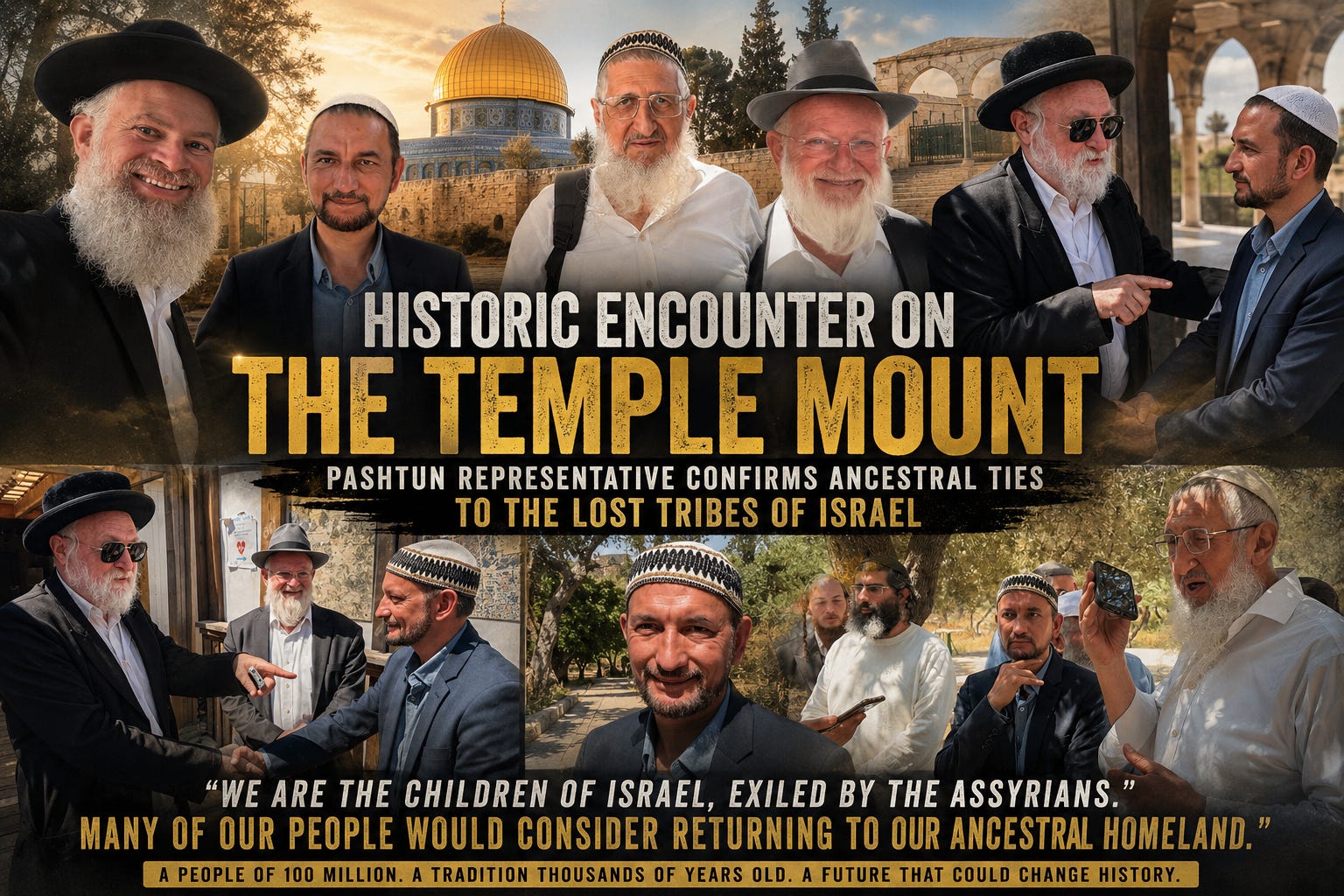
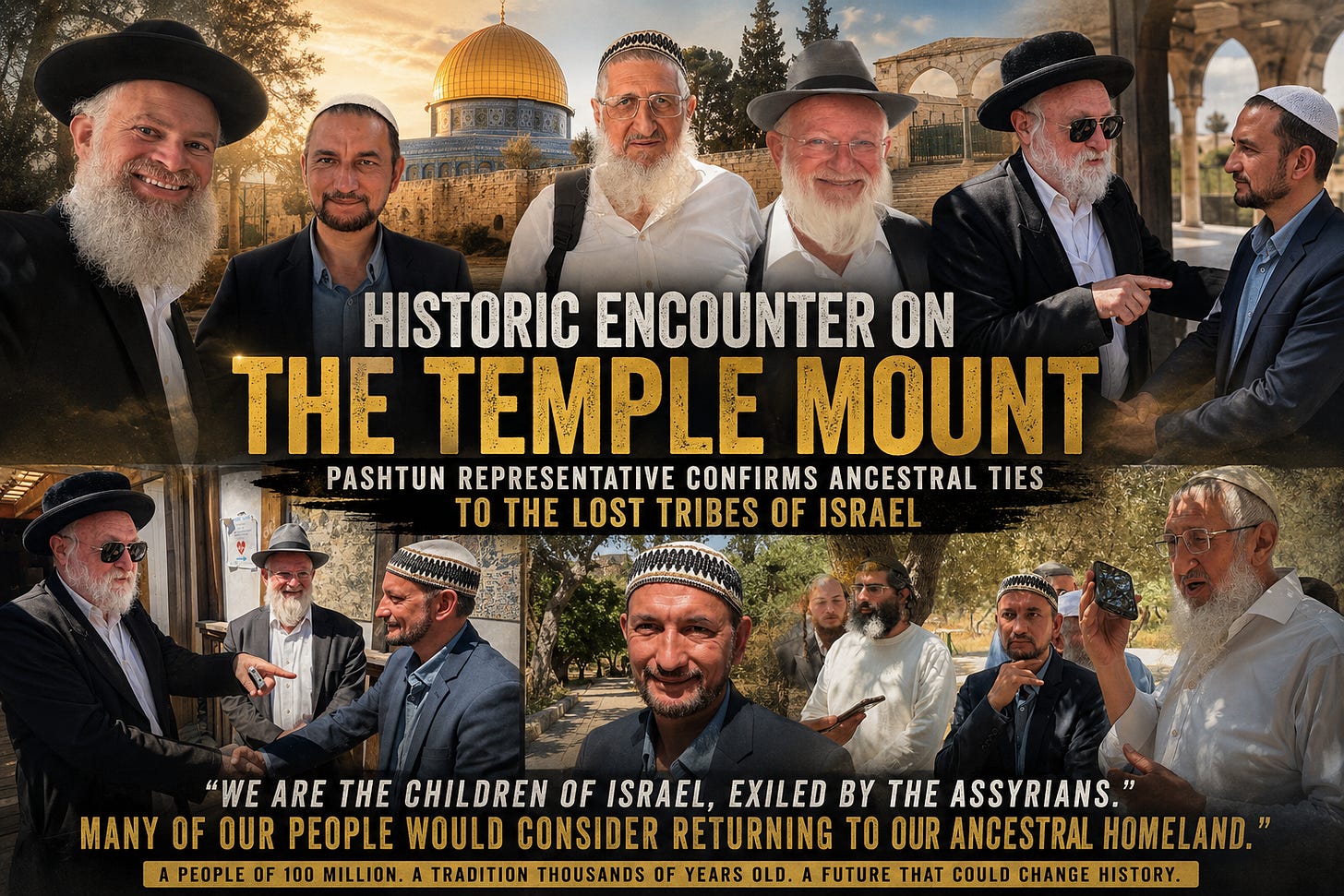
Yesterday, on the Temple Mount, a meeting took place that should have sent shockwaves through the Jewish world, the Muslim world, and the entire geopolitical order of the Middle East. Yet almost nobody knows it happened. There were no cameras from CNN, no State Department officials, no UN observers, and no carefully scripted diplomatic statements. Just a quiet but electrifying encounter on Har HaBayit between Jews and a representative of the Pashtun people of Afghanistan and Pakistan. But beneath the surface of what appeared to be a simple conversation lies the potential for one of the most explosive developments in modern Jewish history.
The Pashtun representative openly confirmed something that his people have preserved for generations: a deeply rooted tradition that they are descendants of Bnei Israel, the Ten Lost Tribes exiled by the Assyrians thousands of years ago from the northern Kingdom of Israel. Most Jews hear the phrase “Lost Tribes” and imagine mythology, legends, fantasy, or perhaps small obscure communities hidden somewhere in remote mountains. But what happens when the “lost tribes” are not a few thousand people, but an ethnic population numbering nearly 100 million spread across Afghanistan and northern Pakistan? That is roughly ten times the current Jewish population of the State of Israel. Suddenly this is no longer an interesting theory for late-night Torah discussions. This becomes a demographic, spiritual, and geopolitical earthquake.
For centuries, many Pashtun tribes have maintained oral histories linking themselves to ancient Israel. Researchers over the years have pointed to unusual tribal names, customs, traditions surrounding purity, marriage, inheritance, burial practices, and behavior patterns that appear strikingly similar to ancient Israelite traditions. Even after centuries of Islamic rule and forced conversion, many reportedly continue practices that seem oddly disconnected from standard Islamic norms and more reminiscent of ancient Jewish behavior. Whether every claim can ultimately be proven or not, the persistence of this identity after nearly three thousand years is itself remarkable.
What made the encounter even more extraordinary was that the Beit Din convened at the meeting did not merely hear secondhand stories from one representative. During the gathering, they were given the opportunity to speak directly by phone with elders from Pashtun tribes in Afghanistan and Pakistan. Questions were asked regarding traditions, lineage, customs, historical memory, and practices preserved within their communities. Those participating described the conversations as deeply informative and at times almost surreal. For many present, it felt less like an academic discussion and more like opening a living window into a chapter of Jewish history believed lost for nearly three millennia.
But perhaps the most symbolic aspect of the entire encounter is where it happened. Har HaBayit was precisely the place where the split between Judah and the northern tribes ultimately manifested itself in Jewish history. Following the reign of King Solomon, the kingdom fractured into the northern Kingdom of Israel and the southern Kingdom of Judah. Yeravam established rival centers of worship in order to sever the northern tribes from Jerusalem and the Beit HaMikdash, beginning a tragic process of national disconnection that ultimately culminated in the Assyrian exile and the disappearance of the Ten Tribes from history. The destruction of the First Temple and the exile that followed became one of the greatest national traumas our people ever experienced.
And now, thousands of years later, representatives of those very tribes may be standing once again on the Temple Mount itself speaking openly about reconnecting with their brothers from Judah. History is not merely repeating itself. It is potentially coming full circle. As we pray three times each day, “וּפְדֵה כִנְאֻמֶךָ יְהוּדָה וְיִשְׂרָאֵל” — redeem, as You promised, Judah and Israel. For most Jews, these words have become familiar liturgy repeated by rote. But perhaps we are beginning to witness those ancient prayers moving from the siddur into reality itself.
The representative explained that many among his people would seriously consider returning to the regions historically associated with the northern tribes of Israel. In modern terms, that includes areas of present-day Syria, Lebanon, and northern Jordan. Think about the implications of that for a moment. At the exact time that Israel is surrounded by enemies, struggling with demographic pressure, internal division, and growing international isolation, there exists the possibility that tens of millions of people east of Israel preserve some level of identity linking themselves to Am Yisrael and may one day seek reconnection with their ancestral homeland. This is the kind of statement that sounds insane until history suddenly makes it real.
After all, the return of the Jewish people itself once sounded insane. The idea that Jews would return from exile, revive Hebrew, rebuild sovereignty, and establish a modern Jewish state after two thousand years was dismissed as fantasy by much of the world. Yet today it is reality. And perhaps this is what people still fail to understand about the era we are living in. The process of Kibbutz Galuyot did not end with Russian aliyah or Ethiopian Jewry. The prophets never described a small ingathering. They described a global upheaval. They described scattered tribes returning from the ends of the earth. They described Ephraim reemerging from distant lands. They described nations moving toward Zion. Most people read those prophecies symbolically because they cannot psychologically process what they would actually look like in reality.
But standing on the Temple Mount yesterday, hearing a Pashtun representative calmly discuss his people’s preserved Israelite identity while overlooking the place where the Beit HaMikdash once stood, those prophecies suddenly felt far less abstract. Of course enormous questions remain. Halachic questions. Historical questions. Genetic questions. Security concerns. Nobody is suggesting that tomorrow morning 100 million Pashtuns are moving into Israel waving Israeli flags and putting on tefillin. But history does not begin with mass migration. It begins with ideas, with conversations, and with identities resurfacing after centuries of dormancy.
Perhaps that is the real story here. Not merely anthropology, genetics, or politics, but the possibility that Jewish history is far bigger, far stranger, and far closer to its next chapter than most people are prepared to admit. And if even a fraction of this proves true, the entire Middle East may one day look completely different than the world we know today.
To watch a video of this incredible historic encounter, click on the YouTube link below: